Department of Anesthesiology and Intensive Care Medicine (CCM/CVK), Charité - Universitätsmedizin, Berlin, Germany.
School of Medicine, University of Nottingham, Nottingham, UK.
Eur J Phys Rehabil Med. 2023 Dec;59(6):772-781. doi: 10.23736/S1973-9087.23.08031-0.
Mechanical ventilation (MV) is a lifesaving procedure for critically ill patients. Diaphragm activation and stimulation may counteract side effects, such as ventilator-induced diaphragm dysfunction (VIDD). The effects of stimulation on diaphragm atrophy and patient outcomes are reported in this systematic review.
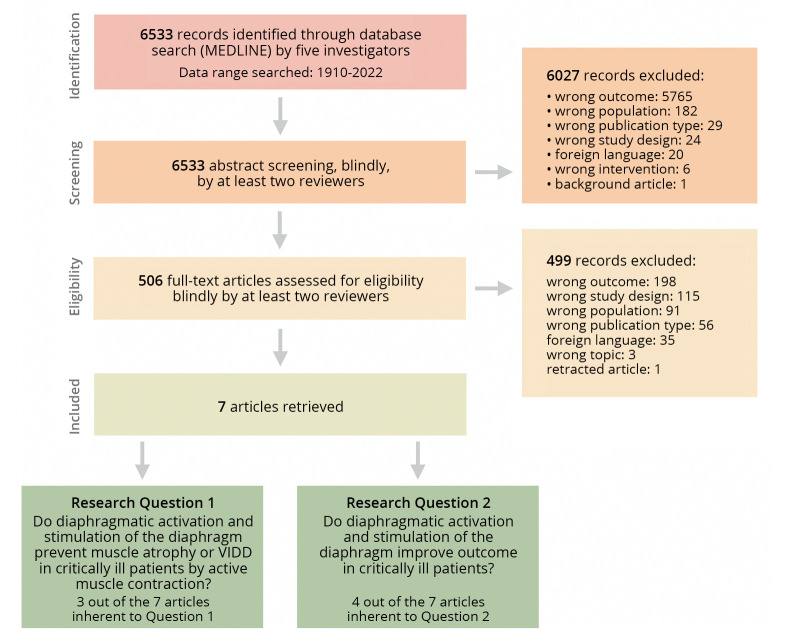
Studies investigating diaphragmatic stimulation versus standard of care in critically ill patients and evaluating clinical outcomes were extracted from a Medline database last on January 23, 2023, after registration in Prospero (CRD42021259353). Selected studies included the investigation of diaphragmatic stimulation versus standard of care in critically ill patients, an evaluation of the clinical outcomes. These included muscle atrophy, VIDD, weaning failure, mortality, quality of life, ventilation time, diaphragmatic function, length of stay in the Intensive Care Unit (ICU), and length of hospital stay. All articles were independently evaluated by two reviewers according to their abstract and title and, secondly, a full texts evaluation by two independent reviewers was performed. To resolve diverging evaluations, a third reviewer was consulted to reach a final decision. Data were extracted by the reviewers following the Oxford 2011 levels of evidence guidelines and summarized accordingly.
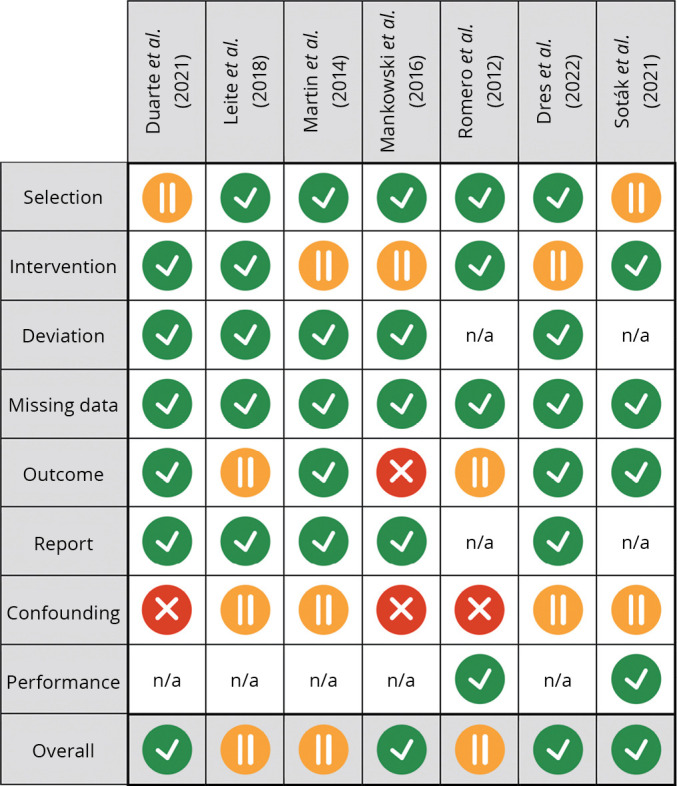
Seven studies were extracted and descriptively synthesized, since a metanalysis was not feasible. Patients undergoing diaphragm stimulation had moderate evidence of higher maximal inspiratory pressure (MIP), less atrophy, less mitochondrial respiratory dysfunction, less oxidative stress, less molecular atrophy, shorter MV time, shorter ICU length of stay, longer survival, and better SF-36 scores than control.
Evidence of the molecular and histological benefits of diaphragmatic stimulation is limited. The results indicate positive clinical effects of diaphragm activation with a moderate level of evidence for MIP and a low level of evidence for other outcomes. Diaphragm activation could be a therapeutic solution to avoid diaphragm atrophy, accelerate weaning, shorten MV time, and counteract VIDD; however, better-powered studies are needed to increase the level of evidence.
机械通气(MV)是危重病患者的救命程序。膈神经激活和刺激可以对抗副作用,如呼吸机诱导的膈肌功能障碍(VIDD)。本系统评价报告了刺激对膈肌萎缩和患者结局的影响。
从 Medline 数据库中提取了最后于 2023 年 1 月 23 日注册 Prospero(CRD42021259353)后,研究膈神经刺激与危重病患者标准治疗的对照,并评估临床结局。选择的研究包括对危重病患者膈神经刺激与标准治疗的比较,以及对临床结局的评估。这些结局包括肌肉萎缩、VIDD、脱机失败、死亡率、生活质量、通气时间、膈肌功能、重症监护病房(ICU)住院时间和住院时间。所有文章均由两名评审员根据其摘要和标题进行独立评估,其次是两名独立评审员对全文进行评估。为了解决意见分歧,咨询了第三名评审员以做出最终决定。评审员根据牛津 2011 年证据水平指南提取数据并进行相应总结。
提取了 7 项研究并进行描述性综合,因为无法进行荟萃分析。与对照组相比,接受膈神经刺激的患者有更高的最大吸气压力(MIP)、较少的萎缩、较少的线粒体呼吸功能障碍、较少的氧化应激、较少的分子萎缩、较短的 MV 时间、较短的 ICU 住院时间、更长的生存时间和更好的 SF-36 评分,证据等级为中等。
膈神经刺激的分子和组织学获益证据有限。结果表明,膈神经激活具有中等水平的 MIP 临床效果证据,以及其他结局的低水平证据。膈神经激活可能是一种治疗解决方案,可避免膈肌萎缩,加速脱机,缩短 MV 时间,并对抗 VIDD;然而,需要进行更好的研究来提高证据水平。