ResMed Science Center, San Diego, CA.
ResMed Science Center, Halifax, NS, Canada.
Chest. 2024 May;165(5):1228-1238. doi: 10.1016/j.chest.2024.01.020. Epub 2024 Jan 10.
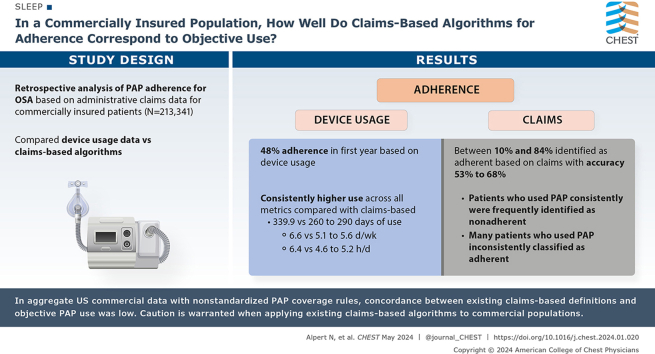
Positive airway pressure (PAP) therapy is first-line therapy for OSA, but consistent use is required for it to be effective. Previous studies have used Medicare fee-for-service claims data (eg, device, equipment charges) as a proxy for PAP adherence to assess its effects. However, this approach has not been validated in a US commercially insured population, where coverage rules are not standardized.
In a commercially insured population in the United States, how well do claims-based algorithms for defining PAP adherence correspond with objective PAP device usage?
Deidentified administrative claims data of commercially insured patients (aged 18-64 years) with OSA were linked to objective PAP therapy usage data from cloud-connected devices. Adherence was defined based on device use (using an extension of Centers for Medicare & Medicaid Services 90-day compliance criteria) and from claims-based algorithms to compare usage metrics and identify potential misclassifications.
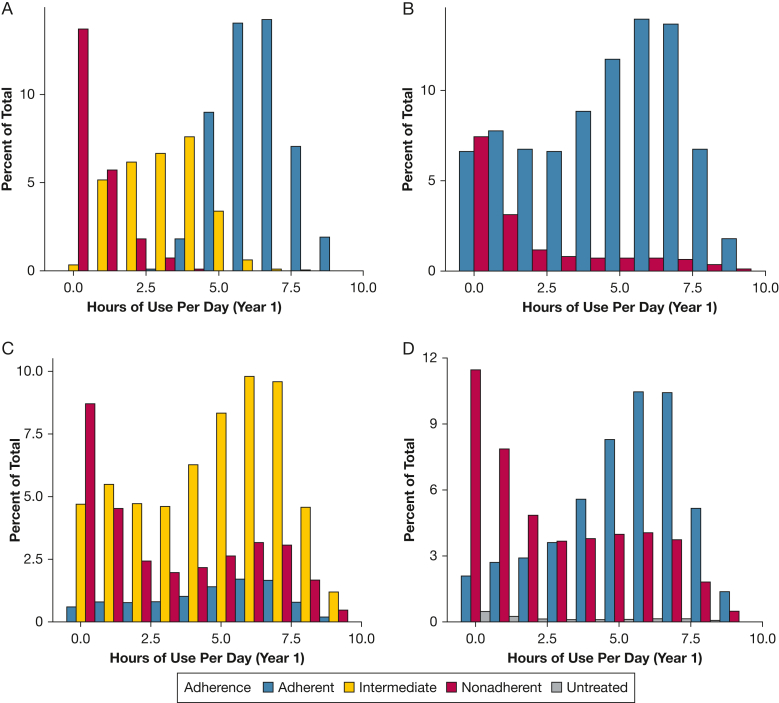
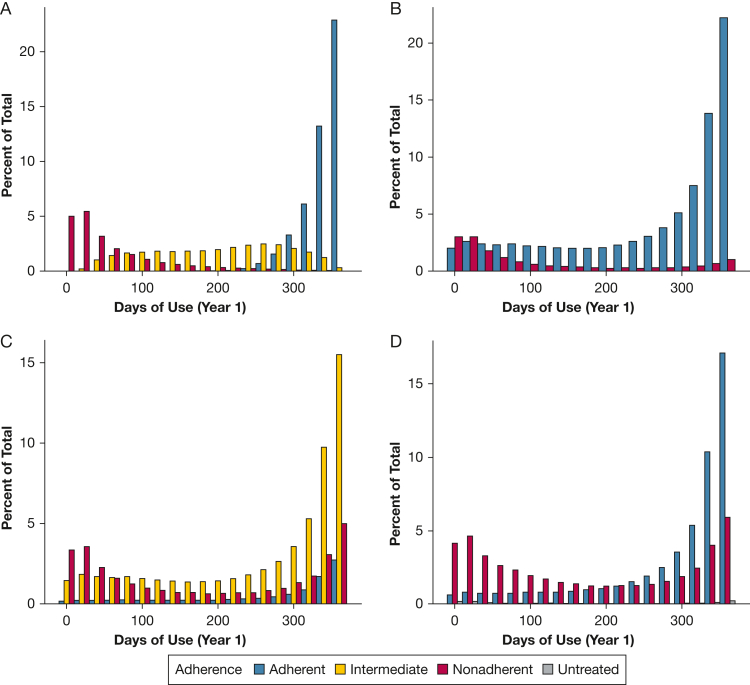
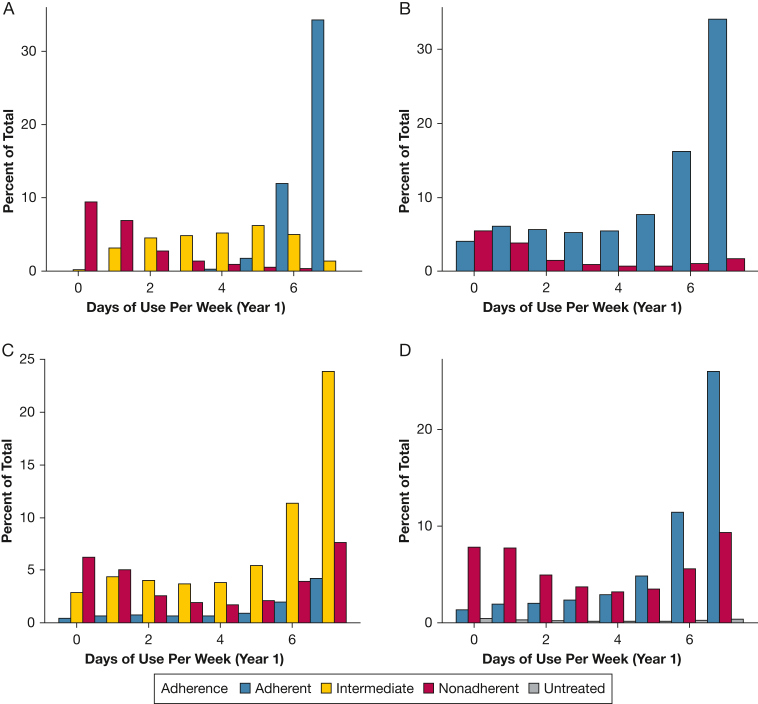
The final sample included 213,341 patients. Based on device usage, 48% were adherent in the first year. Based on claims, between 10% and 84% of patients were identified as adherent (accuracy, sensitivity, and specificity ranges: 53%-68%, 12%-95%, and 26%-92%, respectively). Relative to patients who were claims-adherent, patients who were device-adherent had consistently higher usage across all metrics (mean, 339.9 vs 260.0-290.0 days of use; 6.6 vs 5.1-5.6 d/wk; 6.4 vs 4.6-5.2 h/d). Consistent PAP users were frequently identified by claims-based algorithms as nonadherent, whereas many inconsistent users were classified by claims-based algorithms as adherent.
In aggregate US commercial data with nonstandardized PAP coverage rules, concordance between existing claims-based definitions and objective PAP use was low. Caution is warranted when applying existing claims-based algorithms to commercial populations.
气道正压(PAP)疗法是 OSA 的一线治疗方法,但需要持续使用才能有效。以前的研究使用医疗保险按服务收费的索赔数据(例如,设备、设备费用)作为 PAP 依从性的代理指标来评估其效果。然而,这种方法尚未在美国商业保险人群中得到验证,因为覆盖范围规则不标准化。
在美国商业保险人群中,基于索赔的 PAP 依从性算法与客观 PAP 设备使用情况的相关性如何?
将患有 OSA 的商业保险患者(年龄 18-64 岁)的匿名行政索赔数据与云连接设备的客观 PAP 治疗使用数据相关联。依从性基于设备使用情况(使用医疗保险和医疗补助服务中心 90 天依从性标准的扩展)和基于索赔的算法来比较使用指标并确定潜在的错误分类。
最终样本包括 213341 名患者。根据设备使用情况,第一年有 48%的患者依从。根据索赔,有 10%至 84%的患者被认定为依从(准确性、敏感性和特异性范围分别为 53%-68%、12%-95%和 26%-92%)。与依从索赔的患者相比,依从设备的患者在所有指标上的使用频率都更高(平均值,339.9 与 260.0-290.0 天的使用;6.6 与 5.1-5.6 天/周;6.4 与 4.6-5.2 小时/天)。经常使用 PAP 的患者通常被索赔算法认定为不依从,而许多不规律使用 PAP 的患者被索赔算法认定为依从。
在具有非标准化 PAP 覆盖规则的美国综合商业数据中,现有的基于索赔的定义与客观 PAP 使用之间的一致性较低。在将现有的基于索赔的算法应用于商业人群时应谨慎。