Department of Plant Biology, Osun State University, P.M.B, Osogbo, 4494, Nigeria.
Department of Horticultural Sciences, Faculty of Applied Sciences, Cape Peninsula University of Technology, Bellville, 7535, South Africa.
BMC Complement Med Ther. 2024 Jan 12;24(1):35. doi: 10.1186/s12906-023-04300-5.
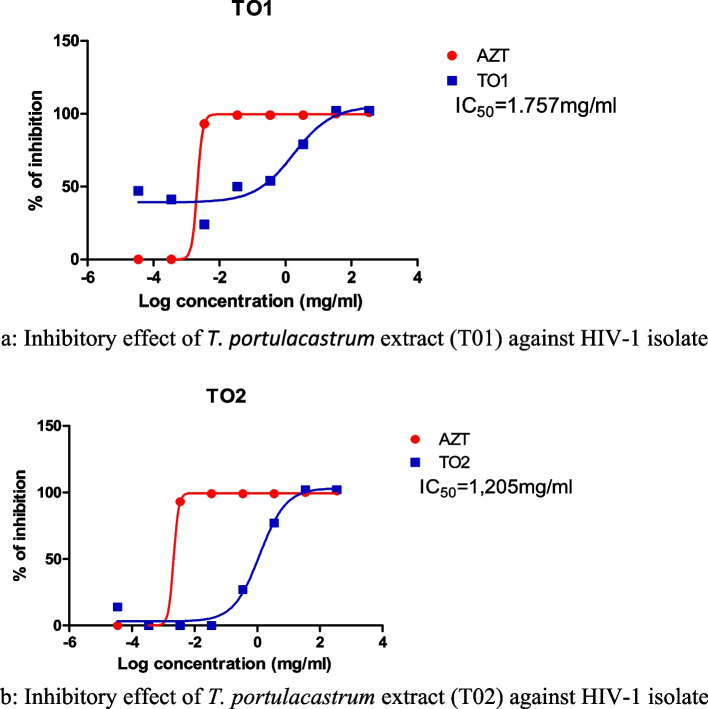
The development of antiretroviral therapy has brought a tremendous relief to the world as it minimizes mortality, reduces HIV transmission, and suppresses progression in infected patients. However, the orthodox antiretroviral therapy is faced with limitations which have necessitated a continuous search for more novel plant-based antiviral compounds, which can bypass the existing barriers created by drug resistance and target more viral proteins. Despite the edibility and enormous pharmacological benefits of T. portulacastrum, little is known about its nutrient profiles and potential use as a natural source of antiviral drug. This study focuses on the full feed analysis and anti-HIV potential of two biotypes of T. portulacastrum. Ethanolic extracts of both biotypes of T. portulacastrum (T01 and T02) had significant inhibitory effects on the level of replication of the HIV-1. Both extracts induced the inhibition of at least 50% of the HIV-1 viral load at considerably low IC values of 1.757 mg/mL (T01) and 1.205 mg/mL (T02) which is comparable to the AZT standard. The protein composition ranged between 8.63-22.69%; fat (1.84-4.33%); moisture (7.89-9.04%); fibre (23.84-49.98%); and carbohydrate content (38.54-70.14%). Mineral contents of tested T. portulacastrum varied considerably in different parts of the plant. Nitrogen N mineral ranged between 13.8-36.3 mg/g; sodium Na (2.0-14.0 mg/g); potassium K (14.0-82.0 mg/g); magnesium Mg (2.8-7.1 mg/g); calcium Ca (9.1-24.7 mg/g); phosphorus P (1.3-3.6 mg/g); iron Fe (193.5-984.0 ppm); zinc Zn (42.5-96.0 ppm); manganese Mn (28.5-167.5 ppm); and copper Cu (2.0-8.5 ppm). These mineral values are comparable or higher than values quoted for common vegetables, suggesting that T. portulacastrum is a nutrient-dense vegetable that could provide alternative sources of antiviral nutrients to HIV-infected individuals. Further studies are recommended to unravel key metabolites responsible for high nutrient profiles and antiretroviral effects in T. portulacastrum.
抗逆转录病毒疗法的发展给世界带来了巨大的缓解,因为它最大限度地降低了死亡率,减少了 HIV 的传播,并抑制了感染患者的病情进展。然而,传统的抗逆转录病毒疗法面临着限制,这就需要不断寻找更新型的植物源抗病毒化合物,这些化合物可以绕过现有耐药性造成的障碍,并针对更多的病毒蛋白。尽管马齿苋的可食用性和巨大的药理学益处,但人们对其营养成分和作为天然抗病毒药物来源的潜在用途知之甚少。本研究集中于两种马齿苋生物型的全饲料分析和抗 HIV 潜力。两种马齿苋生物型(T01 和 T02)的乙醇提取物对 HIV-1 的复制水平具有显著的抑制作用。两种提取物均能诱导至少 50%的 HIV-1 病毒载量抑制,IC 值分别为 1.757 mg/mL(T01)和 1.205 mg/mL(T02),与 AZT 标准相当。蛋白质组成在 8.63-22.69%之间;脂肪(1.84-4.33%);水分(7.89-9.04%);纤维(23.84-49.98%);碳水化合物含量(38.54-70.14%)。测试的马齿苋植物不同部位的矿物质含量差异很大。氮 N 矿化范围在 13.8-36.3 mg/g 之间;钠 Na(2.0-14.0 mg/g);钾 K(14.0-82.0 mg/g);镁 Mg(2.8-7.1 mg/g);钙 Ca(9.1-24.7 mg/g);磷 P(1.3-3.6 mg/g);铁 Fe(193.5-984.0 ppm);锌 Zn(42.5-96.0 ppm);锰 Mn(28.5-167.5 ppm);铜 Cu(2.0-8.5 ppm)。这些矿物质值与常见蔬菜的数值相当或更高,表明马齿苋是一种营养丰富的蔬菜,可以为感染 HIV 的个体提供抗病毒营养物质的替代来源。建议进行进一步的研究,以揭示马齿苋中负责高营养成分和抗逆转录病毒作用的关键代谢物。