Institute of Marine Drugs, Guangxi University of Chinese Medicine, Nanning, Guangxi, China.
Guangxi Key Laboratory of Marine Drugs, Guangxi University of Chinese Medicine, Nanning, Guangxi, China.
Cancer Biomark. 2024;39(3):231-243. doi: 10.3233/CBM-230175.
Epithelial-mesenchymal transition (EMT) is an important biological process by which malignant tumor cells to acquire migration and invasion abilities. This study explored the role of KLF5 in the EMT process of in cervical cancer cell lines.
Krüpple-like factor 5 (KLF5) is a basic transcriptional factor that plays a key role in cell-cycle arrest and inhibition of apoptosis. However, the molecular mechanism by which KLF5 mediates the biological functions of cervical cancer cell lines has not been elucidated. Here, we focus on the potential function of ELF5 in regulating the EMT process in in vitro model of cervical cancer cell lines.
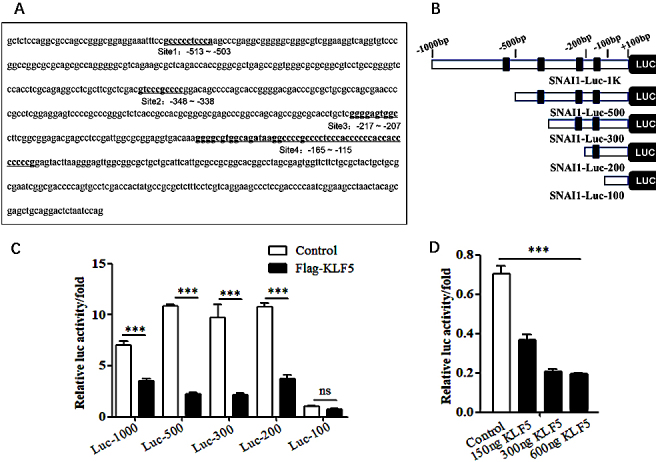
Western-blot and real-time quantitative PCR were used to detect the expression of EMT-related genes in HeLa cells. MTT assays, cell scratch and Transwell assays were used to assess HeLa cells proliferation and invasion capability. Using the bioinformatics tool JASPAR, we identified a high-scoring KLF5-like binding sequence in the SNAI1 gene promoter. Luciferase reporter assays was used to detect transcriptional activity for different SNAI1 promoter truncates.
After overexpressing the KLF5 gene in HeLa cells, KLF5 not only significantly inhibited the invasion and migration of HeLa cells, but also increased the expression of E-cadherin and decreased the expression of N-cadherin and MMP9. In addition, the mRNA expression of upstream regulators of E-cadherin, such as SNAI1, SLUG, ZEB1/2 and TWIST1 was also decreased. Furthermore, KLF5 inhibiting the expression of the SNAI1 gene via binding its promoter region, and the EMT of Hela cells was promoted after overexpression of the SNAI1 gene.
These results indicate that KLF5 can downregulate the EMT process of HeLa cells by decreasing the expression of the SNAI1 gene, thereby inhibiting the migration and invasion of HeLa cervical cancer cells.
上皮间质转化(EMT)是恶性肿瘤细胞获得迁移和侵袭能力的重要生物学过程。本研究探讨了 KLF5 在宫颈癌细胞系 EMT 过程中的作用。
Krüpple 样因子 5(KLF5)是一种基本转录因子,在细胞周期阻滞和抑制细胞凋亡中发挥关键作用。然而,KLF5 介导宫颈癌细胞系生物学功能的分子机制尚未阐明。在这里,我们专注于 ELF5 在调节体外宫颈癌细胞系 EMT 过程中的潜在功能。
Western blot 和实时定量 PCR 用于检测 HeLa 细胞中 EMT 相关基因的表达。MTT assays、细胞划痕和 Transwell assays 用于评估 HeLa 细胞的增殖和侵袭能力。使用 JASPAR 生物信息学工具,我们在 SNAI1 基因启动子中鉴定出一个高评分的 KLF5 样结合序列。荧光素酶报告基因检测用于检测不同 SNAI1 启动子截断的转录活性。
在 HeLa 细胞中转染 KLF5 基因后,KLF5 不仅显著抑制了 HeLa 细胞的侵袭和迁移,而且增加了 E-钙黏蛋白的表达,降低了 N-钙黏蛋白和 MMP9 的表达。此外,E-钙黏蛋白上游调节剂的 mRNA 表达,如 SNAI1、SLUG、ZEB1/2 和 TWIST1 也降低了。此外,KLF5 通过结合其启动子区域抑制 SNAI1 基因的表达,而过表达 SNAI1 基因后促进了 Hela 细胞的 EMT。
这些结果表明,KLF5 可以通过降低 SNAI1 基因的表达下调 HeLa 细胞的 EMT 过程,从而抑制 HeLa 宫颈癌细胞的迁移和侵袭。