Department of Nutrition, Dietetics and Food, School of Clinical Sciences, Faculty of Medicine, Nursing and Health Sciences, Monash University, Melbourne, Victoria, Australia.
Nutrition and Dietetics Department, Allied Health, Monash Health, Melbourne, Victoria, Australia.
Nutr Rev. 2024 Nov 1;82(11):1605-1621. doi: 10.1093/nutrit/nuad157.
Assessment for vitamin C deficiency (VCD) is rarely undertaken in an acute hospital setting in high-income countries. However, with growing interest in VCD in community settings, there is emerging evidence investigating the prevalence and impact of VCD during hospitalization.
In this scoping review, the prevalence of VCD in adult hospitalized patients is explored, patient characteristics are described, and risk factors and clinical outcomes associated with VCD are identified.
A systematic scoping review was conducted in accordance with the PRISMA-ScR framework. The Ovid MEDLINE, Ovid Embase, Scopus, CINAHL Plus, Allied and Complementary Medicine Database, and the Cochrane Library databases were searched for interventional, comparative, and case-series studies that met eligibility criteria, including adult hospital inpatients in high-income countries, as defined by the Organization for Economic Co-operation and Development, that reported VCD prevalence using World Health Organization reference standards. These standards define VCD deficiency as plasma or serum vitamin C level <11.4 µmol/L, wholeblood level <17 µmol/L, or leukocytes <57 nmol/108 cells.
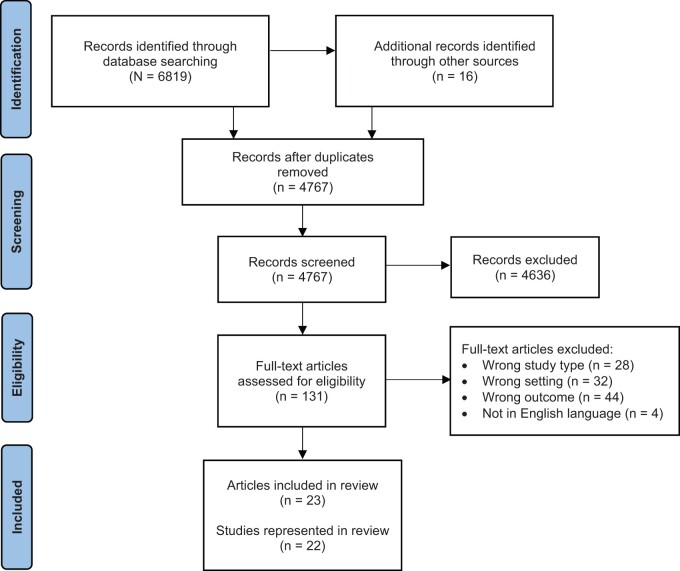
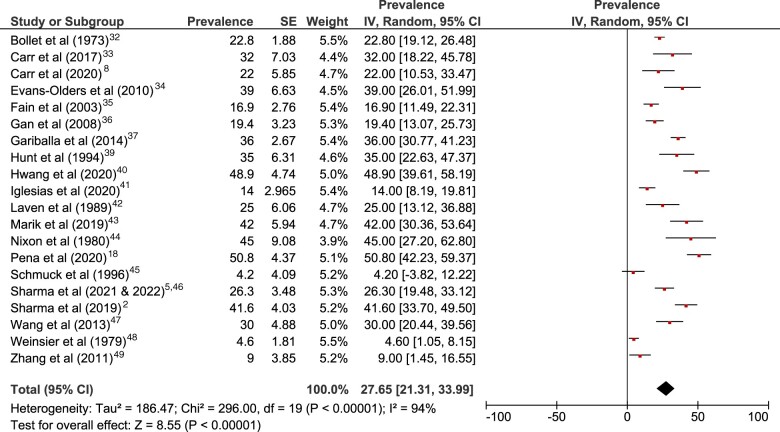
Twenty-three articles were included, representing 22 studies. The cumulative prevalence of VCD was 27.7% (n = 2494; 95% confidence interval [CI], 21.3-34.0). High prevalence of VCD was observed in patients with severe acute illness and poor nutritional status. Scurvy was present in 48% to 62% of patients with VCD assessed in 2 studies (n = 71). Being retired (P = 0.015) and using excessive amounts of alcohol and tobacco (P = 0.0003) were independent risk factors for VCD (n = 184). Age was not conclusively associated with VCD (n = 631). Two studies examined nutrition associations (n = 309); results were inconsistent. Clinical outcomes for VCD included increased risk of frailty (adjusted odds ratio, 4.3; 95%CI, 1.33-13.86; P = 0.015) and cognitive impairment (adjusted odds ratio, 2.93; 95%CI, 1.05-8.19, P = 0.031) (n = 160).
VCD is a nutritional challenge facing the healthcare systems of high-income countries. Research focused on early identification and treatment of patients with VCD is warranted.
Open Science Framework ( https://doi.org/10.17605/OSF.IO/AJGHX ).
在高收入国家的急性医院环境中,很少对维生素 C 缺乏症 (VCD) 进行评估。然而,随着社区对 VCD 的兴趣日益浓厚,越来越多的证据开始调查住院期间 VCD 的患病率和影响。
在本次范围界定综述中,我们探讨了成年住院患者 VCD 的患病率,描述了患者特征,并确定了与 VCD 相关的风险因素和临床结局。
按照 PRISMA-ScR 框架进行系统范围界定综述。检索了 Ovid MEDLINE、Ovid Embase、Scopus、CINAHL Plus、补充和综合医学数据库以及 Cochrane 图书馆数据库,以寻找符合入选标准的干预性、比较性和病例系列研究,包括高收入国家的成年住院患者,这些患者的定义是根据经济合作与发展组织确定的,并且使用世界卫生组织参考标准报告 VCD 患病率。这些标准将 VCD 定义为血浆或血清维生素 C 水平<11.4µmol/L、全血水平<17µmol/L 或白细胞<57nmol/108 细胞。
纳入了 23 篇文章,代表了 22 项研究。VCD 的累积患病率为 27.7%(n=2494;95%置信区间,21.3-34.0)。患有严重急性疾病和营养状况不良的患者中 VCD 患病率较高。在 2 项评估 VCD 的研究中(n=71),48%至 62%的患者存在坏血病。退休(P=0.015)和过量饮酒和吸烟(P=0.0003)是 VCD 的独立风险因素(n=184)。年龄与 VCD 之间没有明确的相关性(n=631)。有 2 项研究检查了营养相关性(n=309);结果不一致。VCD 的临床结局包括虚弱风险增加(调整后比值比,4.3;95%置信区间,1.33-13.86;P=0.015)和认知障碍(调整后比值比,2.93;95%置信区间,1.05-8.19,P=0.031)(n=160)。
VCD 是高收入国家医疗体系面临的营养挑战。有必要针对 VCD 患者的早期识别和治疗进行研究。
Open Science Framework(https://doi.org/10.17605/OSF.IO/AJGHX)。