School of Medicine, Faculty of Science, Medicine and Health, University of Wollongong, Wollongong, NSW, Australia.
Illawarra Health & Medical Research Institute, Wollongong, NSW, Australia.
J Hum Nutr Diet. 2022 Dec;35(6):1043-1058. doi: 10.1111/jhn.13009. Epub 2022 Apr 26.
Malnutrition affects between 20% and 50% of hospital inpatients on admission, with further declines expected during hospitalisation. This review summarises the existing literature on hospital-acquired malnutrition that examines the magnitude of nutritional deterioration amongst adult inpatients and identifies preventable barriers to optimising nutrition support during episodes of care.
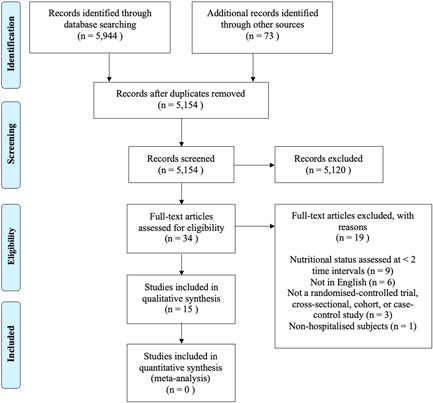
A systematic review was conducted to answer the question: Among adult hospital inpatients, the presence of which modifiable factors contribute to hospital-acquired malnutrition? A database search was conducted between the 24 April and 30 June 2020 using CINAHL, MEDLINE, Scopus and PubMed databases according to a protocol registered with PROSPERO (CD42020182728). In addition, issues of the 10 top clinical nutrition journals published during the period of from 1 April 2015 to 30 March 2020 were hand-searched.
Fifteen articles were eligible for inclusion from a total of 5944 retrieved abstracts. A narrative synthesis of evidence was completed because of the high level of heterogeneity in methodologies. Nutritional deterioration is common among previously well-nourished and nutritionally compromised patients, with studies reporting that 10%-65% of patients experienced nutritional decline. Frequently reported barriers were mealtime interruptions, meal dissatisfaction, procedure-related fasting, effects of illness or treatment, chewing difficulties, poor appetite and malnutrition as a low clinical priority.
The findings of this review support the need for routine nutritional risk screening throughout each hospital admission with hospital-acquired malnutrition affecting up to 65% of inpatients. Clear establishment of the roles and responsibilities of each member within multidisciplinary healthcare teams in the provision of nutrition care and cost-benefit analyses are recommended to demonstrate the effectiveness of changes to models of care.
营养不良影响入院时 20%至 50%的住院患者,住院期间预计还会进一步下降。本综述总结了现有的关于医院获得性营养不良的文献,研究了成年住院患者营养恶化的程度,并确定了在护理期间优化营养支持的可预防障碍。
按照在 PROSPERO(CD42020182728)注册的方案,于 2020 年 4 月 24 日至 6 月 30 日,通过 CINAHL、MEDLINE、Scopus 和 PubMed 数据库进行了系统检索,以回答问题:在成年住院患者中,哪些可改变的因素会导致医院获得性营养不良?此外,还对手册检索了在 2015 年 4 月 1 日至 2020 年 3 月 30 日期间出版的 10 种顶级临床营养杂志的问题。
从总共检索到的 5944 篇摘要中,有 15 篇文章符合纳入标准。由于方法学的高度异质性,完成了证据的叙述性综合。营养恶化在营养状况良好和营养状况较差的患者中很常见,研究报告称 10%-65%的患者出现营养下降。经常报道的障碍包括用餐时间中断、对膳食不满意、与治疗相关的禁食、疾病或治疗的影响、咀嚼困难、食欲不佳和营养不良作为低临床重点。
本综述的结果支持在每次住院期间进行常规营养风险筛查的必要性,高达 65%的住院患者会发生医院获得性营养不良。建议明确多学科医疗团队中每个成员在提供营养护理方面的角色和责任,并进行成本效益分析,以证明对护理模式的改变的有效性。