Ibrahem Amelmasin Faris, Melkie Tadese Belayneh, Filatie Tesera Dereje, Tegegne Biresaw Ayen, Admassie Belete Muluadam
Department of Anesthesia, College of Medicine and Health Sciences, Dire Dawa University, Dire Dawa.
Department of Anesthesia, College of Medicine and Health Sciences, University of Gondar, North Gondar, Ethiopia.
Ann Med Surg (Lond). 2023 Nov 27;86(1):139-145. doi: 10.1097/MS9.0000000000001571. eCollection 2024 Jan.
Caesarean section is one of the most common procedures and clinician faces dual challenges with feto-maternal morbidity and mortality after caesarean delivery. Enhanced recovery after caesarean delivery protocols might effectively reduce postoperative feto-maternal morbidity and mortality. Therefore, this study aimed to assess practice of enhanced recovery after caesarean delivery among parturients who underwent elective caesarean delivery.
A cross-sectional study design was conducted from March to June 2021 on 225 consecutive parturients scheduled for elective caesarean delivery. A semi-structured questionnaire which developed from Society of Obstetric Anesthesia and Perinatology, evidence-based recommendations regarding enhanced recovery after a caesarean (2020) to collect data. Data was collected through direct observation, reviewing the chart, and patient's interview. Data were entered and analyzed in SPSS version 20.
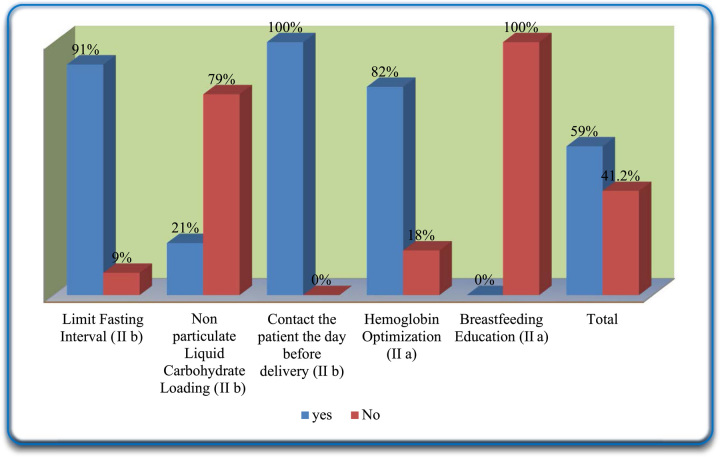
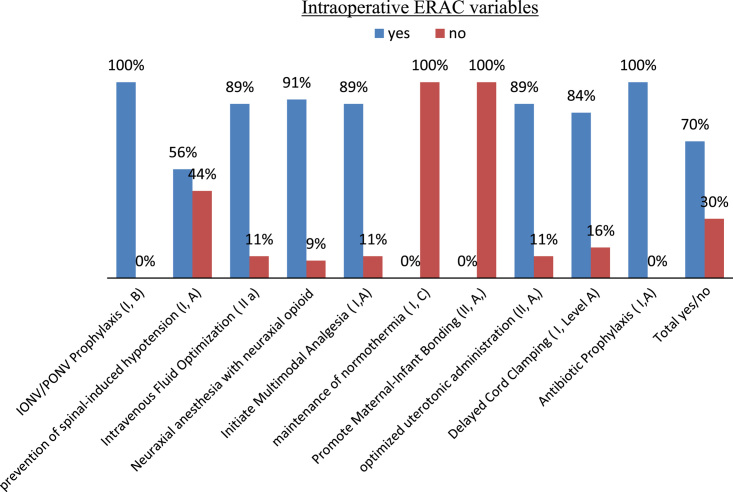
Preoperative pathway; limit fasting interval (91%), haemoglobin screen and optimization (82%), and patient education (100%) found good Areas of practice Intraoperative pathway; administering postoperative nausea and vomiting prophylaxis (100%), fluid optimization (88%), neuraxial anaesthesia with a neuraxial opioid (91%), initiating multimodal analgesia (88%), optimal uterotonic administration (88%), delayed umbilical cord clamping (85%), and prophylactic antibiotic (100%) found areas with good areas of practice. Postoperative pathways; initiation of multimodal analgesia (74%) and early removal of the urinary catheter (62%) were found areas good areas of practice.
The overall practice of enhanced recovery after caesarean delivery was below the target. The authors recommend that this comprehensive and specialized hospital administrator implement enhanced recovery after caesarean delivery protocol and give short-term training for health professionals' about the protocol.
剖宫产是最常见的手术之一,临床医生在剖宫产术后面临母婴发病和死亡的双重挑战。剖宫产术后加速康复方案可能有效降低术后母婴发病和死亡率。因此,本研究旨在评估择期剖宫产产妇的剖宫产术后加速康复实践情况。
2021年3月至6月,对225例连续计划择期剖宫产的产妇进行了横断面研究设计。采用由产科麻醉与围产医学学会制定的半结构化问卷,依据剖宫产术后加速康复的循证建议(2020年)收集数据。通过直接观察、查阅病历和患者访谈收集数据。数据录入SPSS 20版进行分析。
术前路径;限制禁食时间(91%)、血红蛋白筛查与优化(82%)以及患者教育(100%)的实践情况良好。术中路径;给予术后恶心呕吐预防措施(100%)、液体优化(88%)、联合使用阿片类药物的椎管内麻醉(91%)、启动多模式镇痛(88%)、最佳宫缩剂给药(88%)、延迟脐带结扎(85%)以及预防性使用抗生素(100%)的实践情况良好。术后路径;启动多模式镇痛(74%)和早期拔除尿管(62%)的实践情况良好。
剖宫产术后加速康复的整体实践情况未达目标。作者建议这家综合专科医院的管理人员实施剖宫产术后加速康复方案,并为医护人员提供关于该方案的短期培训。