Faisal Hina, Qamar Fatima, Hsu En Shuo, Xu Jiaqiong, Lai Eugene C, Wong Stephen T, Masud Faisal N
Department of Surgery, Houston Methodist, Houston, TX.
Department of Surgery, Weill Cornell Medicine, New York, NY.
Crit Care Explor. 2024 Jan 11;6(1):e1032. doi: 10.1097/CCE.0000000000001032. eCollection 2024 Jan.
Delirium is a common postoperative complication for older patients in the ICU. Ketamine, used primarily as an analgesic, has been thought to prevent delirium.
Determine the prevalence and association of delirium with low-dose ketamine use in ICU patients after abdominal surgery.
Single-center, retrospective, propensity-matched cohort study.
Eight hospital academic medical center.
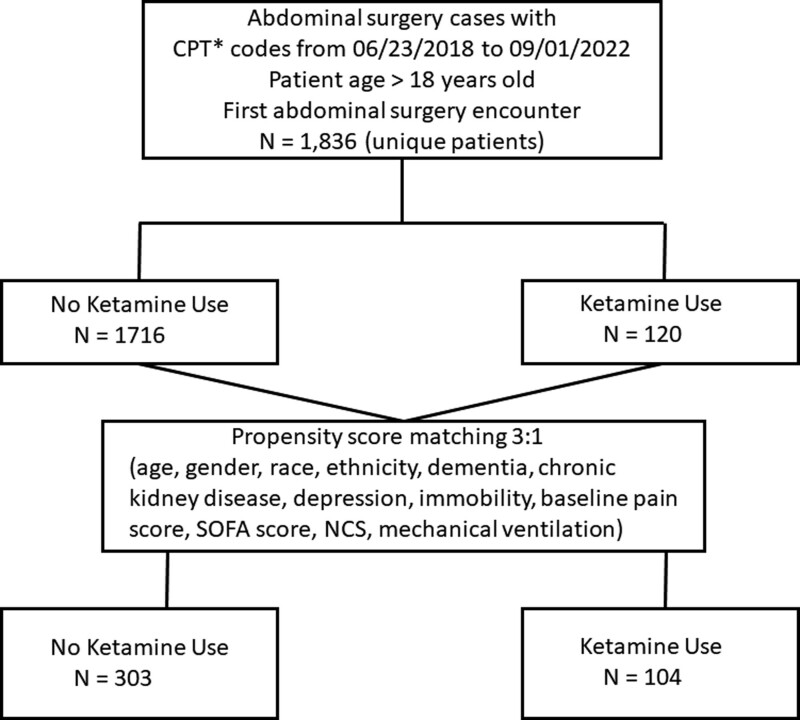
Cohort comprising 1836 patients admitted to the ICU after abdominal surgery between June 23, 2018 and September 1, 2022.
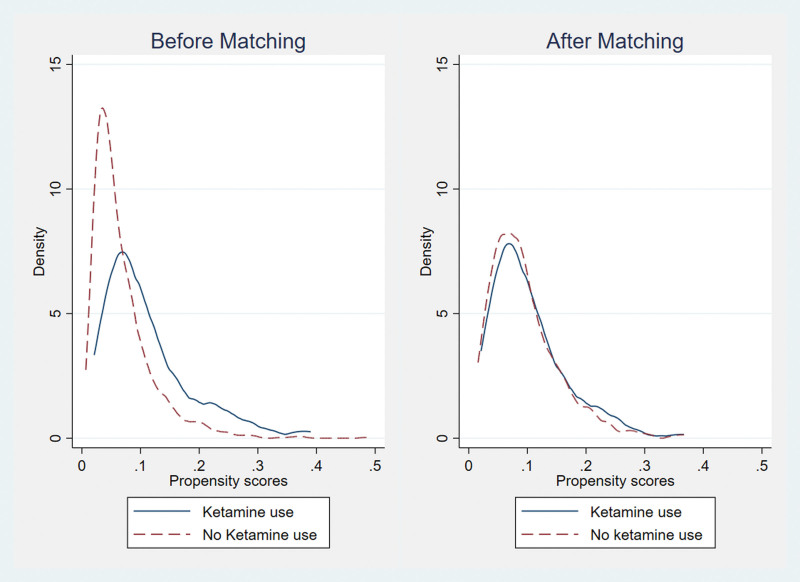
Propensity score matching (PSM) with a 3:1 ratio between no-ketamine use and ketamine use was performed through a greedy algorithm (caliper of 0.005). Outcomes of interest included: delirium (assessed by Confusion Assessment Method-ICU), mean pain score (Numeric Pain Scale or Critical Care Pain Observation Tool score as available), mean opioid consumption (morphine milligram equivalents), length of stay (d), and mortality.
Prevalence of delirium was 47.71% (95% CI, 45.41-50.03%) in the cohort. Of 1836 patients, 120 (6.54%) used low-dose ketamine infusion. After PSM, the prevalence of delirium was 56.02% (95% CI, 51.05-60.91%) in all abdominal surgery patients. The ketamine group had 41% less odds of delirium (odds ratio [OR] = 0.59; 95% CI, 0.37-0.94; = 0.026) than patients with no-ketamine use. Patients with ketamine use had higher mean pain scores (3.57 ± 2.86 vs. 2.21 ± 2.09, < 0.001). In the subgroup analysis, patients in the ketamine-use group 60 years old or younger had 64% less odds of delirium (OR = 0.36; 95% CI, 0.13-0.95; = 0.039). The mean pain scores were higher in the ketamine group for patients 60 years old or older. There was no significant difference in mortality and opioid consumption.
Low-dose ketamine infusion was associated with lower prevalence of delirium in ICU patients following abdominal surgery. Prospective studies should further evaluate ketamine use and delirium.
谵妄是重症监护病房(ICU)老年患者常见的术后并发症。氯胺酮主要用作镇痛药,一直被认为可预防谵妄。
确定腹部手术后ICU患者谵妄的患病率以及与低剂量氯胺酮使用的关联。
单中心、回顾性、倾向评分匹配队列研究。
八家医院学术医疗中心。
队列包括2018年6月23日至2022年9月1日期间接受腹部手术后入住ICU的1836例患者。
通过贪婪算法(卡尺为0.005)对未使用氯胺酮和使用氯胺酮的患者进行3:1比例的倾向评分匹配(PSM)。感兴趣的结局包括:谵妄(通过ICU意识模糊评估方法评估)、平均疼痛评分(数字疼痛量表或可用的重症监护疼痛观察工具评分)、平均阿片类药物消耗量(吗啡毫克当量)、住院时间(天)和死亡率。
该队列中谵妄的患病率为47.71%(95%CI,45.41 - 50.03%)。在1836例患者中,120例(6.54%)使用了低剂量氯胺酮输注。PSM后,所有腹部手术患者中谵妄的患病率为56.02%(95%CI,51.05 - 60.91%)。与未使用氯胺酮的患者相比,氯胺酮组发生谵妄的几率低41%(优势比[OR]=0.59;95%CI,0.37 - 0.94;P = 0.026)。使用氯胺酮的患者平均疼痛评分更高(3.57±2.86对2.21±2.09,P<0.001)。在亚组分析中,60岁及以下使用氯胺酮组的患者发生谵妄的几率低64%(OR = 0.36;95%CI,0.13 - 0.95;P = 0.039)。60岁及以上患者中,氯胺酮组的平均疼痛评分更高。死亡率和阿片类药物消耗量无显著差异。
腹部手术后ICU患者中,低剂量氯胺酮输注与谵妄患病率较低相关。前瞻性研究应进一步评估氯胺酮的使用与谵妄。