Division of Neurology, Department of Paediatrics, Puerta del Mar University Hospital, Cádiz, Spain.
Area of Paediatrics, Department of Child and Mother Health and Radiology, Medical School, University of Cádiz, C/Doctor Marañón, 3, Cádiz, Spain.
Pediatr Res. 2024 Jul;96(2):409-417. doi: 10.1038/s41390-023-02994-4. Epub 2024 Jan 15.
The corpus callosum (CC) is suggested as an indirect biomarker of white matter volume, which is often affected in preterm birth. However, diagnosing mild white matter injury is challenging.
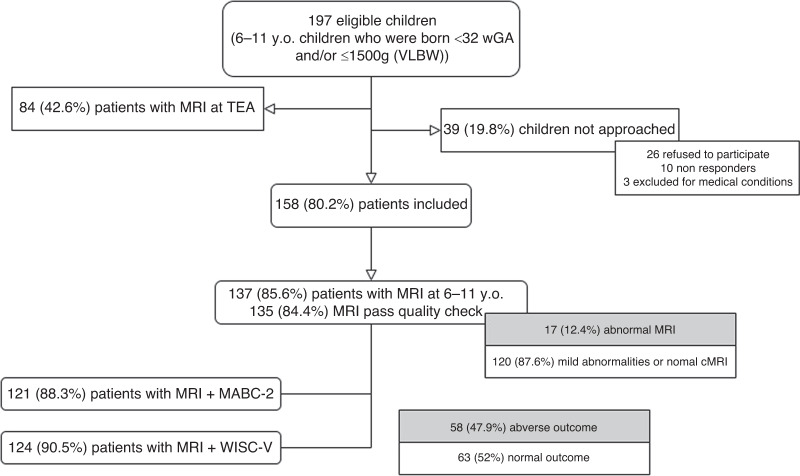
We studied 124 children born preterm (mean age: 8.4 ± 1.1 years), using MRI to assess CC measurements and cognitive/motor outcomes based on the Wechsler Intelligence Scale for Children-V (WPPSI-V) and Movement Assessment Battery for Children-2 (MABC-2).
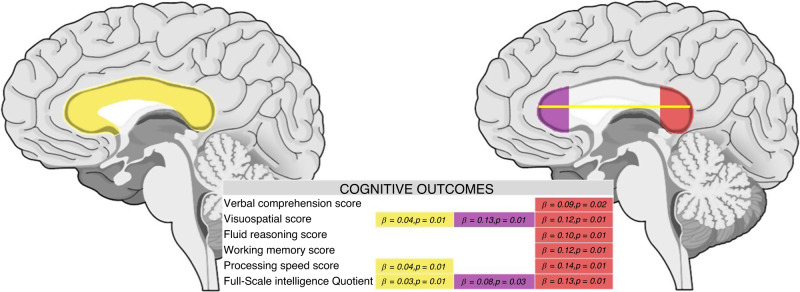
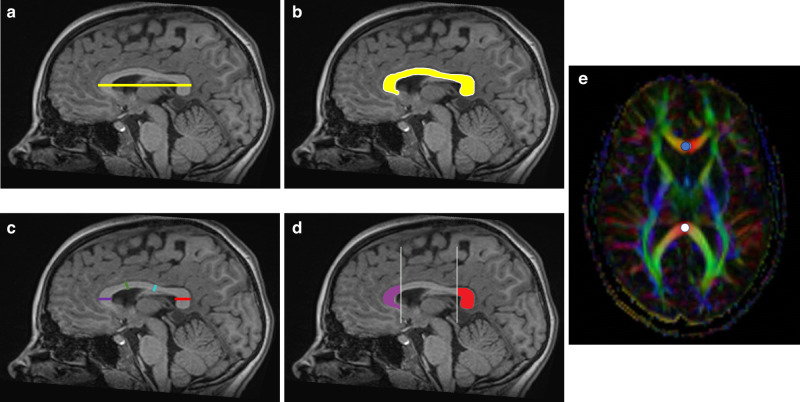
Children with normal outcomes exhibited greater height (10.2 ± 2.1 mm vs. 9.4 ± 2.3 mm; p = 0.01) and fractional anisotropy at splenium (895[680-1000] vs 860.5[342-1000]) and total CC length (69.1 ± 4.8 mm vs. 67.3 ± 5.1 mm; p = 0.02) compared to those with adverse outcomes. All measured CC areas were smaller in the adverse outcome group. Models incorporating posterior CC measurements demonstrated the highest specificity (83.3% Sp, AUC: 0.65) for predicting neurological outcomes. CC length and splenium height were the only linear measurements associated with manual dexterity and total MABC-2 score while both the latter and genu were related with Full-Scale Intelligence Quotient.
CC biometry in children born very preterm at school-age is associated with outcomes and exhibits a specific subregion alteration pattern. The posterior CC may serve as an important neurodevelopmental biomarker in very preterm infants.
The corpus callosum has the potential to serve as a reliable and easily measurable biomarker of white matter integrity in very preterm children. Estimating diffuse white matter injury in preterm infants using conventional MRI sequences is not always conclusive. The biometry of the posterior part of the corpus callosum is associated with cognitive and certain motor outcomes at school age in children born very preterm. Length and splenium measurements seem to serve as reliable biomarkers for assessing neurological outcomes in this population.
胼胝体(CC)被认为是白质体积的间接生物标志物,而白质体积在早产儿中经常受到影响。然而,轻度白质损伤的诊断具有挑战性。
我们研究了 124 名早产儿(平均年龄:8.4±1.1 岁),使用 MRI 评估 CC 测量值以及基于韦氏儿童智力量表第五版(WPPSI-V)和儿童运动评估测试第二版(MABC-2)的认知/运动结果。
正常结局的儿童在前联合高度(10.2±2.1mm 比 9.4±2.3mm;p=0.01)和后联合分数各向异性(895[680-1000] 比 860.5[342-1000])和总 CC 长度(69.1±4.8mm 比 67.3±5.1mm;p=0.02)上表现出更大的差异。所有测量的 CC 区域在不良结局组中均较小。纳入后联合测量的模型对预测神经结局具有最高的特异性(83.3% Sp,AUC:0.65)。CC 长度和后联合高度仅与手灵巧性和总 MABC-2 评分相关,而后者和膝状体与全量表智商均相关。
在学龄期极早产儿中,CC 生物测量与结局相关,并表现出特定的亚区改变模式。后部 CC 可能成为极早产儿重要的神经发育生物标志物。
CC 可作为极早产儿脑白质完整性的可靠且易于测量的生物标志物。使用常规 MRI 序列评估早产儿弥漫性白质损伤并不总是具有结论性。在极早产儿中,出生后 CC 后部分的生物测量与认知和某些运动结局相关。长度和后联合的测量值似乎可作为评估该人群神经结局的可靠生物标志物。