Division of Pediatric Hospital Medicine, Department of Pediatrics, Monroe Carell Jr Children's Hospital at Vanderbilt, Vanderbilt University School of Medicine, Nashville, Tennessee.
Department of Biostatistics, Vanderbilt University School of Medicine, Nashville, Tennessee.
JAMA Netw Open. 2024 Jan 2;7(1):e2350969. doi: 10.1001/jamanetworkopen.2023.50969.
Inadequate communication between caregivers and clinicians at hospital discharge contributes to medication dosing errors in children. Health literacy-informed communication strategies during medication counseling can reduce dosing errors but have not been tested in the pediatric hospital setting.
To test a health literacy-informed communication intervention to decrease liquid medication dosing errors compared with standard counseling in hospitalized children.
DESIGN, SETTING, AND PARTICIPANTS: This parallel, randomized clinical trial was performed from June 22, 2021, to August 20, 2022, at a tertiary care, US children's hospital. English- and Spanish-speaking caregivers of hospitalized children 6 years or younger prescribed a new, scheduled liquid medication at discharge were included in the analysis.
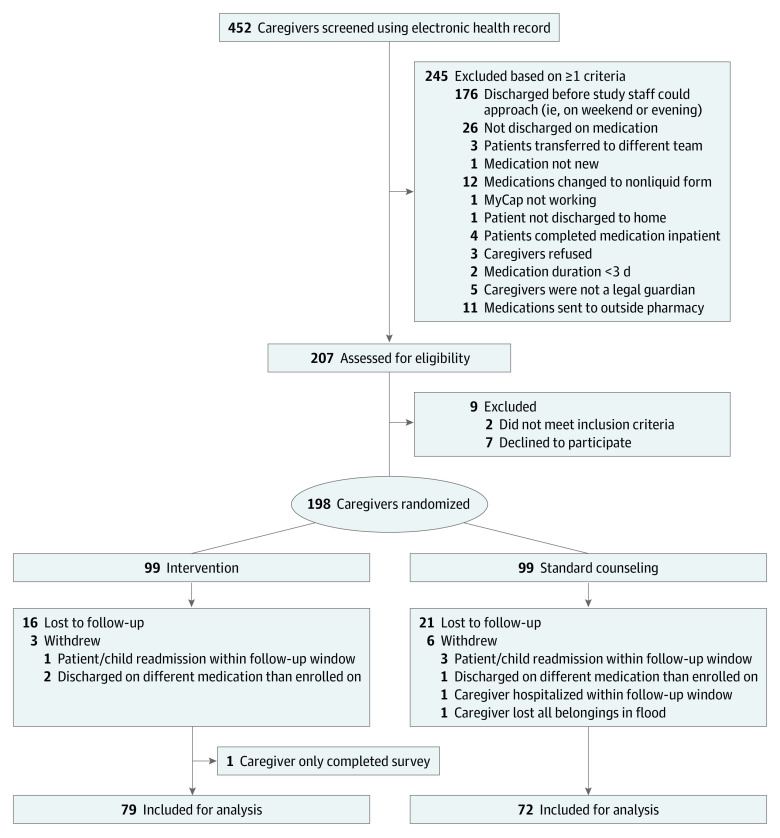
Permuted block (n = 4) randomization (1:1) to a health literacy-informed discharge medication communication bundle (n = 99) compared with standard counseling (n = 99). A study team member delivered the intervention consisting of a written, pictogram-based medication instruction sheet, teach back (caregivers state information taught), and demonstration of dosing with show back (caregivers show how they would draw the liquid medication in the syringe).
Observed dosing errors, assessed using a caregiver-submitted photograph of their child's medication-filled syringe and expressed as the percentage difference from the prescribed dose. Secondary outcomes included caregiver-reported medication knowledge. Outcome measurements were blinded to participant group assignment.
Among 198 caregivers randomized (mean [SD] age, 31.4 [6.5] years; 186 women [93.9%]; 36 [18.2%] Hispanic or Latino and 158 [79.8%] White), the primary outcome was available for 151 (76.3%). The observed mean (SD) percentage dosing error was 1.0% (2.2 percentage points) among the intervention group and 3.3% (5.1 percentage points) among the standard counseling group (absolute difference, 2.3 [95% CI, 1.0-3.6] percentage points; P < .001). Twenty-four of 79 caregivers in the intervention group (30.4%) measured an incorrect dose compared with 39 of 72 (54.2%) in the standard counseling group (P = .003). The intervention enhanced caregiver-reported medication knowledge compared with the standard counseling group for medication dose (71 of 76 [93.4%] vs 55 of 69 [79.7%]; P = .03), duration of administration (65 of 76 [85.5%] vs 49 of 69 [71.0%]; P = .04), and correct reporting of 2 or more medication adverse effects (60 of 76 [78.9%] vs 13 of 69 [18.8%]; P < .001). There were no differences in knowledge of medication name, indication, frequency, or storage.
A health literacy-informed discharge medication communication bundle reduced home liquid medication administration errors and enhanced caregiver medication knowledge compared with standard counseling. Routine use of these standardized strategies can promote patient safety following hospital discharge.
ClinicalTrials.gov Identifier: NCT05143047.
在患儿出院时,护理人员和临床医生之间沟通不足会导致用药剂量错误。在用药咨询中使用基于健康素养的沟通策略可以减少剂量错误,但尚未在儿科医院环境中进行测试。
测试一种基于健康素养的沟通干预措施,与标准咨询相比,减少住院儿童的液体药物剂量错误。
设计、设置和参与者:这是一项平行、随机临床试验,于 2021 年 6 月 22 日至 2022 年 8 月 20 日在美国一家三级护理儿童医院进行。包括接受新规定液体药物出院的 6 岁及以下住院儿童的英语和西班牙语护理人员。
通过Permuted block (n = 4)随机化(1:1),将参与者分为健康素养指导的出院药物沟通套餐组(n = 99)和标准咨询组(n = 99)。研究团队成员提供干预措施,包括书面的、基于图片的药物使用说明表、回授(护理人员陈述所教信息)和使用示教回授(护理人员展示如何在注射器中抽取液体药物)演示剂量。
观察药物剂量错误,通过护理人员提交的其儿童药物填充注射器照片进行评估,并用与规定剂量的百分比差异表示。次要结局包括护理人员报告的药物知识。结果测量对参与者分组是盲态的。
在 198 名被随机分配的护理人员中(平均[标准差]年龄为 31.4[6.5]岁;186 名女性[93.9%];36 名[18.2%]西班牙裔或拉丁裔和 158 名[79.8%]白人),151 名(76.3%)的主要结局数据可用。干预组的平均(标准差)实际剂量误差为 1.0%(2.2 个百分点),而标准咨询组为 3.3%(5.1 个百分点)(绝对差异,2.3 [95%CI,1.0-3.6]个百分点;P < .001)。在干预组中,有 24 名(30.4%)护理人员测量的剂量不正确,而在标准咨询组中,有 39 名(54.2%)护理人员测量的剂量不正确(P = .003)。与标准咨询组相比,干预组增强了护理人员报告的药物知识,包括药物剂量(71 名[93.4%] vs 55 名[79.7%];P = .03)、用药持续时间(65 名[85.5%] vs 49 名[71.0%];P = .04)和正确报告 2 种或以上药物不良反应(60 名[78.9%] vs 13 名[18.8%];P < .001)。药物名称、适应证、频率和储存方面的知识没有差异。
与标准咨询相比,基于健康素养的出院药物沟通套餐减少了家庭液体药物给药错误,并增强了护理人员的药物知识。常规使用这些标准化策略可以促进患者出院后的安全。
ClinicalTrials.gov 标识符:NCT05143047。