Kwak Kyeongmin, Hwang Seung-Sik
Department of Occupational and Environmental Medicine, Korea University Ansan Hospital, Korea University College of Medicine, Ansan, Korea.
Department of Environmental and Occupational Health, Korea University Graduate School of Public Health, Seoul, Korea.
Cancer Res Treat. 2024 Jul;56(3):898-908. doi: 10.4143/crt.2023.981. Epub 2024 Jan 15.
This study aimed to evaluate the effectiveness of the national human papillomavirus (HPV) vaccination program of South Korea among its entire female population, particularly among younger age groups.
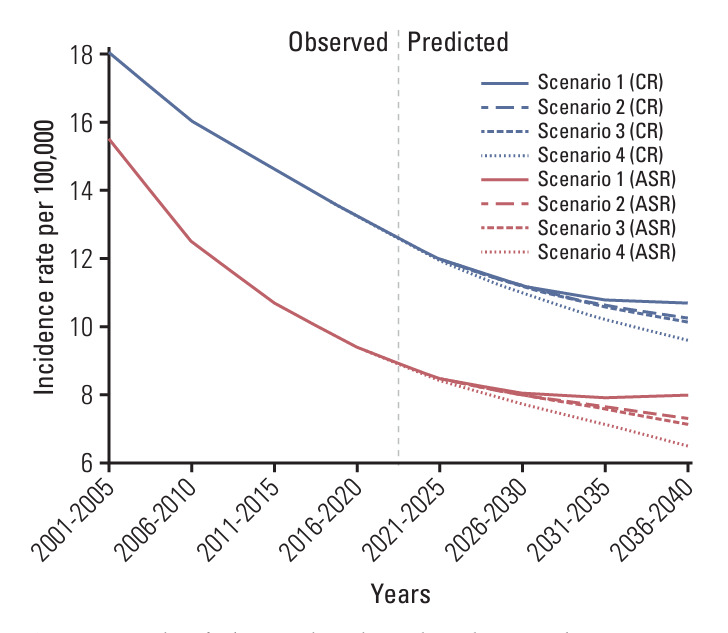
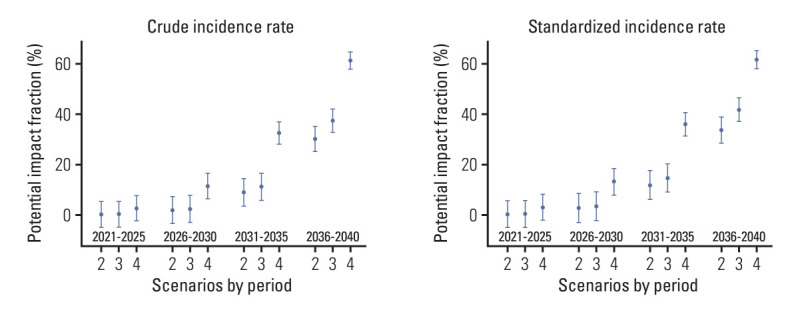
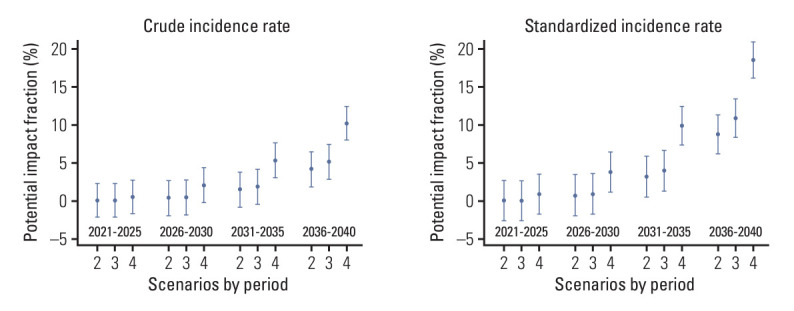
We first predicted the incidence of cervical cancer over the next 20 years (2021-2040) using the Nordpred package based on Møller's age-period-cohort model under several scenarios for the national HPV vaccination program. We calculated the potential impact fractions and proportional differences under the current national vaccination programs, and alternative scenarios using the no-vaccination assumption as a reference.
We estimated that the current national vaccination program would prevent 4.13% of cervical cancer cases and reduce the age-standardized incidence rate (ASR) by 8.79% in the overall population by 2036-2040. Under the alternative scenario of implementing the nine-valent vaccine, 5.13% of cervical cancer cases could be prevented and the ASR reduced by 10.93% during the same period. In another scenario, expanding the vaccination age to 9-17 years could prevent 10.19% of cervical cancer cases, with the ASR reduced by 18.57% during the same period. When restricted to ages < 40 years, the prevention effect was remarkably greater. We predict that the current national HPV program will reduce its incidence by more than 30% between 2036 and 2040 in women aged < 40 years.
The effectiveness of the vaccination program in reducing the incidence of cervical cancer was confirmed, with a considerable impact anticipated in younger age groups.
本研究旨在评估韩国全国人乳头瘤病毒(HPV)疫苗接种计划在全体女性人群,特别是年轻年龄组中的有效性。
我们首先基于Møller的年龄-时期-队列模型,使用Nordpred软件包在国家HPV疫苗接种计划的几种情景下预测未来20年(2021 - 2040年)宫颈癌的发病率。我们计算了当前国家疫苗接种计划下的潜在影响分数和比例差异,并以无疫苗接种假设为参考计算了替代情景下的相应指标。
我们估计,到2036 - 2040年,当前国家疫苗接种计划将预防4.13%的宫颈癌病例,并使总体人群的年龄标准化发病率(ASR)降低8.79%。在实施九价疫苗的替代情景下,同期可预防5.13%的宫颈癌病例,ASR降低10.93%。在另一种情景下,将疫苗接种年龄扩大到9 - 17岁可预防10.19%的宫颈癌病例,同期ASR降低18.57%。当仅限于年龄<40岁的人群时,预防效果显著增强。我们预测,当前国家HPV计划将使2036年至2040年期间年龄<40岁女性的发病率降低超过30%。
疫苗接种计划在降低宫颈癌发病率方面的有效性得到证实,预计对年轻年龄组有相当大的影响。