Department of Cognitive Neuroscience, Donders Institute for Brain, Cognition and Behaviour, Radboud University Medical Centre, Kapittelweg 29, 6525EN, Nijmegen, The Netherlands.
Department of Psychology, Utrecht University, Utrecht, The Netherlands.
Mol Autism. 2024 Jan 17;15(1):3. doi: 10.1186/s13229-024-00583-8.
Autism spectrum disorder (henceforth autism) is a complex neurodevelopmental condition associated with differences in gray matter (GM) volume covariations, as reported in our previous study of the Longitudinal European Autism Project (LEAP) data. To make progress on the identification of potential neural markers and to validate the robustness of our previous findings, we aimed to replicate our results using data from the Enhancing Neuroimaging Genetics Through Meta-Analysis (ENIGMA) autism working group.
We studied 781 autistic and 927 non-autistic individuals (6-30 years, IQ ≥ 50), across 37 sites. Voxel-based morphometry was used to quantify GM volume as before. Subsequently, we used spatial maps of the two autism-related independent components (ICs) previously identified in the LEAP sample as templates for regression analyses to separately estimate the ENIGMA-participant loadings to each of these two ICs. Between-group differences in participants' loadings on each component were examined, and we additionally investigated the relation between participant loadings and autistic behaviors within the autism group.
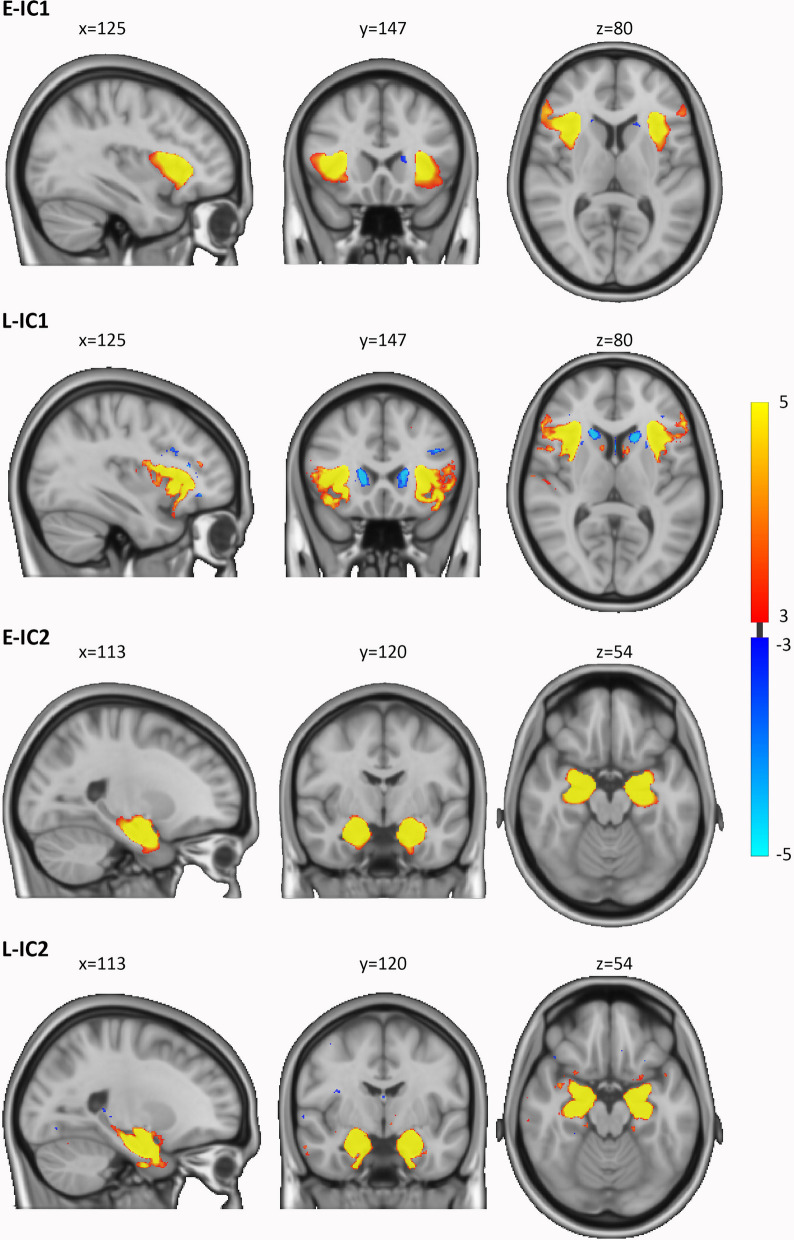
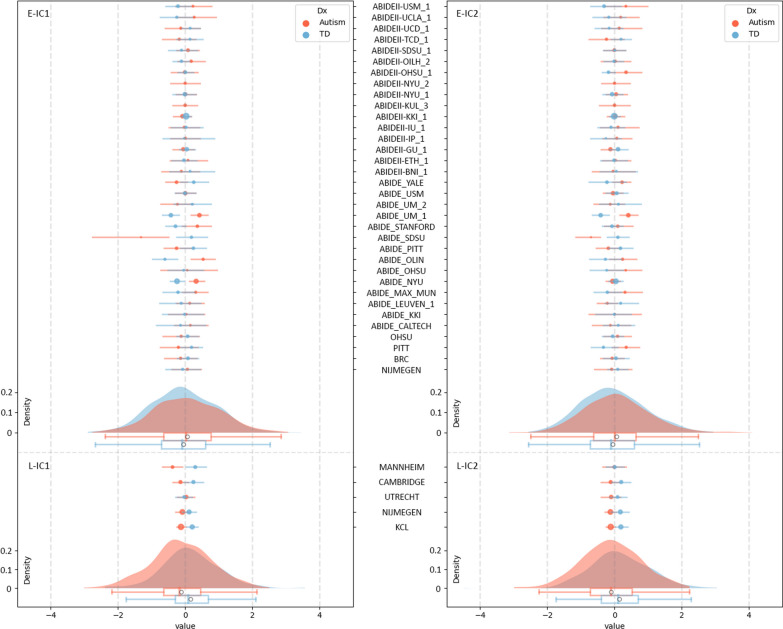
The two components of interest, previously identified in the LEAP dataset, showed significant between-group differences upon regressions into the ENIGMA cohort. The associated brain patterns were consistent with those found in the initial identification study. The first IC was primarily associated with increased volumes of bilateral insula, inferior frontal gyrus, orbitofrontal cortex, and caudate in the autism group relative to the control group (β = 0.129, p = 0.013). The second IC was related to increased volumes of the bilateral amygdala, hippocampus, and parahippocampal gyrus in the autism group relative to non-autistic individuals (β = 0.116, p = 0.024). However, when accounting for the site-by-group interaction effect, no significant main effect of the group can be identified (p > 0.590). We did not find significant univariate association between the brain measures and behavior in autism (p > 0.085).
The distributions of age, IQ, and sex between LEAP and ENIGMA are statistically different from each other. Owing to limited access to the behavioral data of the autism group, we were unable to further our understanding of the neural basis of behavioral dimensions of the sample.
The current study is unable to fully replicate the autism-related brain patterns from LEAP in the ENIGMA cohort. The diverse group effects across ENIGMA sites demonstrate the challenges of generalizing the average findings of the GM covariation patterns to a large-scale cohort integrated retrospectively from multiple studies. Further analyses need to be conducted to gain additional insights into the generalizability of these two GM covariation patterns.
自闭症谱系障碍(自闭症)是一种复杂的神经发育障碍,与灰质(GM)体积变化有关,这是我们之前对纵向欧洲自闭症项目(LEAP)数据的研究报告的结果。为了在确定潜在的神经标记物方面取得进展,并验证我们之前发现的稳健性,我们旨在使用增强神经影像遗传学通过荟萃分析(ENIGMA)自闭症工作组的数据复制我们的结果。
我们研究了 781 名自闭症患者和 927 名非自闭症个体(6-30 岁,智商≥50),分布在 37 个地点。像以前一样,使用基于体素的形态测量法来量化 GM 体积。随后,我们使用以前在 LEAP 样本中确定的两个与自闭症相关的独立成分(IC)的空间图谱作为回归分析的模板,分别估计这两个 IC 中每个 IC 的 ENIGMA 参与者负荷。检查了两组参与者在每个成分上的负荷差异,我们还研究了自闭症组内参与者负荷与自闭症行为之间的关系。
两个感兴趣的成分,以前在 LEAP 数据集中确定,在回归到 ENIGMA 队列时显示出显著的组间差异。相关的大脑模式与初始识别研究中发现的模式一致。第一个 IC 主要与自闭症组相对于对照组双侧岛叶、额下回、眶额皮层和尾状核体积增加有关(β=0.129,p=0.013)。第二个 IC 与自闭症组双侧杏仁核、海马和海马旁回体积增加有关,而与非自闭症个体相比(β=0.116,p=0.024)。然而,当考虑到组间交互效应时,不能确定组的显著主效应(p>0.590)。我们没有发现大脑测量值与自闭症行为之间存在显著的单变量关联(p>0.085)。
LEAP 和 ENIGMA 之间的年龄、智商和性别分布在统计学上彼此不同。由于无法获得自闭症组的行为数据,我们无法进一步了解样本行为维度的神经基础。
目前的研究无法在 ENIGMA 队列中完全复制 LEAP 的自闭症相关脑模式。ENIGMA 各站点的多样化组效应表明,将 GM 协变模式的平均发现推广到从多个研究中回顾性整合的大规模队列存在挑战。需要进一步分析,以深入了解这两种 GM 协变模式的可推广性。