Daubney Emily R, D'Urso Shannon, Cuellar-Partida Gabriel, Rajbhandari Dorrilyn, Peach Elizabeth, de Guzman Erika, McArthur Colin, Rhodes Andrew, Meyer Jason, Finfer Simon, Myburgh John, Cohen Jeremy, Schirra Horst Joachim, Venkatesh Balasubramanian, Evans David M
Institute for Molecular Bioscience, University of Queensland, Brisbane, QLD, Australia.
Centre for Advanced Imaging, The University of Queensland, Brisbane, QLD, Australia.
Crit Care Explor. 2024 Jan 17;6(1):e1030. doi: 10.1097/CCE.0000000000001030. eCollection 2024 Jan.
We sought to assess whether genetic associations with metabolite concentrations in septic shock patients could be used to identify pathways of potential importance for understanding sepsis pathophysiology.
Retrospective multicenter cohort studies of septic shock patients.
All participants who were admitted to 27 participating hospital sites in three countries (Australia, New Zealand, and the United Kingdom) were eligible for inclusion.
Adult, critically ill, mechanically ventilated patients with septic shock ( = 230) who were a subset of the Adjunctive Corticosteroid Treatment in Critically Ill Patients with Septic Shock trial (ClinicalTrials.gov number: NCT01448109).
None.
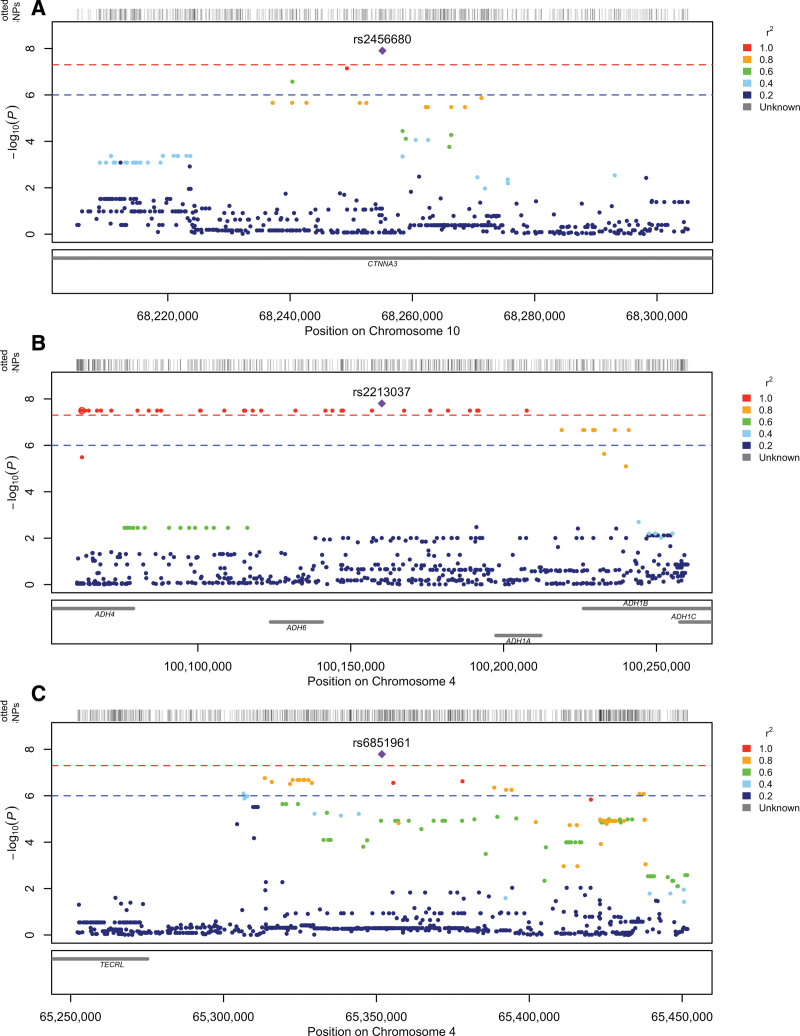
A genome-wide association study was conducted for a range of serum metabolite levels for participants. Genome-wide significant associations ( ≤ 5 × 10) were found for the two major ketone bodies (3-hydroxybutyrate [rs2456680] and acetoacetate [rs2213037] and creatinine (rs6851961). One of these single-nucleotide polymorphisms (SNPs) (rs2213037) was located in the alcohol dehydrogenase cluster of genes, which code for enzymes related to the metabolism of acetoacetate and, therefore, presents a plausible association for this metabolite. None of the three SNPs showed strong associations with risk of sepsis, 28- or 90-day mortality, or Acute Physiology and Chronic Health Evaluation score (a measure of sepsis severity).
We suggest that the genetic associations with metabolites may reflect a starvation response rather than processes involved in sepsis pathophysiology. However, our results require further investigation and replication in both healthy and diseased cohorts including those of different ancestry.
我们试图评估败血症休克患者中与代谢物浓度的基因关联是否可用于识别对理解败血症病理生理学具有潜在重要性的途径。
对败血症休克患者进行回顾性多中心队列研究。
所有入住三个国家(澳大利亚、新西兰和英国)27个参与医院的参与者均符合纳入标准。
成年、重症、机械通气的败血症休克患者( = 230),他们是重症败血症休克患者辅助性皮质类固醇治疗试验(ClinicalTrials.gov编号:NCT01448109)的一个子集。
无。
对参与者的一系列血清代谢物水平进行了全基因组关联研究。发现两种主要酮体(3-羟基丁酸[rs2456680]和乙酰乙酸[rs2213037])和肌酐(rs6851961)存在全基因组显著关联(≤5×10)。其中一个单核苷酸多态性(SNP)(rs2213037)位于酒精脱氢酶基因簇中,该基因簇编码与乙酰乙酸代谢相关的酶,因此与该代谢物存在合理关联。这三个SNP均未显示与败血症风险、28天或90天死亡率或急性生理学与慢性健康评估评分(败血症严重程度的一种衡量指标)有强关联。
我们认为与代谢物的基因关联可能反映的是饥饿反应,而非败血症病理生理学所涉及的过程。然而,我们的结果需要在包括不同血统的健康和患病队列中进一步研究和验证。