Liu Zhongyi, Wei Yuhuan, Yang Ying, Kong Linghua
Department of Psychiatry, School of Clinical Medicine, Cheeloo College of Medicine, Shandong University, Jinan, China.
Childhood Psychiatry Unit, Shandong Mental Health Center, Jinan, China.
Front Psychiatry. 2024 Jan 5;14:1259909. doi: 10.3389/fpsyt.2023.1259909. eCollection 2023.
Non-suicidal self-injury (NSSI) is a highly prevalent behavioral problem among depression adolescent patients that can result in numerous adverse outcomes. This study endeavors to bridge this knowledge gap by creating a comprehensive model that incorporates multiple aspects of NSSI to accurately evaluate its risk in adolescents with depression, thereby enhancing our ability to prevent and address this challenging issue.
Using a cross-sectional design, we recruited 302 adolescents with depressive disorders who visited or were hospitalized at Shandong Mental Health Center from December 2021 to June 2022. The participants completed several self-report questionnaires, including the Chinese version of the Internet Addiction Test, the Pittsburgh Sleep Quality Index questionnaire, the Defeat Scale, the Social Avoidance and Distress Scale and the Children's Depression Inventory. Logistic regression analysis was performed to identify the diagnostic factors, which were further used to establish clinical risk assessment models. A receiver operating characteristic curve (ROC) to identify the best model. An external validating team was introduced to verify the assessing efficiency.
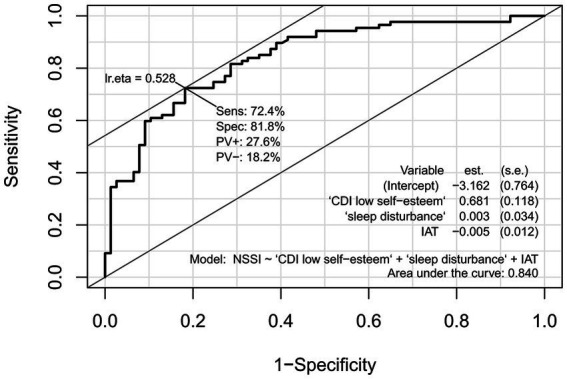
Based on a logistic regression analysis, three variables have been identified as significant risk factors. Specifically, adolescents with depression who experience low self-esteem, internet use, or suffer from sleep disturbance face an increased risk of NSSI. An integrated risk index for NSSI exhibits excellent accuracy in identifying depressed adolescents at risk of NSSI (area under the curve = 0.86, sensitivity = 0.88, specificity = 0.69). In the validation cohort, the identification performance remains strong (area under the curve = 0.84, sensitivity = 0.72, specificity = 0.81).
This study highlighted the role of self-esteem, internet use and sleep disturbance in the development of NSSI. The risk index diagnosing NSSI onset may help to guide the design and application of novel interventions to minimize this risky behavior in future depressed adolescents.
非自杀性自伤行为(NSSI)是抑郁青少年患者中一种非常普遍的行为问题,可能导致众多不良后果。本研究致力于通过创建一个综合模型来填补这一知识空白,该模型纳入了NSSI的多个方面,以准确评估其在抑郁青少年中的风险,从而提高我们预防和解决这一具有挑战性问题的能力。
采用横断面设计,我们招募了2021年12月至2022年6月期间在山东精神卫生中心就诊或住院的302名患有抑郁症的青少年。参与者完成了几份自我报告问卷,包括中文版的网络成瘾测试、匹兹堡睡眠质量指数问卷、挫败感量表、社交回避与苦恼量表以及儿童抑郁量表。进行逻辑回归分析以确定诊断因素,并进一步用于建立临床风险评估模型。绘制受试者工作特征曲线(ROC)以确定最佳模型。引入外部验证团队以验证评估效率。
基于逻辑回归分析,已确定三个变量为显著风险因素。具体而言,患有抑郁症且自尊心较低、有上网行为或睡眠障碍的青少年面临NSSI的风险增加。NSSI的综合风险指数在识别有NSSI风险的抑郁青少年方面表现出优异的准确性(曲线下面积=0.86,敏感性=0.88,特异性=0.69)。在验证队列中,识别性能仍然很强(曲线下面积=0.84,敏感性=0.72,特异性=0.81)。
本研究强调了自尊、上网行为和睡眠障碍在NSSI发生发展中的作用。诊断NSSI发病的风险指数可能有助于指导新型干预措施的设计和应用,以尽量减少未来抑郁青少年的这种危险行为。