Seifelnasr Amr, Si Xiuhua, Xi Jinxiang
Department of Biomedical Engineering, University of Massachusetts, Lowell, MA 01854, USA.
Department of Mechanical Engineering, California Baptist University, Riverside, CA 92504, USA.
Pharmaceuticals (Basel). 2024 Jan 6;17(1):73. doi: 10.3390/ph17010073.
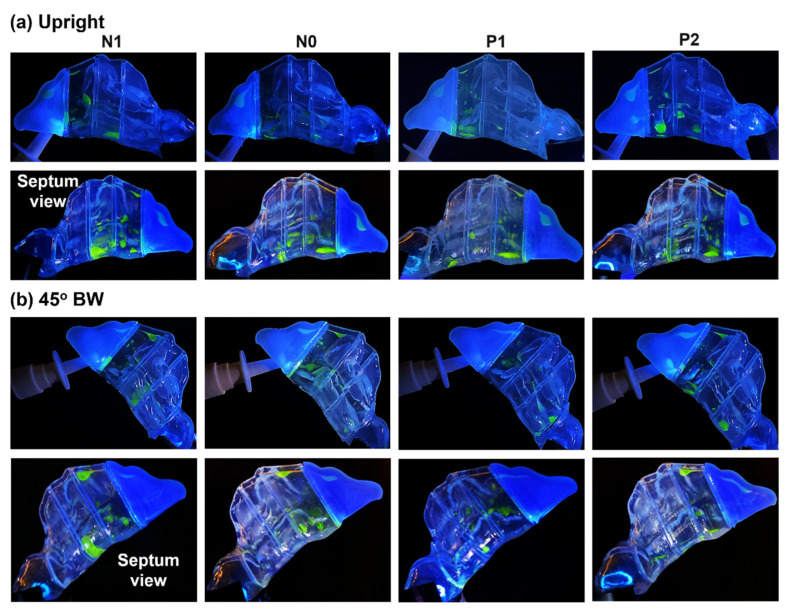
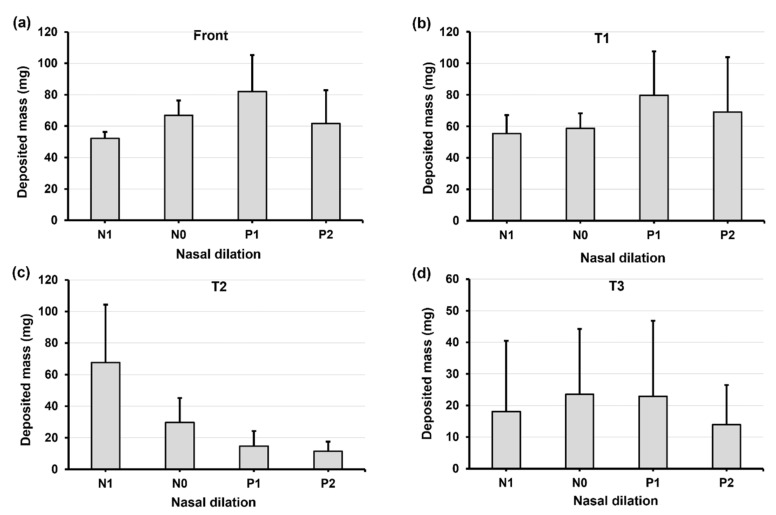
This study investigated the intricate dynamics of intranasal spray deposition within nasal models, considering variations in head orientation and stages of the nasal cycle. Employing controlled delivery conditions, we compared the deposition patterns of saline nasal sprays in models representing congestion (N1), normal (N0), and decongestion (P1, P2) during one nasal cycle. The results highlighted the impact of the nasal cycle on spray distribution, with congestion leading to confined deposition and decongestion allowing for broader dispersion of spray droplets and increased sedimentation towards the posterior turbinate. In particular, the progressive nasal dilation from N1 to P2 decreased the spray deposition in the middle turbinate. The head angle, in conjunction with the nasal cycle, significantly influenced the nasal spray deposition distribution, affecting targeted drug delivery within the nasal cavity. Despite controlled parameters, a notable variance in deposition was observed, emphasizing the complex interplay of gravity, flow shear, nasal cycle, and nasal morphology. The magnitude of variance increased as the head tilt angle increased backward from upright to 22.5° to 45° due to increasing gravity and liquid film destabilization, especially under decongestion conditions (P1, P2). This study's findings underscore the importance of considering both natural physiological variations and head orientation in optimizing intranasal drug delivery.
本研究调查了鼻腔模型中鼻喷雾剂沉积的复杂动态过程,考虑了头部方向和鼻周期各阶段的变化。在可控的给药条件下,我们比较了在一个鼻周期内,生理盐水鼻喷雾剂在代表充血(N1)、正常(N0)和充血解除(P1、P2)状态的模型中的沉积模式。结果突出了鼻周期对喷雾剂分布的影响,充血导致沉积受限,而充血解除则使喷雾液滴更广泛地分散,并增加了向后鼻甲的沉降。特别是,从N1到P2的渐进性鼻腔扩张减少了中鼻甲的喷雾沉积。头部角度与鼻周期共同显著影响鼻喷雾剂的沉积分布,影响鼻腔内的靶向药物递送。尽管参数可控,但仍观察到沉积存在显著差异,这强调了重力、流动剪切力、鼻周期和鼻腔形态之间复杂的相互作用。由于重力增加和液膜失稳,尤其是在充血解除状态(P1、P2)下,随着头部倾斜角度从直立向后增加到22.5°再到45°,差异程度增大。本研究结果强调了在优化鼻内给药时考虑自然生理变化和头部方向的重要性。