• 文献检索
  • 文档翻译
  • 深度研究
  • 学术资讯
  • Suppr Zotero 插件Zotero 插件
  • 邀请有礼
  • 套餐&价格
  • 历史记录
应用&插件
Suppr Zotero 插件Zotero 插件浏览器插件Mac 客户端Windows 客户端微信小程序
定价
高级版会员购买积分包购买API积分包
服务
文献检索文档翻译深度研究API 文档MCP 服务
关于我们
关于 Suppr公司介绍联系我们用户协议隐私条款
关注我们

Suppr 超能文献

核心技术专利:CN118964589B侵权必究
粤ICP备2023148730 号-1Suppr @ 2026

文献检索

告别复杂PubMed语法,用中文像聊天一样搜索,搜遍4000万医学文献。AI智能推荐,让科研检索更轻松。

立即免费搜索

文件翻译

保留排版,准确专业,支持PDF/Word/PPT等文件格式,支持 12+语言互译。

免费翻译文档

深度研究

AI帮你快速写综述,25分钟生成高质量综述,智能提取关键信息,辅助科研写作。

立即免费体验

circadian 光疗法和光剂量对抑郁的年轻人:系统评价和荟萃分析。

Circadian light therapy and light dose for depressed young people: a systematic review and meta-analysis.

机构信息

School of Architecture and Urban Planning, Chongqing University, Chongqing, China.

Key Laboratory of New Technology for Construction of Cities in Mountain Area, Chongqing University, Chongqing, China.

出版信息

Front Public Health. 2024 Jan 8;11:1257093. doi: 10.3389/fpubh.2023.1257093. eCollection 2023.

DOI:10.3389/fpubh.2023.1257093
PMID:38259764
原文链接:https://pmc.ncbi.nlm.nih.gov/articles/PMC10800803/
Abstract

BACKGROUND

Empirical evidence has shown that light therapy (LT) can reduce depression symptoms by stimulating circadian rhythms. However, there is skepticism and inconclusive results, along with confusion regarding dosing. The purpose of this study is to quantify light as a stimulus for the circadian system and create a dose-response relationship that can help reduce maladies among adolescents and young adults (AYAs). This will provide a reference for light exposure and neural response, which are crucial in the neuropsychological mechanism of light intervention. The study also aims to provide guidance for clinical application.

METHODS

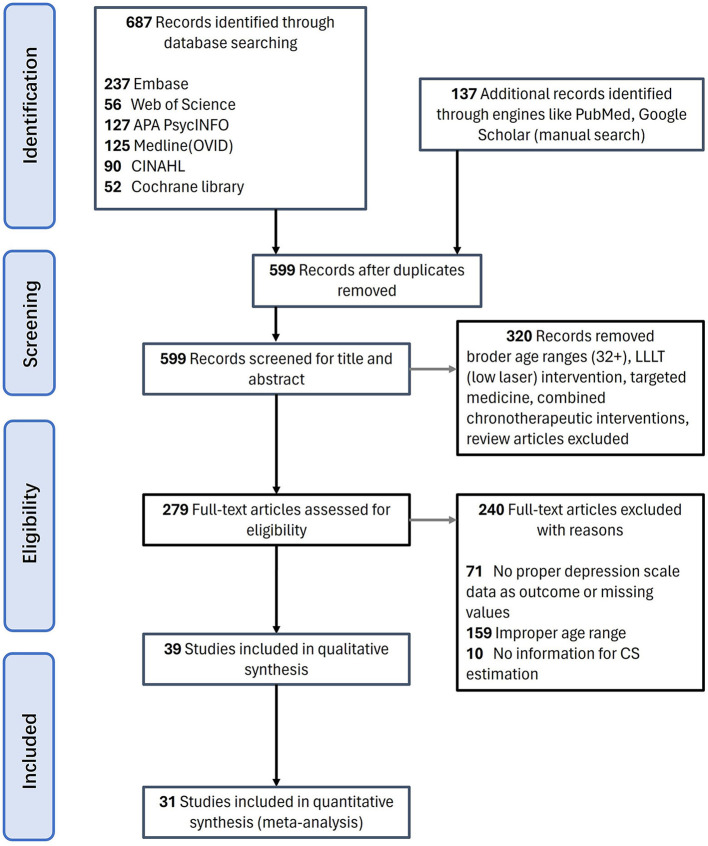
The latest quantitative model of CL (circadian light) and CS (circadian stimulus) was adopted to quantify light dose for circadian phototransduction in youth depression-related light therapy. Articles published up to 2023 through Web of Science, Cochrane Library, Medline (OVID), CINAHL, APA PsycINFO, Embase, and Scholars were retrieved. A meta-analysis of 31 articles (1,031 subjects) was performed using Stata17.0, CMA3.0 (comprehensive meta-analysis version 3.0) software, and Python 3.9 platform for light therapy efficacy comparison and dose-response quantification.

RESULTS

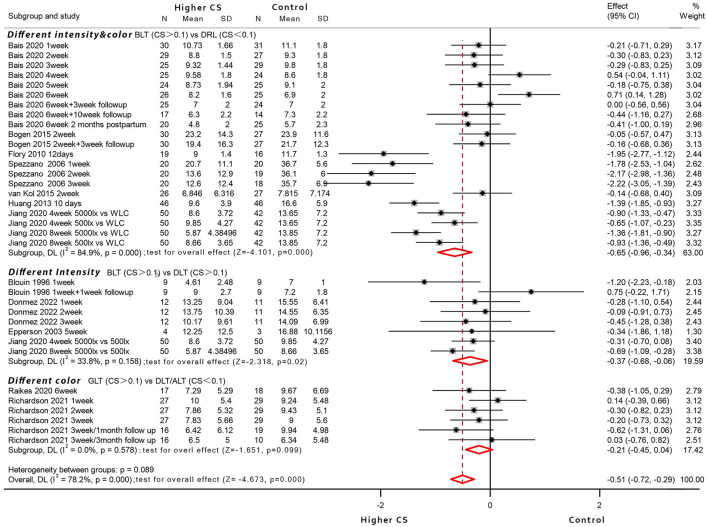
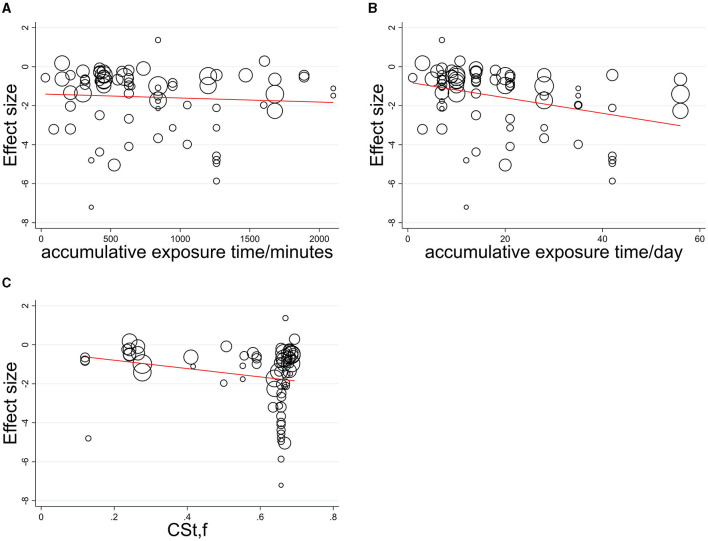
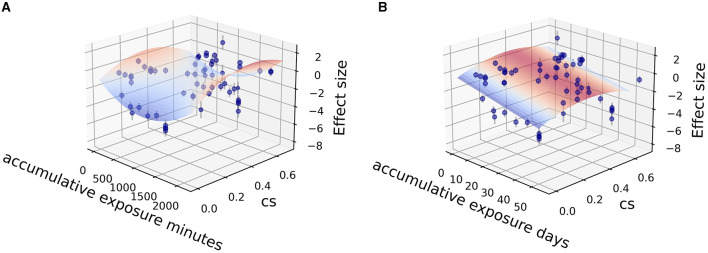
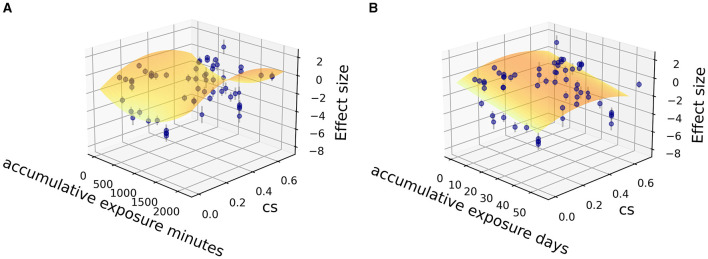
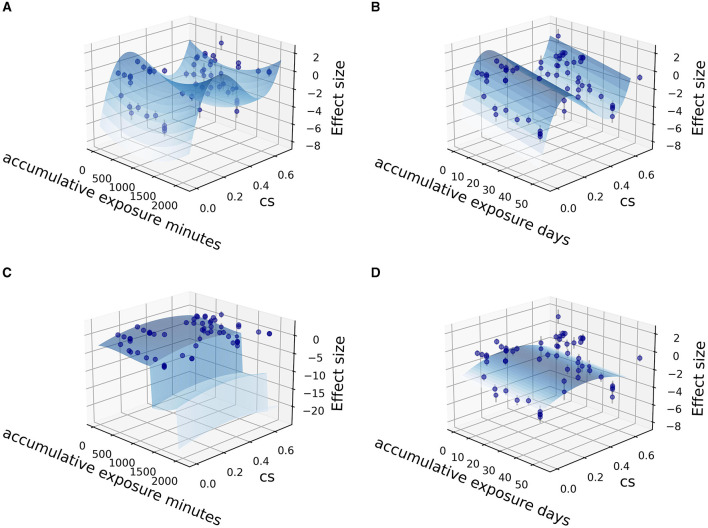
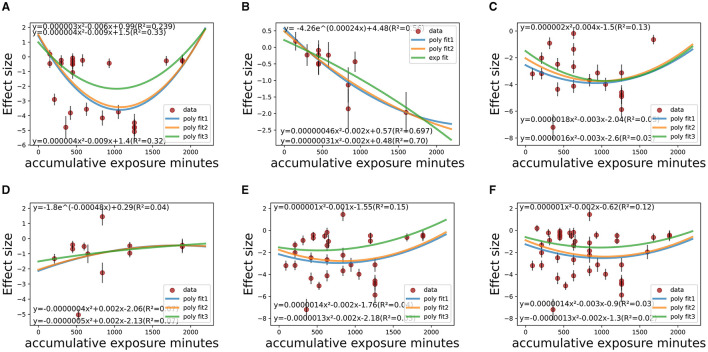
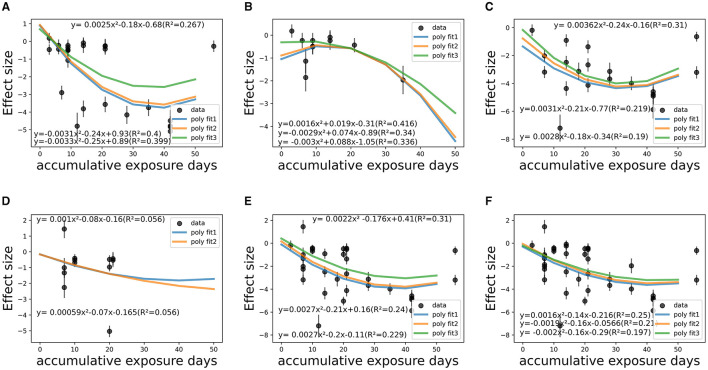
Under various circadian stimulus conditions (0.1 < CS < 0.7) of light therapy (LT), malady reductions among AYAs were observed (pooled SMD = -1.59, 95%CI = -1.86 to -1.32; = -11.654, = 0.000; = 92.8%), with temporal pattern ( = 0.044) and co-medication ( = 0.000) suggested as main heterogeneity sources. For the efficacy advantage of LT with a higher circadian stimulus that is assumed to be influenced by visualization, co-medication, disease severity, and time pattern, sets of meta-analysis among random-controlled trials (RCTs) found evidence for significant efficacy of circadian-active bright light therapy (BLT) over circadian-inactive dim red light (SMD = -0.65, 95% CI = -0.96 to -0.34; = -4.101, = 0.000; = 84.9%) or circadian-active dimmer white light (SMD = -0.37, 95% CI = -0.68 to -0.06; = -2.318, = 0.02; = 33.8%), whereas green-blue, circadian-active BLT showed no significant superiority over circadian-inactive red/amber light controls (SMD = -0.21, 95% CI = -0.45 to 0.04; = -2.318, = 0.099; = 0%). Overall, circadian-active BLT showed a greater likelihood of clinical response than dim light controls, with increased superiority observed with co-medication. For pre-to-post-treatment amelioration and corresponding dose-response relationship, cumulative duration was found more influential than other categorical (co-medication, severity, study design) or continuous (CS) variables. Dose-response fitting indicated that the therapeutic effect would reach saturation among co-medicated patients at 32-42 days (900-1,000 min) and 58-59 days (1,100-1,500 min) among non-medicated AYAs. When exerting high circadian stimulus of light therapy (0.6 < CS < 0.7), there was a significantly greater effect size in 1,000-1,500 min of accumulative duration than <1,000 or >1,500 min of duration, indicating a threshold for practical guidance.

LIMITATIONS

The results have been based on limited samples and influenced by a small sample effect. The placebo effect could not be ignored.

CONCLUSIONS

Although the superiority of LT with higher circadian stimulus over dimmer light controls remains unproven, greater response potentials of circadian-active BLT have been noticed among AYAs, taking co-medication, disease severity, time pattern, and visual characteristics into consideration. The dose-response relationship with quantified circadian stimulus and temporal pattern had been elaborated under various conditions to support clinical depression treatment and LT device application in the post-pandemic era.
https://cdn.ncbi.nlm.nih.gov/pmc/blobs/fd77/10800803/e5caa847111d/fpubh-11-1257093-g0008.jpg
https://cdn.ncbi.nlm.nih.gov/pmc/blobs/fd77/10800803/2ad0403c5689/fpubh-11-1257093-g0001.jpg
https://cdn.ncbi.nlm.nih.gov/pmc/blobs/fd77/10800803/a0cf5c64108e/fpubh-11-1257093-g0002.jpg
https://cdn.ncbi.nlm.nih.gov/pmc/blobs/fd77/10800803/23070df04065/fpubh-11-1257093-g0003.jpg
https://cdn.ncbi.nlm.nih.gov/pmc/blobs/fd77/10800803/c49d6d6f70c7/fpubh-11-1257093-g0004.jpg
https://cdn.ncbi.nlm.nih.gov/pmc/blobs/fd77/10800803/c246764f5fd7/fpubh-11-1257093-g0005.jpg
https://cdn.ncbi.nlm.nih.gov/pmc/blobs/fd77/10800803/044a6472f529/fpubh-11-1257093-g0006.jpg
https://cdn.ncbi.nlm.nih.gov/pmc/blobs/fd77/10800803/57a1bd091714/fpubh-11-1257093-g0007.jpg
https://cdn.ncbi.nlm.nih.gov/pmc/blobs/fd77/10800803/e5caa847111d/fpubh-11-1257093-g0008.jpg
https://cdn.ncbi.nlm.nih.gov/pmc/blobs/fd77/10800803/2ad0403c5689/fpubh-11-1257093-g0001.jpg
https://cdn.ncbi.nlm.nih.gov/pmc/blobs/fd77/10800803/a0cf5c64108e/fpubh-11-1257093-g0002.jpg
https://cdn.ncbi.nlm.nih.gov/pmc/blobs/fd77/10800803/23070df04065/fpubh-11-1257093-g0003.jpg
https://cdn.ncbi.nlm.nih.gov/pmc/blobs/fd77/10800803/c49d6d6f70c7/fpubh-11-1257093-g0004.jpg
https://cdn.ncbi.nlm.nih.gov/pmc/blobs/fd77/10800803/c246764f5fd7/fpubh-11-1257093-g0005.jpg
https://cdn.ncbi.nlm.nih.gov/pmc/blobs/fd77/10800803/044a6472f529/fpubh-11-1257093-g0006.jpg
https://cdn.ncbi.nlm.nih.gov/pmc/blobs/fd77/10800803/57a1bd091714/fpubh-11-1257093-g0007.jpg
https://cdn.ncbi.nlm.nih.gov/pmc/blobs/fd77/10800803/e5caa847111d/fpubh-11-1257093-g0008.jpg
摘要

背景

实证证据表明,光疗(LT)可以通过刺激昼夜节律来减轻抑郁症状。然而,对于剂量存在怀疑和不确定的结果,以及混淆。本研究的目的是量化光作为昼夜系统的刺激因素,并建立剂量-反应关系,以帮助减少青少年和年轻人(AYAs)的疾病。这将为光暴露和神经反应提供参考,这在光干预的神经心理学机制中至关重要。该研究还旨在为临床应用提供指导。

方法

采用最新的 CL(circadian light)和 CS(circadian stimulus)定量模型,对与青少年抑郁相关的光疗中的光治疗昼夜光转导进行光剂量量化。通过 Web of Science、Cochrane Library、Medline(OVID)、CINAHL、APA PsycINFO、Embase 和 Scholars 检索了截至 2023 年的文章。使用 Stata17.0、CMA3.0(综合荟萃分析版本 3.0)软件和 Python 3.9 平台对 31 篇文章(1031 名受试者)进行了荟萃分析,以比较光疗疗效并量化剂量-反应。

结果

在各种昼夜刺激条件(0.1<CS<0.7)下,AYAs 的疾病减轻情况(pooled SMD=-1.59,95%CI=-1.86 至-1.32;= -11.654,= 0.000;= 92.8%),存在时间模式(=0.044)和合并用药(=0.000)作为主要异质性来源。对于假设受可视化、合并用药、疾病严重程度和时间模式影响的昼夜刺激较高的光疗疗效优势,随机对照试验(RCT)的荟萃分析结果表明,昼夜活性强光疗(BLT)对昼夜非活性弱红光(SMD=-0.65,95%CI=-0.96 至-0.34;= -4.101,= 0.000;= 84.9%)或昼夜活性弱白光(SMD=-0.37,95%CI=-0.68 至-0.06;= -2.318,= 0.02;= 33.8%)的疗效具有显著优势,而蓝绿色、昼夜活性 BLT 对昼夜非活性红/琥珀光对照(SMD=-0.21,95%CI=-0.45 至-0.04;= -2.318,= 0.099;= 0%)没有显著优势。总体而言,昼夜活性 BLT 比弱光对照更有可能产生临床反应,并且合并用药的效果更大。对于治疗前后的改善和相应的剂量-反应关系,累积时间比其他类别(合并用药、严重程度、研究设计)或连续(CS)变量更有影响力。剂量反应拟合表明,在合并用药患者中,治疗效果将在 32-42 天(900-1000 分钟)和 58-59 天(1100-1500 分钟)达到饱和,而非合并用药的 AYAs 中则在 1000-1500 分钟累积时间内达到饱和。当发挥较高的昼夜刺激光疗(0.6<CS<0.7)时,在 1000-1500 分钟的累积时间内,光疗的效果大小明显大于<1000 分钟或>1500 分钟的时间,这表明存在实际指导的阈值。

局限性

结果基于有限的样本,受小样本效应的影响。安慰剂效应不容忽视。

结论

尽管高昼夜刺激光疗相对于弱光对照的优势仍未得到证实,但昼夜活性 BLT 在 AYAs 中表现出更大的反应潜力,同时考虑到合并用药、疾病严重程度、时间模式和视觉特征。在各种条件下,已经详细阐述了与量化昼夜刺激和时间模式相关的剂量-反应关系,以支持抑郁症的临床治疗和光疗设备在后疫情时代的应用。

相似文献

1
Circadian light therapy and light dose for depressed young people: a systematic review and meta-analysis.circadian 光疗法和光剂量对抑郁的年轻人:系统评价和荟萃分析。
Front Public Health. 2024 Jan 8;11:1257093. doi: 10.3389/fpubh.2023.1257093. eCollection 2023.
2
Systemic pharmacological treatments for chronic plaque psoriasis: a network meta-analysis.慢性斑块状银屑病的全身药理学治疗:一项网状荟萃分析。
Cochrane Database Syst Rev. 2017 Dec 22;12(12):CD011535. doi: 10.1002/14651858.CD011535.pub2.
3
Drugs for preventing postoperative nausea and vomiting in adults after general anaesthesia: a network meta-analysis.成人全身麻醉后预防术后恶心呕吐的药物:网状Meta分析
Cochrane Database Syst Rev. 2020 Oct 19;10(10):CD012859. doi: 10.1002/14651858.CD012859.pub2.
4
Systemic pharmacological treatments for chronic plaque psoriasis: a network meta-analysis.系统性药理学治疗慢性斑块状银屑病:网络荟萃分析。
Cochrane Database Syst Rev. 2021 Apr 19;4(4):CD011535. doi: 10.1002/14651858.CD011535.pub4.
5
Systemic pharmacological treatments for chronic plaque psoriasis: a network meta-analysis.慢性斑块状银屑病的全身药理学治疗:一项网状Meta分析。
Cochrane Database Syst Rev. 2020 Jan 9;1(1):CD011535. doi: 10.1002/14651858.CD011535.pub3.
6
Intravenous magnesium sulphate and sotalol for prevention of atrial fibrillation after coronary artery bypass surgery: a systematic review and economic evaluation.静脉注射硫酸镁和索他洛尔预防冠状动脉搭桥术后房颤:系统评价与经济学评估
Health Technol Assess. 2008 Jun;12(28):iii-iv, ix-95. doi: 10.3310/hta12280.
7
Psychological and/or educational interventions for the prevention of depression in children and adolescents.预防儿童和青少年抑郁症的心理和/或教育干预措施。
Cochrane Database Syst Rev. 2004(1):CD003380. doi: 10.1002/14651858.CD003380.pub2.
8
Non-contraceptive oestrogen-containing preparations for controlling symptoms of premenstrual syndrome.用于控制经前综合征症状的含雌激素非避孕制剂。
Cochrane Database Syst Rev. 2017 Mar 3;3(3):CD010503. doi: 10.1002/14651858.CD010503.pub2.
9
E-Health interventions for anxiety and depression in children and adolescents with long-term physical conditions.针对患有长期身体疾病的儿童和青少年焦虑与抑郁的电子健康干预措施。
Cochrane Database Syst Rev. 2018 Aug 15;8(8):CD012489. doi: 10.1002/14651858.CD012489.pub2.
10
Active body surface warming systems for preventing complications caused by inadvertent perioperative hypothermia in adults.用于预防成人围手术期意外低温引起并发症的主动体表升温系统。
Cochrane Database Syst Rev. 2016 Apr 21;4(4):CD009016. doi: 10.1002/14651858.CD009016.pub2.

引用本文的文献

1
Rhythms under tension: Circadian clocks in an Unsynced Society.紧张状态下的节律:非同步社会中的生物钟
Biomed J. 2025 May 17;48(3):100873. doi: 10.1016/j.bj.2025.100873.

本文引用的文献

1
Light Therapy for Adolescent Depression: A Scoping Review.光照疗法治疗青少年抑郁症:范围综述。
Curr Psychiatry Rep. 2023 Sep;25(9):373-386. doi: 10.1007/s11920-023-01437-5. Epub 2023 Jul 25.
2
Diurnal Circadian Lighting Accumulation Model: A Predictor of the Human Circadian Phase Shift Phenotype.昼夜节律光照累积模型:人类昼夜节律相移表型的预测指标。
Phenomics. 2022 Feb 11;2(1):50-63. doi: 10.1007/s43657-021-00039-6. eCollection 2022 Feb.
3
High circadian stimulus lighting therapy for depression: Meta-analysis of clinical trials.
用于治疗抑郁症的高昼夜节律刺激光照疗法:临床试验的荟萃分析。
Front Neurosci. 2022 Oct 6;16:975576. doi: 10.3389/fnins.2022.975576. eCollection 2022.
4
Possible Effects of Bright Light Therapy on Electroencephalogram-Vigilance in the Treatment of Depression in Adolescents: A Pilot Study.强光疗法对青少年抑郁症治疗中脑电图警觉性的可能影响:一项初步研究。
Front Psychiatry. 2022 May 12;13:820090. doi: 10.3389/fpsyt.2022.820090. eCollection 2022.
5
Blue-Light Therapy for Seasonal and Non-Seasonal Depression: A Systematic Review and Meta-Analysis of Randomized Controlled Trials.蓝光疗法治疗季节性和非季节性抑郁症的系统评价和荟萃分析:随机对照试验。
Can J Psychiatry. 2022 Oct;67(10):745-754. doi: 10.1177/07067437221097903. Epub 2022 May 6.
6
Efficacy of bright light therapy in perinatal depression: A randomized, double-blind, placebo-controlled study.围生期抑郁症光照治疗的疗效:一项随机、双盲、安慰剂对照研究。
J Psychiatr Res. 2022 May;149:315-322. doi: 10.1016/j.jpsychires.2022.02.027. Epub 2022 Mar 10.
7
The Clinical Effect of Blue Light Therapy on Patients with Delayed Sleep-Wake Phase Disorder.蓝光疗法对睡眠-觉醒时相延迟障碍患者的临床疗效
Nat Sci Sleep. 2022 Jan 18;14:75-82. doi: 10.2147/NSS.S344616. eCollection 2022.
8
Multi-Level Processes and Retina-Brain Pathways of Photic Regulation of Mood.情绪光调节的多级过程与视网膜-脑通路
J Clin Med. 2022 Jan 16;11(2):448. doi: 10.3390/jcm11020448.
9
Light Therapy for QoL/Depression in AYA With Cancer: A Randomized Trial.青少年癌症患者生活质量/抑郁症的光疗法:一项随机试验。
J Pediatr Psychol. 2022 Mar 5;47(3):306-317. doi: 10.1093/jpepsy/jsab098.
10
Circadian rhythm sleep-wake disturbances and depression in young people: implications for prevention and early intervention.昼夜节律睡眠-觉醒障碍与年轻人的抑郁:对预防和早期干预的启示。
Lancet Psychiatry. 2021 Sep;8(9):813-823. doi: 10.1016/S2215-0366(21)00034-1.