
B 细胞淋巴瘤微环境中的免疫细胞:从基础研究到临床应用。
Immune cells in the B-cell lymphoma microenvironment: From basic research to clinical applications.
机构信息
Department of Hematology, The First Affiliated Hospital of Zhengzhou University, Zhengzhou, Henan 450052, China.
Department of Hematology, Henan Provincial Hematology Hospital, Zhengzhou, Henan 450000, China.
出版信息
Chin Med J (Engl). 2024 Apr 5;137(7):776-790. doi: 10.1097/CM9.0000000000002919. Epub 2024 Jan 25.
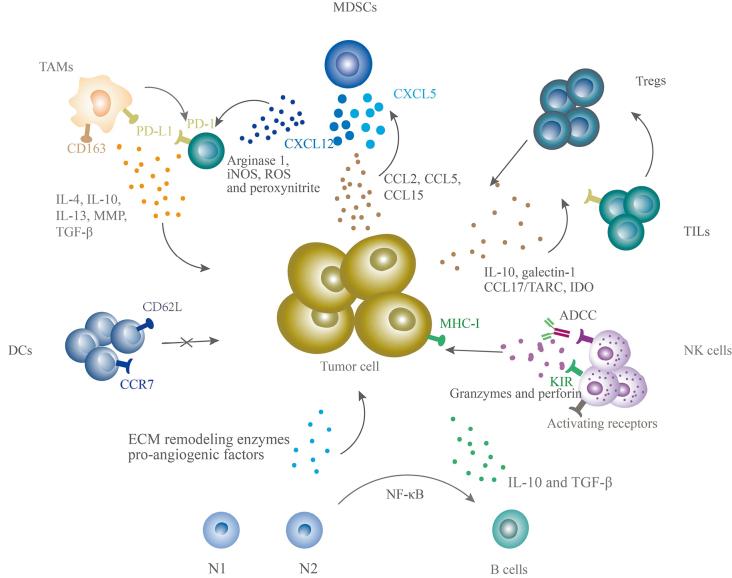
B-cell lymphoma is a group of hematological malignancies characterized by variable genetic and biological features and clinical behaviors. The tumor microenvironment (TME) is a complex network in tumors, which consists of surrounding blood vessels, extracellular matrix, immune and non-immune cells, and signaling molecules. Increasing evidence has shown that the TME, especially immune cells within, is a double-edged sword, acting either as a tumor killer or as a promoter of tumor progression. These pro-tumor activities are driven by subpopulations of immune cells that express typical markers but have unique transcriptional characteristics, making tumor-associated immune cells good targets for human anti-cancer therapy by ablating immunosuppressive cells or enhancing immune-activated cells. Thus, exploring the role of immune cells in the TME provides distinct insights for immunotherapy in B-cell lymphoma. In this review, we elucidated the interaction between immune cells and tumor cells and their function in the initiation, progression, and prognosis of B-cell lymphoma, from preclinical experiments to clinical trials. Furthermore, we outlined potential therapeutic approaches and discussed the potential clinical value and future perspectives of targeting immune cells in patients with B-cell lymphoma.
B 细胞淋巴瘤是一组以不同遗传和生物学特征以及临床行为为特征的血液系统恶性肿瘤。肿瘤微环境(TME)是肿瘤中一个复杂的网络,由周围的血管、细胞外基质、免疫和非免疫细胞以及信号分子组成。越来越多的证据表明,TME,尤其是其中的免疫细胞,是一把双刃剑,既可以作为肿瘤杀伤者,也可以作为肿瘤进展的促进者。这些促肿瘤活性是由表达典型标志物但具有独特转录特征的免疫细胞亚群驱动的,这使得肿瘤相关免疫细胞成为通过消融免疫抑制细胞或增强免疫激活细胞进行人类抗癌治疗的良好靶点。因此,探索免疫细胞在 TME 中的作用为 B 细胞淋巴瘤的免疫治疗提供了独特的见解。在这篇综述中,我们从临床前实验到临床试验,阐述了免疫细胞与肿瘤细胞之间的相互作用及其在 B 细胞淋巴瘤的发生、进展和预后中的作用。此外,我们概述了潜在的治疗方法,并讨论了针对 B 细胞淋巴瘤患者的免疫细胞进行靶向治疗的潜在临床价值和未来展望。

 Zotero 插件