
因呼吸衰竭而行气管切开术与住院患者的高死亡率相关:这是重新考虑治疗目标的一个潜在触发因素。
Tracheostomies for respiratory failure are associated with a high inpatient mortality: a potential trigger to reconsider goals of care.
作者信息
Colbert Cameron, Streblow Aaron D, Sherry Scott P, Dobbertin Konrad, Cook Mackenzie
机构信息
Department of Surgery, Oregon Health & Science University, Portland, Oregon, USA.
出版信息
Trauma Surg Acute Care Open. 2024 Jan 10;9(1):e001105. doi: 10.1136/tsaco-2023-001105. eCollection 2024.
INTRODUCTION
Acute care surgeons are frequently consulted for tracheostomy placement in the intensive care unit (ICU). Tracheostomy may facilitate ventilator weaning and improve physical comfort. Short-term outcomes after tracheostomy are not well studied. We hypothesize that a high proportion of ICU patients who underwent tracheostomy died prior to discharge. These data will help guide clinical decision-making at a key pivot point in care.
METHODS
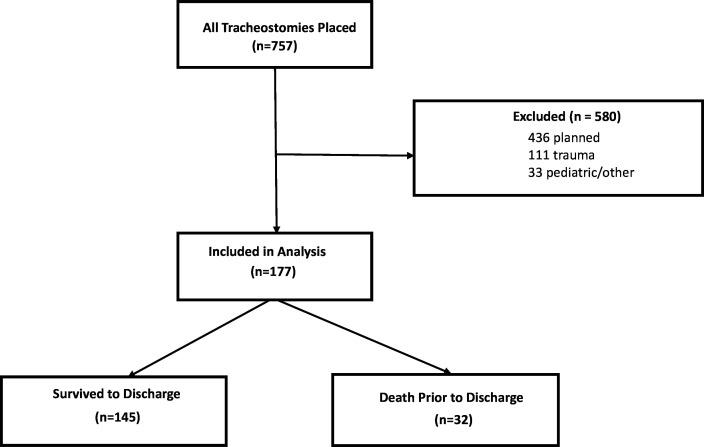
We identified 177 mixed ICU patients who received a tracheostomy for respiratory failure between January 2013 and December 2018. We excluded patients with trauma. Patient information was collected and comparisons made with univariable and multivariable statistics.
RESULTS
Of the 177 patients who underwent a tracheostomy for respiratory failure, 45% were women, median age was 63 (51-71) years. Of this group 18% died prior to discharge, 63% were discharged to a care facility and only 16% discharged home. Compared with survivors, patients with tracheostomies who died during their admission were older, age 69 (64-76) versus 61 (49-71) years (p<0.01) on univariable analysis. In this model, no single comorbid condition or length of stay (LOS) variable was predictive of death before discharge. A multivariable model controlling for covariation similarly identified age, as well as a longer ICU LOS of 34 (20-49) versus 23 (16-31) days (p=0.003) as factors associated with increased likelihood of death before discharge.
CONCLUSIONS
Tracheostomy placement in a mixed ICU population is associated with a nearly 20% inpatient mortality and the vast majority of surviving patients were discharged to a care facility. This suggests that the need for tracheostomy could be considered a trigger for re-evaluation of patient goals. The high risk of death due to underlying illness and high intensity care after their hospitalization emphasize the need for clear advanced care planning discussions around the time of tracheostomy placement.
LEVEL OF EVIDENCE
Level IV, Retrospective cohort study.
引言
重症监护病房(ICU)中的急性病外科医生经常会被咨询有关气管切开术的问题。气管切开术有助于撤机并提高身体舒适度。气管切开术后的短期预后尚未得到充分研究。我们假设,接受气管切开术的ICU患者中有很大一部分在出院前死亡。这些数据将有助于在护理的关键转折点指导临床决策。
方法
我们确定了2013年1月至2018年12月期间因呼吸衰竭接受气管切开术的177例综合性ICU患者。我们排除了创伤患者。收集患者信息并进行单变量和多变量统计比较。
结果
在177例因呼吸衰竭接受气管切开术的患者中,45%为女性,中位年龄为63(51-71)岁。该组中18%在出院前死亡,63%出院后前往护理机构,只有16%回家。单变量分析显示,与幸存者相比,住院期间死亡的气管切开术患者年龄更大,分别为69(64-76)岁和61(49-71)岁(p<0.01)。在该模型中,没有单一的合并症或住院时间(LOS)变量可预测出院前死亡。控制协变量的多变量模型同样确定年龄以及较长的ICU住院时间,分别为34(20-49)天和23(16-31)天(p=0.003)是与出院前死亡可能性增加相关的因素。
结论
综合性ICU患者进行气管切开术的住院死亡率接近20%,绝大多数存活患者出院后前往护理机构。这表明气管切开术的需求可被视为重新评估患者目标的触发因素。潜在疾病导致的高死亡风险以及住院后的高强度护理强调了在气管切开术时进行明确的高级护理计划讨论的必要性。
证据水平
IV级,回顾性队列研究。
 Zotero 插件