Posta Edit, Fekete Istvan, Gyarmati Eva, Stündl László, Zold Eva, Barta Zsolt
GI Unit, Department of Infectology, Faculty of Medicine, University of Debrecen, Bartok Bela Street 2-26, 4031 Debrecen, Hungary.
Institute of Food Technology, Faculty of Agricultural and Food Sciences and Environmental Management, University of Debrecen, Böszörményi út 138, 4032 Debrecen, Hungary.
Life (Basel). 2023 Dec 20;14(1):10. doi: 10.3390/life14010010.
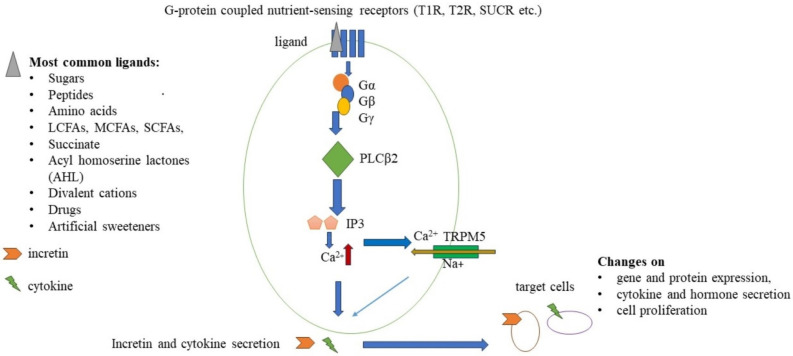
The consumption of artificial and low-calorie sweeteners (ASs, LCSs) is an important component of the Western diet. ASs play a role in the pathogenesis of metabolic syndrome, dysbiosis, inflammatory bowel diseases (IBDs), and various inflammatory conditions. Intestinal nutrient-sensing receptors act as a crosstalk between dietary components, the gut microbiota, and the regulation of immune, endocrinological, and neurological responses. This narrative review aimed to summarize the possible effects of ASs and LCSs on intestinal nutrient-sensing receptors and their related functions. Based on the findings of various studies, long-term AS consumption has effects on the gut microbiota and intestinal nutrient-sensing receptors in modulating incretin hormones, antimicrobial peptides, and cytokine secretion. These effects contribute to the regulation of glucose metabolism, ion transport, gut permeability, and inflammation and modulate the gut-brain, and gut-kidney axes. Based on the conflicting findings of several in vitro, in vivo, and randomized and controlled studies, artificial sweeteners may have a role in the pathogenesis of IBDs, functional bowel diseases, metabolic syndrome, and cancers via the modulation of nutrient-sensing receptors. Further studies are needed to explore the exact mechanisms underlying their effects to decide the risk/benefit ratio of sugar intake reduction via AS and LCS consumption.
人工甜味剂和低热量甜味剂(ASs,LCSs)的消费是西方饮食的一个重要组成部分。ASs在代谢综合征、肠道菌群失调、炎症性肠病(IBDs)以及各种炎症性疾病的发病机制中发挥作用。肠道营养感应受体在饮食成分、肠道微生物群以及免疫、内分泌和神经反应调节之间起到相互作用。本叙述性综述旨在总结ASs和LCSs对肠道营养感应受体及其相关功能的可能影响。基于各种研究结果,长期食用ASs会对肠道微生物群和肠道营养感应受体产生影响,从而调节肠促胰岛素激素、抗菌肽和细胞因子的分泌。这些影响有助于调节葡萄糖代谢、离子转运、肠道通透性和炎症,并调节肠-脑轴和肠-肾轴。基于一些体外、体内以及随机对照研究的相互矛盾的结果,人工甜味剂可能通过调节营养感应受体在IBDs、功能性肠病、代谢综合征和癌症的发病机制中发挥作用。需要进一步研究以探索其作用的确切机制,从而确定通过食用ASs和LCSs减少糖摄入量的风险/效益比。