
在采用生酮饮食的瘦体重高反应者中,奥利奥饼干疗法降低低密度脂蛋白胆固醇的效果优于高强度他汀类药物治疗:一项奇特的交叉实验。
Oreo Cookie Treatment Lowers LDL Cholesterol More Than High-Intensity Statin therapy in a Lean Mass Hyper-Responder on a Ketogenic Diet: A Curious Crossover Experiment.
作者信息
Norwitz Nicholas G, Cromwell William C
机构信息
Harvard Medical School, Boston, MA 02115, USA.
Lipoprotein and Metabolic Disorders Institute, Raleigh, NC 27615, USA.
出版信息
Metabolites. 2024 Jan 22;14(1):73. doi: 10.3390/metabo14010073.
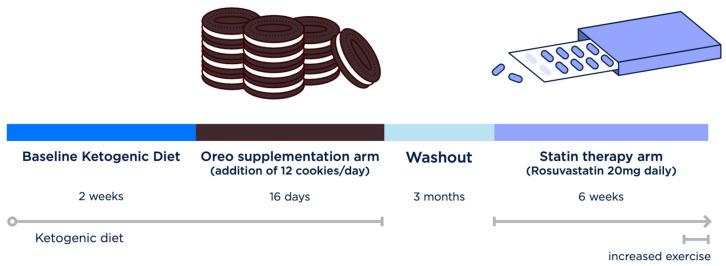
Recent research has identified a unique population of 'Lean Mass Hyper-Responders' (LMHR) who exhibit increases in LDL cholesterol (LDL-C) in response to carbohydrate-restricted diets to levels ≥ 200 mg/dL, in association with HDL cholesterol ≥ 80 mg/dL and triglycerides ≤ 70 mg/dL. This triad of markers occurs primarily in lean metabolically healthy subjects, with the magnitude of increase in LDL-C inversely associated with body mass index. The lipid energy model has been proposed as one explanation for LMHR phenotype and posits that there is increased export and subsequent turnover of VLDL to LDL particles to meet systemic energy needs in the setting of hepatic glycogen depletion and low body fat. This single subject crossover experiment aimed to test the hypothesis that adding carbohydrates, in the form of Oreo cookies, to an LMHR subject on a ketogenic diet would reduce LDL-C levels by a similar, or greater, magnitude than high-intensity statin therapy. The study was designed as follows: after a 2-week run-in period on a standardized ketogenic diet, study arm 1 consisted of supplementation with 12 regular Oreo cookies, providing 100 g/d of additional carbohydrates for 16 days. Throughout this arm, ketosis was monitored and maintained at levels similar to the subject's standard ketogenic diet using supplemental exogenous d-β-hydroxybutyrate supplementation four times daily. Following the discontinuation of Oreo supplementation, the subject maintained a stable ketogenic diet for 3 months and documented a return to baseline weight and hypercholesterolemic status. During study arm 2, the subject received rosuvastatin 20 mg daily for 6 weeks. Lipid panels were drawn water-only fasted and weekly throughout the study. Baseline LDL-C was 384 mg/dL and reduced to 111 mg/dL (71% reduction) after Oreo supplementation. Following the washout period, LDL-C returned to 421 mg/dL, and was reduced to a nadir of 284 mg/dL with 20 mg rosuvastatin therapy (32.5% reduction). In conclusion, in this case study experiment, short-term Oreo supplementation lowered LDL-C more than 6 weeks of high-intensity statin therapy in an LMHR subject on a ketogenic diet. This dramatic metabolic demonstration, consistent with the lipid energy model, should provoke further research and not be seen as health advice.
最近的研究发现了一类独特的“瘦体重高反应者”(LMHR)群体,他们在采用碳水化合物限制饮食后,低密度脂蛋白胆固醇(LDL-C)水平会升高至≥200mg/dL,同时高密度脂蛋白胆固醇≥80mg/dL且甘油三酯≤70mg/dL。这三项指标主要出现在代谢健康的瘦人身上,LDL-C升高的幅度与体重指数呈负相关。脂质能量模型被提出作为对LMHR表型的一种解释,该模型认为在肝糖原耗竭和体脂较低的情况下,极低密度脂蛋白(VLDL)向LDL颗粒的输出及随后的周转增加,以满足全身能量需求。这项单受试者交叉实验旨在检验以下假设:在采用生酮饮食的LMHR受试者中,添加奥利奥饼干形式的碳水化合物,降低LDL-C水平的幅度与高强度他汀类药物治疗相似或更大。该研究设计如下:在标准化生酮饮食的2周导入期后,研究组1包括补充12块普通奥利奥饼干,连续16天每天额外提供100g碳水化合物。在整个研究组中,通过每天四次补充外源性d-β-羟基丁酸来监测并维持酮症水平,使其与受试者的标准生酮饮食水平相似。停止补充奥利奥饼干后,该受试者维持稳定的生酮饮食3个月,并记录到体重和高胆固醇血症状态恢复至基线水平。在研究组2期间,该受试者每天服用20mg瑞舒伐他汀,持续6周。在整个研究过程中,均在仅饮水禁食的状态下每周采集血脂指标。基线LDL-C为384mg/dL,补充奥利奥饼干后降至111mg/dL(降低71%)。在洗脱期后,LDL-C恢复至421mg/dL,采用20mg瑞舒伐他汀治疗后降至最低点284mg/dL(降低32.5%)。总之,在本案例研究实验中,短期补充奥利奥饼干比在采用生酮饮食的LMHR受试者中进行6周的高强度他汀类药物治疗能更有效地降低LDL-C水平。这一显著的代谢表现与脂质能量模型一致,应引发进一步研究,且不应被视为健康建议。

 Zotero 插件