Laboratory for Experimental Immunology of the Eye, Department of Ophthalmology, Faculty of Medicine and University Hospital Cologne, University of Cologne, Cologne, Germany.
Center for Molecular Medicine Cologne (CMMC), University of Cologne, Cologne, Germany.
Front Immunol. 2024 Jan 15;14:1345382. doi: 10.3389/fimmu.2023.1345382. eCollection 2023.
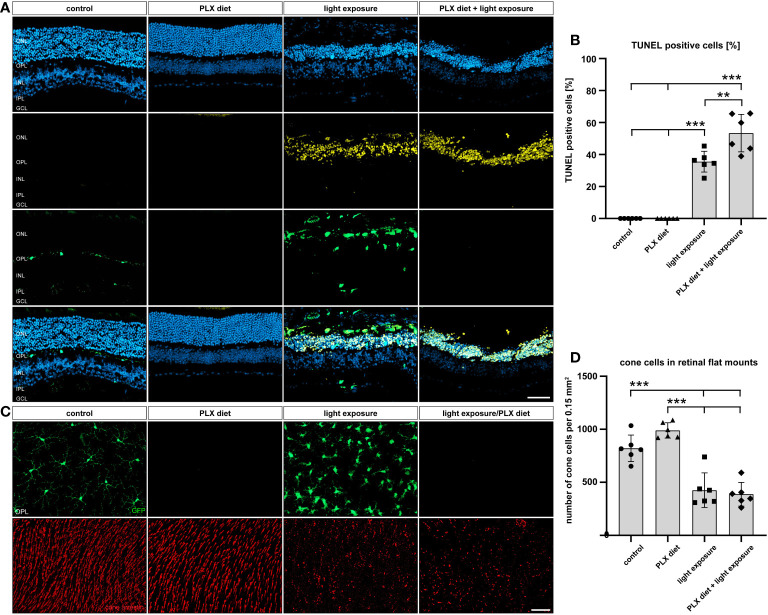
Reactive microglia are a hallmark of age-related retinal degenerative diseases including age-related macular degeneration (AMD). These cells are capable of secreting neurotoxic substances that may aggravate inflammation that leads to loss of photoreceptors and impaired vision. Despite their role in driving detrimental inflammation, microglia also play supporting roles in the retina as they are a crucial cellular component of the regulatory innate immune system. In this study, we used the colony stimulating factor 1 receptor (CSF1R)-antagonist PLX3397 to investigate the effects of microglia depletion and repopulation in a mouse model of acute retinal degeneration that mimics some aspects of dry AMD. Our main goal was to investigate whether microglia depletion and repopulation affects the outcome of light-induced retinal degeneration. We found that microglia depletion effectively decreased the expression of several key pro-inflammatory factors but was unable to influence the extent of retinal degeneration as determined by optical coherence tomography (OCT) and histology. Interestingly, we found prominent cell debris accumulation in the outer retina under conditions of microglia depletion, presumably due to the lack of efficient phagocytosis that could not be compensated by the retinal pigment epithelium. Moreover, our experiments showed that renewal of retinal microglia by repopulation did also not prevent rapid microglia activation or preserve photoreceptor death under conditions of light damage. We conclude that microglia ablation strongly reduces the expression of pro-inflammatory factors but cannot prevent photoreceptor loss in the light-damage paradigm of retinal degeneration.
反应性小胶质细胞是与年龄相关的视网膜退行性疾病的标志,包括年龄相关性黄斑变性(AMD)。这些细胞能够分泌神经毒性物质,可能加重导致光感受器丧失和视力受损的炎症。尽管它们在驱动有害炎症中起作用,但小胶质细胞在视网膜中也起着支持作用,因为它们是调节固有免疫系统的关键细胞成分。在这项研究中,我们使用集落刺激因子 1 受体(CSF1R)拮抗剂 PLX3397 来研究在模拟干性 AMD 某些方面的急性视网膜变性小鼠模型中小胶质细胞耗竭和再填充的影响。我们的主要目标是研究小胶质细胞耗竭和再填充是否会影响光诱导的视网膜变性的结果。我们发现小胶质细胞耗竭有效地降低了几种关键促炎因子的表达,但无法通过光学相干断层扫描(OCT)和组织学来影响视网膜变性的程度。有趣的是,我们发现在外层视网膜中存在明显的细胞碎片堆积,这可能是由于缺乏有效的吞噬作用,而这种吞噬作用无法通过视网膜色素上皮来补偿。此外,我们的实验表明,通过再填充来更新视网膜小胶质细胞也不能防止光损伤条件下小胶质细胞的快速激活或保护光感受器的死亡。我们得出结论,小胶质细胞消融强烈降低了促炎因子的表达,但不能防止光损伤性视网膜变性模型中光感受器的丧失。