
使用深度学习诊断口腔颌面疾病。
Diagnosing oral and maxillofacial diseases using deep learning.
机构信息
HYPERCloud, Seoul, 06038, Korea.
Faculty of Odonto-Stomatology, Hue University of Medicine and Pharmacy, Hue University, Hue, 49120, Vietnam.
出版信息
Sci Rep. 2024 Jan 30;14(1):2497. doi: 10.1038/s41598-024-52929-0.
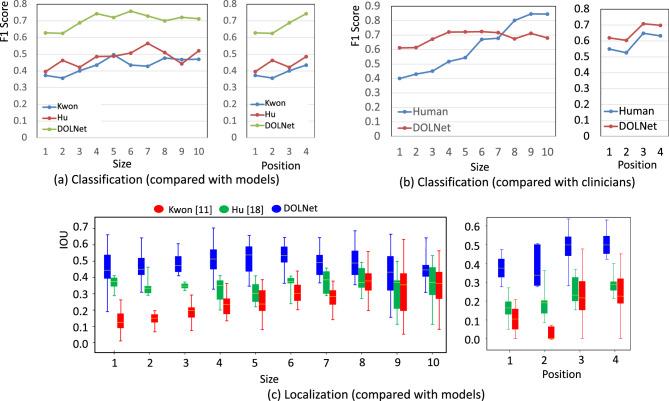
The classification and localization of odontogenic lesions from panoramic radiographs is a challenging task due to the positional biases and class imbalances of the lesions. To address these challenges, a novel neural network, DOLNet, is proposed that uses mutually influencing hierarchical attention across different image scales to jointly learn the global representation of the entire jaw and the local discrepancy between normal tissue and lesions. The proposed approach uses local attention to learn representations within a patch. From the patch-level representations, we generate inter-patch, i.e., global, attention maps to represent the positional prior of lesions in the whole image. Global attention enables the reciprocal calibration of path-level representations by considering non-local information from other patches, thereby improving the generation of whole-image-level representation. To address class imbalances, we propose an effective data augmentation technique that involves merging lesion crops with normal images, thereby synthesizing new abnormal cases for effective model training. Our approach outperforms recent studies, enhancing the classification performance by up to 42.4% and 44.2% in recall and F1 scores, respectively, and ensuring robust lesion localization with respect to lesion size variations and positional biases. Our approach further outperforms human expert clinicians in classification by 10.7 % and 10.8 % in recall and F1 score, respectively.
从全景 X 光片中对牙源性病变进行分类和定位是一项具有挑战性的任务,这是由于病变的位置偏差和类别不平衡。为了解决这些挑战,提出了一种新的神经网络 DOLNet,它使用跨不同图像尺度相互影响的分层注意力,共同学习整个颌骨的全局表示以及正常组织和病变之间的局部差异。所提出的方法使用局部注意力在一个补丁内学习表示。从补丁级别的表示中,我们生成补丁间的注意力图,即全局注意力图,以表示整个图像中病变的位置先验。全局注意力通过考虑来自其他补丁的非局部信息来实现路径级表示的相互校准,从而提高整个图像级表示的生成。为了解决类别不平衡问题,我们提出了一种有效的数据增强技术,涉及将病变裁剪与正常图像合并,从而为有效模型训练合成新的异常病例。我们的方法优于最近的研究,在召回率和 F1 得分方面分别提高了 42.4%和 44.2%,并且确保了对病变大小变化和位置偏差的稳健病变定位。我们的方法在分类方面进一步优于人类专家临床医生,召回率和 F1 得分分别提高了 10.7%和 10.8%。


 Zotero 插件