• 文献检索
  • 文档翻译
  • 深度研究
  • 学术资讯
  • Suppr Zotero 插件Zotero 插件
  • 邀请有礼
  • 套餐&价格
  • 历史记录
应用&插件
Suppr Zotero 插件Zotero 插件浏览器插件Mac 客户端Windows 客户端微信小程序
定价
高级版会员购买积分包购买API积分包
服务
文献检索文档翻译深度研究API 文档MCP 服务
关于我们
关于 Suppr公司介绍联系我们用户协议隐私条款
关注我们

Suppr 超能文献

核心技术专利:CN118964589B侵权必究
粤ICP备2023148730 号-1Suppr @ 2026

文献检索

告别复杂PubMed语法,用中文像聊天一样搜索,搜遍4000万医学文献。AI智能推荐,让科研检索更轻松。

立即免费搜索

文件翻译

保留排版,准确专业,支持PDF/Word/PPT等文件格式,支持 12+语言互译。

免费翻译文档

深度研究

AI帮你快速写综述,25分钟生成高质量综述,智能提取关键信息,辅助科研写作。

立即免费体验

用于计算组织病理学的深度神经网络模型:一项综述。

Deep neural network models for computational histopathology: A survey.

作者信息

Srinidhi Chetan L, Ciga Ozan, Martel Anne L

机构信息

Physical Sciences, Sunnybrook Research Institute, Toronto, Canada; Department of Medical Biophysics, University of Toronto, Canada.

Department of Medical Biophysics, University of Toronto, Canada.

出版信息

Med Image Anal. 2021 Jan;67:101813. doi: 10.1016/j.media.2020.101813. Epub 2020 Sep 25.

DOI:10.1016/j.media.2020.101813
PMID:33049577
原文链接:https://pmc.ncbi.nlm.nih.gov/articles/PMC7725956/
Abstract

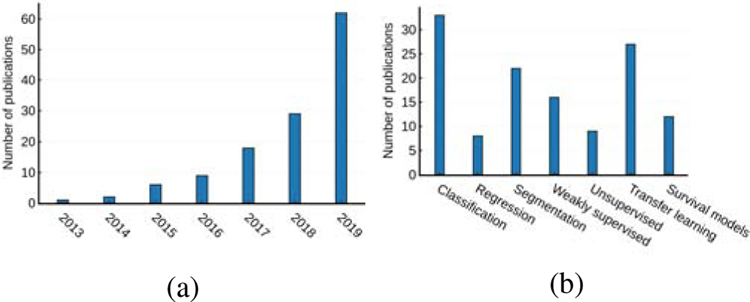
Histopathological images contain rich phenotypic information that can be used to monitor underlying mechanisms contributing to disease progression and patient survival outcomes. Recently, deep learning has become the mainstream methodological choice for analyzing and interpreting histology images. In this paper, we present a comprehensive review of state-of-the-art deep learning approaches that have been used in the context of histopathological image analysis. From the survey of over 130 papers, we review the field's progress based on the methodological aspect of different machine learning strategies such as supervised, weakly supervised, unsupervised, transfer learning and various other sub-variants of these methods. We also provide an overview of deep learning based survival models that are applicable for disease-specific prognosis tasks. Finally, we summarize several existing open datasets and highlight critical challenges and limitations with current deep learning approaches, along with possible avenues for future research.

摘要

组织病理学图像包含丰富的表型信息,可用于监测导致疾病进展和患者生存结果的潜在机制。最近,深度学习已成为分析和解释组织学图像的主流方法选择。在本文中,我们对在组织病理学图像分析背景下使用的最新深度学习方法进行了全面综述。通过对130多篇论文的调研,我们基于不同机器学习策略(如监督学习、弱监督学习、无监督学习、迁移学习以及这些方法的各种其他子变体)的方法学方面来回顾该领域的进展。我们还概述了适用于特定疾病预后任务的基于深度学习的生存模型。最后,我们总结了几个现有的开放数据集,强调了当前深度学习方法面临的关键挑战和局限性,以及未来研究可能的途径。
https://cdn.ncbi.nlm.nih.gov/pmc/blobs/0790/7725956/cb6ee428ff1c/nihms-1632959-f0005.jpg
https://cdn.ncbi.nlm.nih.gov/pmc/blobs/0790/7725956/88ffb2dba947/nihms-1632959-f0001.jpg
https://cdn.ncbi.nlm.nih.gov/pmc/blobs/0790/7725956/509447722f1f/nihms-1632959-f0002.jpg
https://cdn.ncbi.nlm.nih.gov/pmc/blobs/0790/7725956/ab81f0bbf54f/nihms-1632959-f0003.jpg
https://cdn.ncbi.nlm.nih.gov/pmc/blobs/0790/7725956/5e8711c26a78/nihms-1632959-f0004.jpg
https://cdn.ncbi.nlm.nih.gov/pmc/blobs/0790/7725956/cb6ee428ff1c/nihms-1632959-f0005.jpg
https://cdn.ncbi.nlm.nih.gov/pmc/blobs/0790/7725956/88ffb2dba947/nihms-1632959-f0001.jpg
https://cdn.ncbi.nlm.nih.gov/pmc/blobs/0790/7725956/509447722f1f/nihms-1632959-f0002.jpg
https://cdn.ncbi.nlm.nih.gov/pmc/blobs/0790/7725956/ab81f0bbf54f/nihms-1632959-f0003.jpg
https://cdn.ncbi.nlm.nih.gov/pmc/blobs/0790/7725956/5e8711c26a78/nihms-1632959-f0004.jpg
https://cdn.ncbi.nlm.nih.gov/pmc/blobs/0790/7725956/cb6ee428ff1c/nihms-1632959-f0005.jpg

相似文献

1
Deep neural network models for computational histopathology: A survey.用于计算组织病理学的深度神经网络模型:一项综述。
Med Image Anal. 2021 Jan;67:101813. doi: 10.1016/j.media.2020.101813. Epub 2020 Sep 25.
2
Towards label-efficient automatic diagnosis and analysis: a comprehensive survey of advanced deep learning-based weakly-supervised, semi-supervised and self-supervised techniques in histopathological image analysis.迈向标签高效的自动诊断和分析:对基于深度学习的高级弱监督、半监督和自监督技术在组织病理学图像分析中的综合调查。
Phys Med Biol. 2022 Oct 14;67(20). doi: 10.1088/1361-6560/ac910a.
3
ChampKit: A framework for rapid evaluation of deep neural networks for patch-based histopathology classification.ChampKit:一种基于补丁的组织病理学分类的深度神经网络快速评估框架。
Comput Methods Programs Biomed. 2023 Sep;239:107631. doi: 10.1016/j.cmpb.2023.107631. Epub 2023 May 30.
4
A survey on deep learning in medical image analysis.深度学习在医学图像分析中的应用研究综述。
Med Image Anal. 2017 Dec;42:60-88. doi: 10.1016/j.media.2017.07.005. Epub 2017 Jul 26.
5
Clinical applications of graph neural networks in computational histopathology: A review.图神经网络在计算组织病理学中的临床应用:综述
Comput Biol Med. 2023 Sep;164:107201. doi: 10.1016/j.compbiomed.2023.107201. Epub 2023 Jun 30.
6
Semi-supervised training of deep convolutional neural networks with heterogeneous data and few local annotations: An experiment on prostate histopathology image classification.基于异构数据和少量局部标注的深度卷积神经网络的半监督学习:前列腺组织病理学图像分类实验。
Med Image Anal. 2021 Oct;73:102165. doi: 10.1016/j.media.2021.102165. Epub 2021 Jul 14.
7
Recent developments in denoising medical images using deep learning: An overview of models, techniques, and challenges.基于深度学习的医学图像去噪技术的最新进展:模型、技术及挑战综述。
Micron. 2024 May;180:103615. doi: 10.1016/j.micron.2024.103615. Epub 2024 Mar 2.
8
Deep learning approaches for breast cancer detection in histopathology images: A review.深度学习方法在组织病理学图像乳腺癌检测中的应用:综述。
Cancer Biomark. 2024;40(1):1-25. doi: 10.3233/CBM-230251.
9
Predicting cancer outcomes from histology and genomics using convolutional networks.使用卷积网络从组织学和基因组学预测癌症结局。
Proc Natl Acad Sci U S A. 2018 Mar 27;115(13):E2970-E2979. doi: 10.1073/pnas.1717139115. Epub 2018 Mar 12.
10
Deep computational pathology in breast cancer.深度学习在乳腺癌中的应用。
Semin Cancer Biol. 2021 Jul;72:226-237. doi: 10.1016/j.semcancer.2020.08.006. Epub 2020 Aug 17.

引用本文的文献

1
A generalizable pathology foundation model using a unified knowledge distillation pretraining framework.一种使用统一知识蒸馏预训练框架的可推广病理学基础模型。
Nat Biomed Eng. 2025 Sep 2. doi: 10.1038/s41551-025-01488-4.
2
Continuous Monitoring with AI-Enhanced BioMEMS Sensors: A Focus on Sustainable Energy Harvesting and Predictive Analytics.使用人工智能增强型生物微机电系统传感器进行连续监测:聚焦可持续能量收集与预测分析。
Micromachines (Basel). 2025 Jul 31;16(8):902. doi: 10.3390/mi16080902.
3
OKEN: A Supervised Evolutionary Optimizable Dimensionality Reduction Framework for Whole Slide Image Classification.

本文引用的文献

1
Stop Explaining Black Box Machine Learning Models for High Stakes Decisions and Use Interpretable Models Instead.停止为高风险决策解释黑箱机器学习模型,转而使用可解释模型。
Nat Mach Intell. 2019 May;1(5):206-215. doi: 10.1038/s42256-019-0048-x. Epub 2019 May 13.
2
Robust Histopathology Image Analysis: to Label or to Synthesize?强大的组织病理学图像分析:标记还是合成?
Proc IEEE Comput Soc Conf Comput Vis Pattern Recognit. 2019 Jun;2019:8533-8542. doi: 10.1109/CVPR.2019.00873. Epub 2020 Jan 9.
3
Deep Multi-Magnification Networks for multi-class breast cancer image segmentation.
OKEN:用于全切片图像分类的监督式进化可优化降维框架。
Bioengineering (Basel). 2025 Jul 4;12(7):733. doi: 10.3390/bioengineering12070733.
4
Re-identification of patients from imaging features extracted by foundation models.通过基础模型提取的影像特征对患者进行重新识别。
NPJ Digit Med. 2025 Jul 22;8(1):469. doi: 10.1038/s41746-025-01801-0.
5
Advancing open-source visual analytics in digital pathology: A systematic review of tools, trends, and clinical applications.推进数字病理学中的开源视觉分析:对工具、趋势和临床应用的系统评价。
J Pathol Inform. 2025 May 23;18:100454. doi: 10.1016/j.jpi.2025.100454. eCollection 2025 Aug.
6
Risk Classification of Low-Resolution Whole-Slide Thumbnail Images by Multi-dimensional Feature Reconstruction with Multi-task Deep Learning Network Helps Prioritize Pathology Case Registration.通过多任务深度学习网络进行多维特征重建对低分辨率全切片缩略图图像进行风险分类有助于对病理病例登记进行优先级排序。
J Imaging Inform Med. 2025 Jun 25. doi: 10.1007/s10278-025-01582-8.
7
Predicting estrogen receptor status from HE-stained breast cancer slides using artificial intelligence.利用人工智能从苏木精-伊红染色的乳腺癌切片预测雌激素受体状态。
Front Med (Lausanne). 2025 Jun 9;12:1593143. doi: 10.3389/fmed.2025.1593143. eCollection 2025.
8
Macular pigment optical density and measurement technology based on artificial intelligence: a narrative review.基于人工智能的黄斑色素光密度及测量技术:一篇叙述性综述。
Int J Ophthalmol. 2025 Jun 18;18(6):1152-1162. doi: 10.18240/ijo.2025.06.23. eCollection 2025.
9
Role of artificial intelligence in revolutionizing drug discovery.人工智能在变革药物研发中的作用。
Fundam Res. 2024 May 9;5(3):1273-1287. doi: 10.1016/j.fmre.2024.04.021. eCollection 2025 May.
10
Artificial intelligence in pancreatic cancer histopathology and diagnostics - implications for clinical decisions and biomarker discovery?人工智能在胰腺癌组织病理学与诊断中的应用——对临床决策和生物标志物发现的影响?
Cell Div. 2025 Jun 17;20(1):15. doi: 10.1186/s13008-025-00158-w.
用于多类乳腺癌图像分割的深度多重放大网络。
Comput Med Imaging Graph. 2021 Mar;88:101866. doi: 10.1016/j.compmedimag.2021.101866. Epub 2021 Jan 12.
4
Deep learning-based cross-classifications reveal conserved spatial behaviors within tumor histological images.基于深度学习的跨分类揭示了肿瘤组织学图像中保守的空间行为。
Nat Commun. 2020 Dec 11;11(1):6367. doi: 10.1038/s41467-020-20030-5.
5
Measuring Domain Shift for Deep Learning in Histopathology.深度学习在组织病理学中的领域迁移测量。
IEEE J Biomed Health Inform. 2021 Feb;25(2):325-336. doi: 10.1109/JBHI.2020.3032060. Epub 2021 Feb 5.
6
Weakly supervised instance learning for thyroid malignancy prediction from whole slide cytopathology images.基于全切片细胞病理学图像的甲状腺恶性肿瘤预测的弱监督实例学习
Med Image Anal. 2021 Jan;67:101814. doi: 10.1016/j.media.2020.101814. Epub 2020 Sep 25.
7
Weakly Supervised Deep Nuclei Segmentation Using Partial Points Annotation in Histopathology Images.基于部分点标注的弱监督深度学习细胞核分割方法在病理图像中的应用
IEEE Trans Med Imaging. 2020 Nov;39(11):3655-3666. doi: 10.1109/TMI.2020.3002244. Epub 2020 Oct 28.
8
Dataset of segmented nuclei in hematoxylin and eosin stained histopathology images of ten cancer types.十类癌症的苏木精和伊红染色组织病理学图像分割细胞核数据集。
Sci Data. 2020 Jun 19;7(1):185. doi: 10.1038/s41597-020-0528-1.
9
Artificial intelligence for diagnosis and grading of prostate cancer in biopsies: a population-based, diagnostic study.人工智能在前列腺癌活检中的诊断和分级:一项基于人群的诊断研究。
Lancet Oncol. 2020 Feb;21(2):222-232. doi: 10.1016/S1470-2045(19)30738-7. Epub 2020 Jan 8.
10
Automated deep-learning system for Gleason grading of prostate cancer using biopsies: a diagnostic study.利用活检进行前列腺癌 Gleason 分级的自动化深度学习系统:一项诊断研究。
Lancet Oncol. 2020 Feb;21(2):233-241. doi: 10.1016/S1470-2045(19)30739-9. Epub 2020 Jan 8.