Zhang Yuanjin, Liu Zhonglin, Hirschi Marsha, Brodsky Oleg, Johnson Eric, Won Sang Joon, Nagata Asako, Petroski Matthew D, Majmudar Jaimeen D, Niessen Sherry, VanArsdale Todd, Gilbert Adam M, Hayward Matthew M, Stewart Al E, Nager Andrew R, Melillo Bruno, Cravatt Benjamin
Department of Chemistry, The Scripps Research Institute, La Jolla, CA 92037 USA.
Medicine Design, Pfizer Research and Development, Pfizer Inc., La Jolla, CA 92121, USA.
bioRxiv. 2024 Jan 19:2024.01.18.576274. doi: 10.1101/2024.01.18.576274.
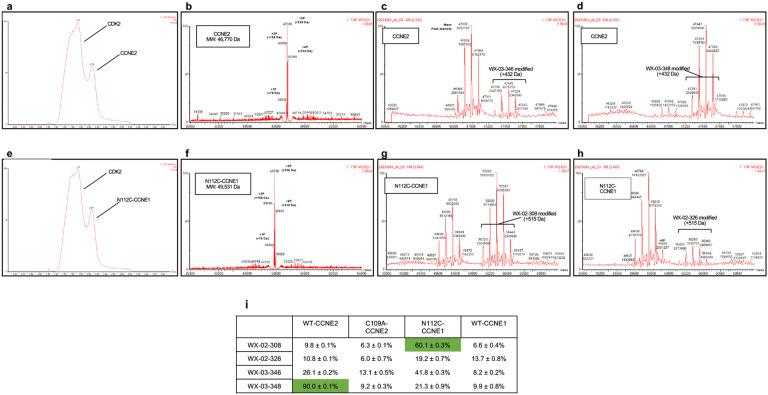
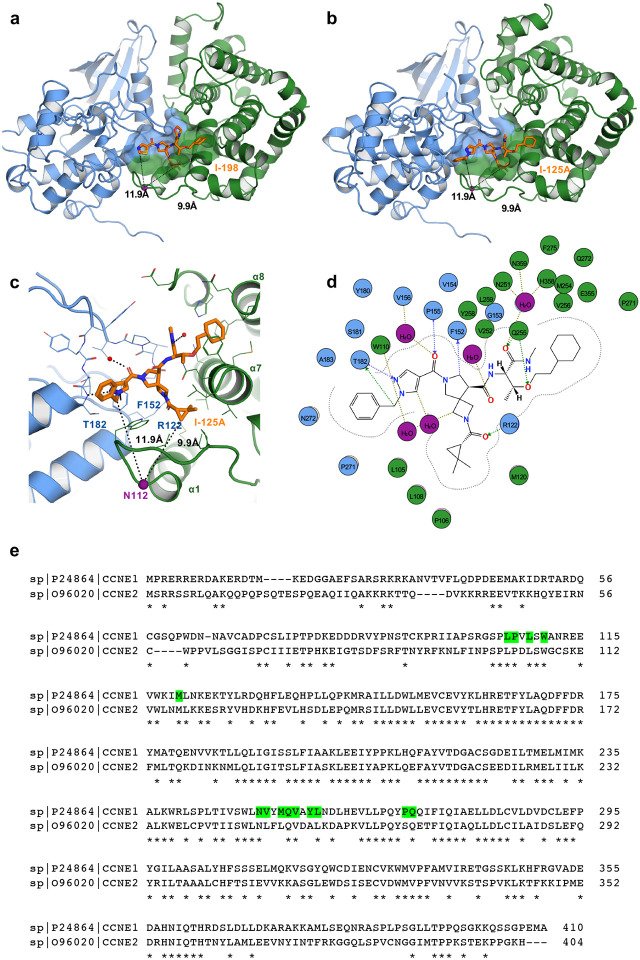
More than half of the ~20,000 protein-encoding human genes have at least one paralog. Chemical proteomics has uncovered many electrophile-sensitive cysteines that are exclusive to a subset of paralogous proteins. Here, we explore whether such covalent compound-cysteine interactions can be used to discover ligandable pockets in paralogs that lack the cysteine. Leveraging the covalent ligandability of C109 in the cyclin CCNE2, we mutated the corresponding residue in paralog CCNE1 to cysteine (N112C) and found through activity-based protein profiling (ABPP) that this mutant reacts stereoselectively and site-specifically with tryptoline acrylamides. We then converted the tryptoline acrylamide-N112C-CCNE1 interaction into a NanoBRET-ABPP assay capable of identifying compounds that reversibly inhibit both N112C- and WT-CCNE1:CDK2 complexes. X-ray crystallography revealed a cryptic allosteric pocket at the CCNE1:CDK2 interface adjacent to N112 that binds the reversible inhibitors. Our findings thus provide a roadmap for leveraging electrophile-cysteine interactions to extend the ligandability of the proteome beyond covalent chemistry.
在约20000个人类蛋白质编码基因中,超过半数都至少有一个旁系同源基因。化学蛋白质组学已发现许多仅存在于旁系同源蛋白质亚群中的亲电敏感半胱氨酸。在此,我们探究此类共价化合物 - 半胱氨酸相互作用是否可用于在缺乏半胱氨酸的旁系同源基因中发现可结合配体的口袋。利用细胞周期蛋白CCNE2中C109的共价可配体性,我们将旁系同源基因CCNE1中的相应残基突变为半胱氨酸(N112C),并通过基于活性的蛋白质谱分析(ABPP)发现该突变体与色胺丙烯酰胺发生立体选择性和位点特异性反应。然后,我们将色胺丙烯酰胺 - N112C - CCNE1相互作用转化为一种能够识别可逆抑制N112C - 和野生型CCNE1:CDK2复合物的化合物的纳米生物发光共振能量转移 - ABPP分析方法。X射线晶体学揭示了在CCNE1:CDK2界面处与N112相邻的一个隐蔽的变构口袋,该口袋可结合可逆抑制剂。因此,我们的研究结果为利用亲电试剂 - 半胱氨酸相互作用将蛋白质组的可配体性扩展到共价化学之外提供了一条路线图。