Department of Respiratory and Critical Care Medicine, the Affiliated Hospital of Qingdao University, Qingdao, China.
Department of Respiratory and Critical Care Medicine, The Affiliated Qingdao Central Hospital of Medical College of Qingdao University, Qingdao, China.
Thorac Cancer. 2024 Mar;15(7):559-569. doi: 10.1111/1759-7714.15225. Epub 2024 Jan 31.
Neutrophil-to-lymphocyte ratio (NLR) and platelet-to-lymphocyte ratio (PLR) are closely related to the prognosis of patients with non-small cell lung cancer, but their effect on extensive-stage small cell lung cancer (ES-SCLC) remains uncertain.
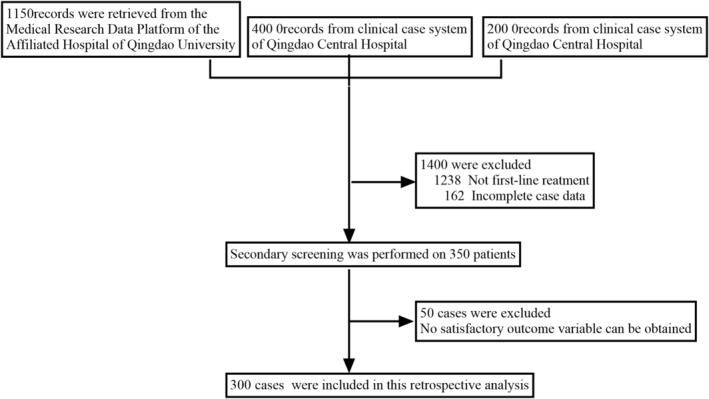
This retrospective study was conducted in ES-SCLC patients treated with first-line atezolizumab or durvalumab and platinum-etoposide. Clinical data from three hospitals were analyzed. Significant risk factors for survival were identified using descriptive statistics and Cox regression. Homogeneity was assessed using t-tests or nonparametric tests. Kaplan-Meier analysis revealed an association between high NLR level and median PFS and OS.
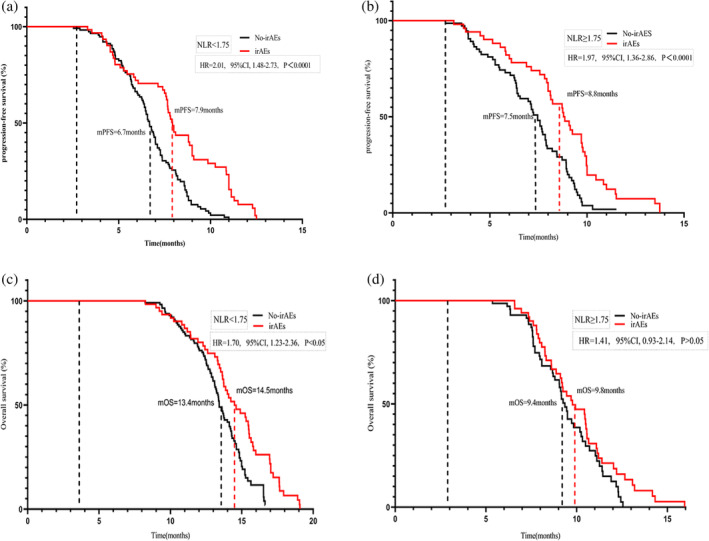
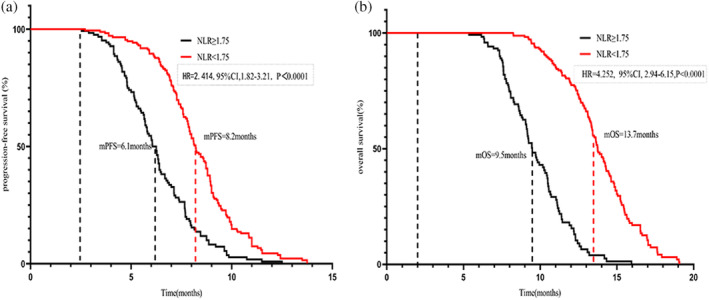
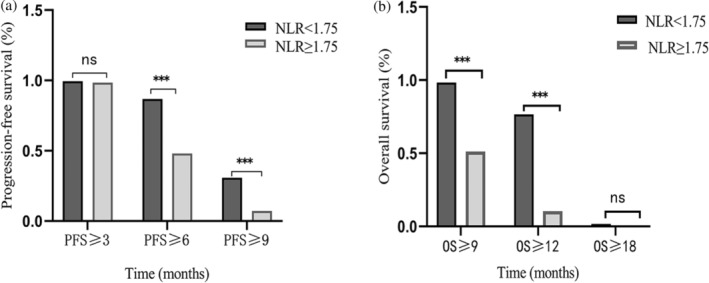
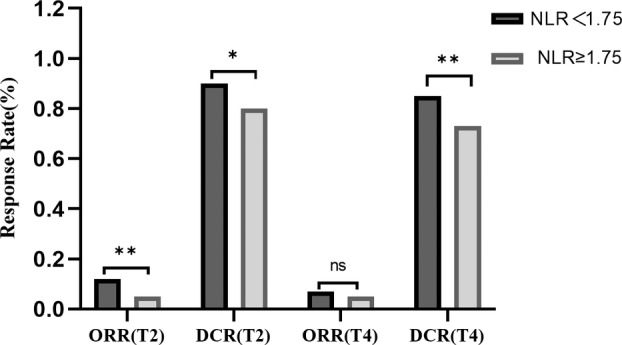
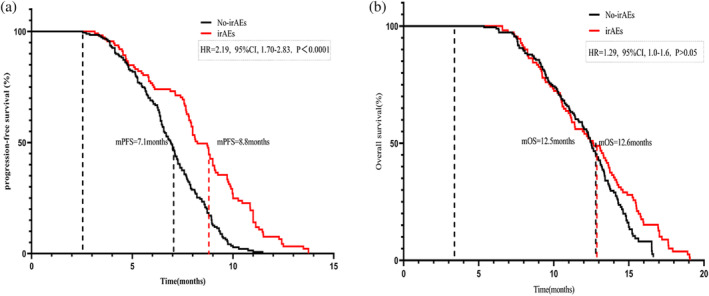
A total of 300 ES-SCLC patients were included in the study. Cox regression analysis revealed that an elevated NLR level after the second treatment cycle (defined as NLRT2) was an independent prognostic factor for survival. Stratifying patients based on median NLRT2 showed significant differences in both PFS (HR: 1.863, 95% CI: 1.62-2.12, p < 0.001) and OS (HR: 2.581, 95% CI: 2.19-3.04, p < 0.001) between NLR ≥ 1.75 and NLR < 1.75 groups. mPFS and mOS were 8.2 versus 6.1 months and 13.7 versus 9.5 months, respectively. NLR was also associated with treatment efficacy and occurrence of irAEs. Further stratification based on NLR and irAEs showed that in the NLR < 1.75 group, patients with irAEs had prolonged mPFS and mOS. In the NLR ≥ 1.75 group, only mPFS showed a significant difference between patients with and without irAEs.
NLRT2 and irAEs can predict the prognosis of ES-SCLC patients with first-line ES-SCLC receiving PD-L1 inhibitors combined with chemotherapy.
中性粒细胞与淋巴细胞比值(NLR)和血小板与淋巴细胞比值(PLR)与非小细胞肺癌患者的预后密切相关,但它们对广泛期小细胞肺癌(ES-SCLC)的影响尚不确定。
本回顾性研究纳入了接受一线阿特珠单抗或度伐利尤单抗联合铂类依托泊苷治疗的 ES-SCLC 患者。对来自 3 家医院的临床数据进行分析。采用描述性统计和 Cox 回归分析确定生存的显著风险因素。采用 t 检验或非参数检验评估同质性。Kaplan-Meier 分析显示 NLR 水平高与中位 PFS 和 OS 相关。
共纳入 300 例 ES-SCLC 患者。Cox 回归分析显示,第 2 个治疗周期后 NLR 升高(定义为 NLRT2)是生存的独立预后因素。基于 NLRT2 中位数对患者进行分层,NLR≥1.75 与 NLR<1.75 组在 PFS(HR:1.863,95%CI:1.62-2.12,p<0.001)和 OS(HR:2.581,95%CI:2.19-3.04,p<0.001)方面均有显著差异。mPFS 和 mOS 分别为 8.2 个月和 6.1 个月,13.7 个月和 9.5 个月。NLR 还与治疗疗效和 irAEs 的发生相关。进一步基于 NLR 和 irAEs 分层显示,在 NLR<1.75 组中,发生 irAEs 的患者 mPFS 和 mOS 延长。在 NLR≥1.75 组中,仅 mPFS 在有和无 irAEs 的患者之间存在显著差异。
NLRT2 和 irAEs 可预测接受 PD-L1 抑制剂联合化疗的一线 ES-SCLC 患者的 ES-SCLC 预后。