Centre de Recherches en Cancérologie de Toulouse, CRCT, Université de Toulouse, Inserm, CNRS, Toulouse, France.
Institut de Génétique Humaine, CNRS, Université de Montpellier, Montpellier, France.
Cancer Res. 2024 Apr 1;84(7):1013-1028. doi: 10.1158/0008-5472.CAN-22-3219.
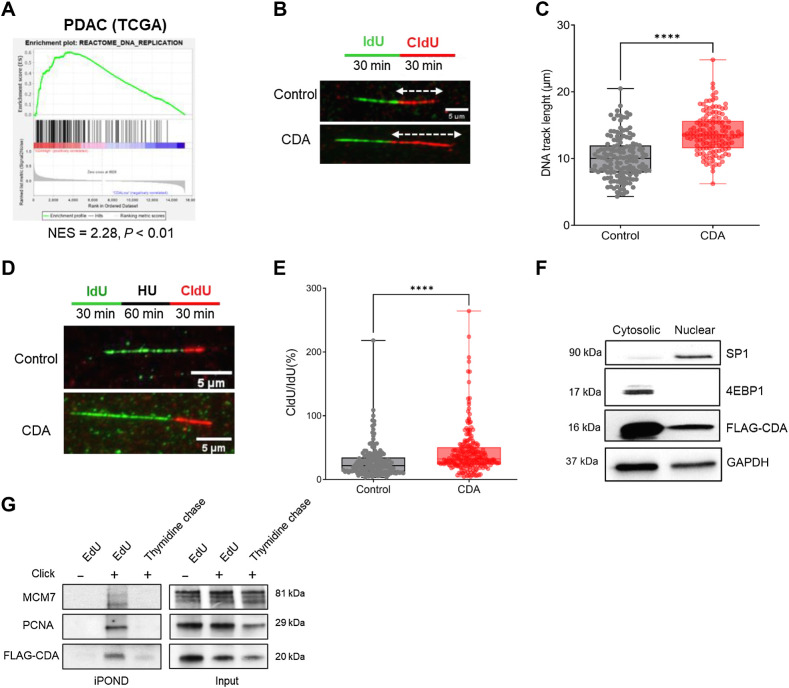
Cytidine deaminase (CDA) functions in the pyrimidine salvage pathway for DNA and RNA syntheses and has been shown to protect cancer cells from deoxycytidine-based chemotherapies. In this study, we observed that CDA was overexpressed in pancreatic adenocarcinoma from patients at baseline and was essential for experimental tumor growth. Mechanistic investigations revealed that CDA localized to replication forks where it increased replication speed, improved replication fork restart efficiency, reduced endogenous replication stress, minimized DNA breaks, and regulated genetic stability during DNA replication. In cellular pancreatic cancer models, high CDA expression correlated with resistance to DNA-damaging agents. Silencing CDA in patient-derived primary cultures in vitro and in orthotopic xenografts in vivo increased replication stress and sensitized pancreatic adenocarcinoma cells to oxaliplatin. This study sheds light on the role of CDA in pancreatic adenocarcinoma, offering insights into how this tumor type modulates replication stress. These findings suggest that CDA expression could potentially predict therapeutic efficacy and that targeting CDA induces intolerable levels of replication stress in cancer cells, particularly when combined with DNA-targeted therapies.
Cytidine deaminase reduces replication stress and regulates DNA replication to confer resistance to DNA-damaging drugs in pancreatic cancer, unveiling a molecular vulnerability that could enhance treatment response.
胞苷脱氨酶(CDA)在 DNA 和 RNA 合成的嘧啶补救途径中发挥作用,并已被证明可以保护癌细胞免受基于脱氧胞苷的化疗药物的侵害。在这项研究中,我们观察到 CDA 在基线时从患者的胰腺腺癌中过表达,并且对实验性肿瘤生长至关重要。机制研究表明,CDA 定位于复制叉,在那里它增加了复制速度,提高了复制叉重新启动效率,降低了内源性复制应激,最小化了 DNA 断裂,并在 DNA 复制过程中调节了遗传稳定性。在细胞胰腺癌细胞模型中,高 CDA 表达与对 DNA 损伤剂的耐药性相关。体外患者来源的原代培养物中和体内原位异种移植中沉默 CDA 会增加复制应激,并使胰腺腺癌细胞对奥沙利铂敏感。这项研究揭示了 CDA 在胰腺腺癌中的作用,深入了解了这种肿瘤类型如何调节复制应激。这些发现表明,CDA 表达可能可以预测治疗效果,并且靶向 CDA 会在癌细胞中引起无法忍受的复制应激水平,特别是与 DNA 靶向治疗联合使用时。
胞苷脱氨酶降低复制应激并调节 DNA 复制,从而赋予胰腺癌细胞对 DNA 损伤药物的耐药性,揭示了一种可能增强治疗反应的分子脆弱性。