Department of Neurosurgery, West China Hospital, Sichuan University, 37 Guoxue Lane, Wuhou District, Chengdu, 610041, Sichuan, China.
Department of Pharmacy, Institute of Metabolic Diseases and Pharmacotherapy, West China Hospital, Sichuan University, 37 Guoxue Lane, Wuhou District, Chengdu, China.
Transl Psychiatry. 2024 Jan 31;14(1):67. doi: 10.1038/s41398-024-02765-7.
The causal effects of gut microbiome and the development of posttraumatic stress disorder (PTSD) are still unknown. This study aimed to clarify their potential causal association using mendelian randomization (MR).
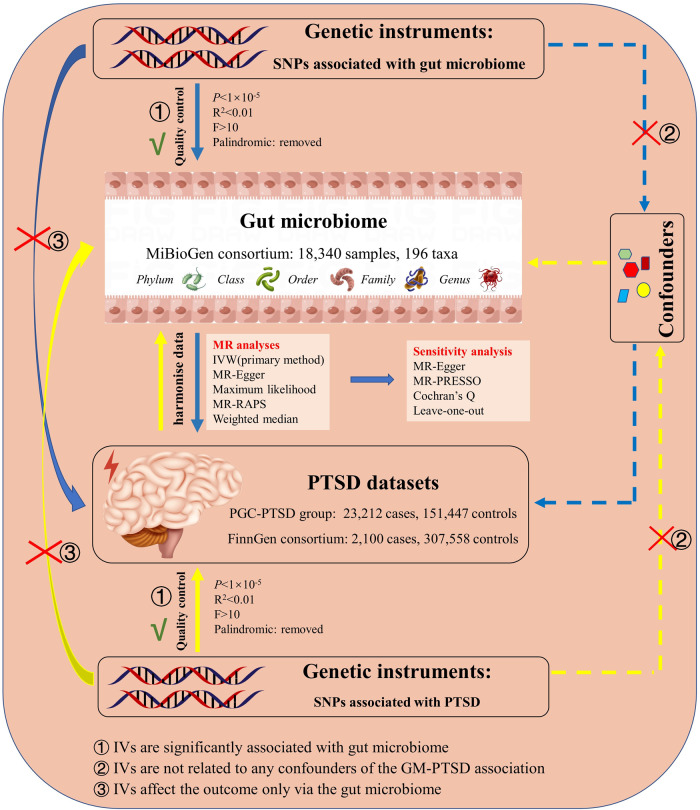
The summary-level statistics for gut microbiome were retrieved from a genome-wide association study (GWAS) of the MiBioGen consortium. As to PTSD, the Freeze 2 datasets were originated from the Psychiatric Genomics Consortium Posttraumatic Stress Disorder Working Group (PGC-PTSD), and the replicated datasets were obtained from FinnGen consortium. Single nucleotide polymorphisms meeting MR assumptions were selected as instrumental variables. The inverse variance weighting (IVW) method was employed as the main approach, supplemented by sensitivity analyses to evaluate potential pleiotropy and heterogeneity and ensure the robustness of the MR results. We also performed reverse MR analyses to explore PTSD's causal effects on the relative abundances of specific features of the gut microbiome.
In Freeze 2 datasets from PGC-PTSD, eight bacterial traits revealed a potential causal association between gut microbiome and PTSD (IVW, all P < 0.05). In addition, Genus.Dorea and genus.Sellimonas were replicated in FinnGen datasets, in which eight bacterial traits revealed a potential causal association between gut microbiome and the occurrence of PTSD. The heterogeneity and pleiotropy analyses further supported the robustness of the IVW findings, providing additional evidence for their reliability.
Our study provides the potential causal impact of gut microbiomes on the development of PTSD, shedding new light on the understanding of the dysfunctional gut-brain axis in this disorder. Our findings present novel evidence and call for investigations to confirm the association between their links, as well as to illuminate the underlying mechanisms.
肠道微生物组与创伤后应激障碍(PTSD)发展之间的因果关系尚不清楚。本研究旨在使用孟德尔随机化(MR)来阐明它们之间潜在的因果关联。
肠道微生物组的汇总统计数据来自 MiBioGen 联盟的全基因组关联研究(GWAS)。至于 PTSD,Freeze 2 数据集源自精神疾病基因组学联合会创伤后应激障碍工作组(PGC-PTSD),复制数据集则来自 FinnGen 联合会。符合 MR 假设的单核苷酸多态性被选为工具变量。采用逆方差加权(IVW)法作为主要方法,辅以敏感性分析来评估潜在的异质性和混杂性,并确保 MR 结果的稳健性。我们还进行了反向 MR 分析,以探讨 PTSD 对肠道微生物组特定特征相对丰度的因果影响。
在 PGC-PTSD 的 Freeze 2 数据集中,八项细菌特征显示肠道微生物组与 PTSD 之间存在潜在的因果关系(IVW,所有 P 值均<0.05)。此外,在 FinnGen 数据集中,属.Dorea 和属.Sellimonas 得到了复制,其中八项细菌特征显示肠道微生物组与 PTSD 的发生之间存在潜在的因果关系。异质性和多效性分析进一步支持了 IVW 结果的稳健性,为其可靠性提供了额外的证据。
本研究提供了肠道微生物组对 PTSD 发展的潜在因果影响,为理解该疾病中肠道-大脑功能障碍轴提供了新的视角。我们的发现提供了新的证据,并呼吁对它们之间的关联进行进一步的调查,以阐明潜在的机制。