Ni Jing-Jing, Xu Qian, Yan Shan-Shan, Han Bai-Xue, Zhang Hong, Wei Xin-Tong, Feng Gui-Juan, Zhao Min, Pei Yu-Fang, Zhang Lei
Jiangsu Key Laboratory of Preventive and Translational Medicine for Geriatric Diseases, Medical College of Soochow University, Suzhou, China.
Center for Genetic Epidemiology and Genomics, School of Public Health, Medical College of Soochow University, Suzhou, China.
Front Microbiol. 2022 Feb 4;12:737197. doi: 10.3389/fmicb.2021.737197. eCollection 2021.
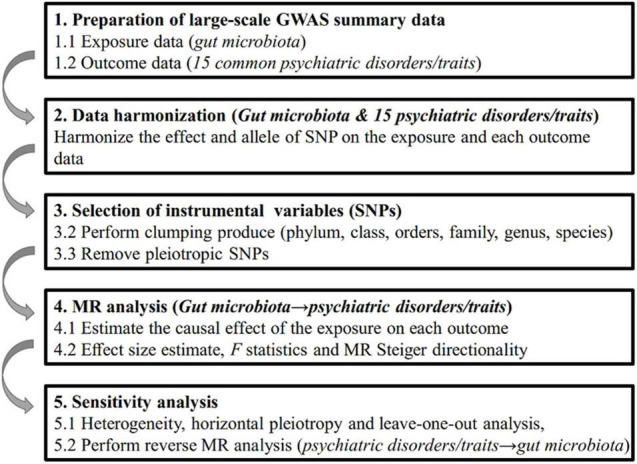
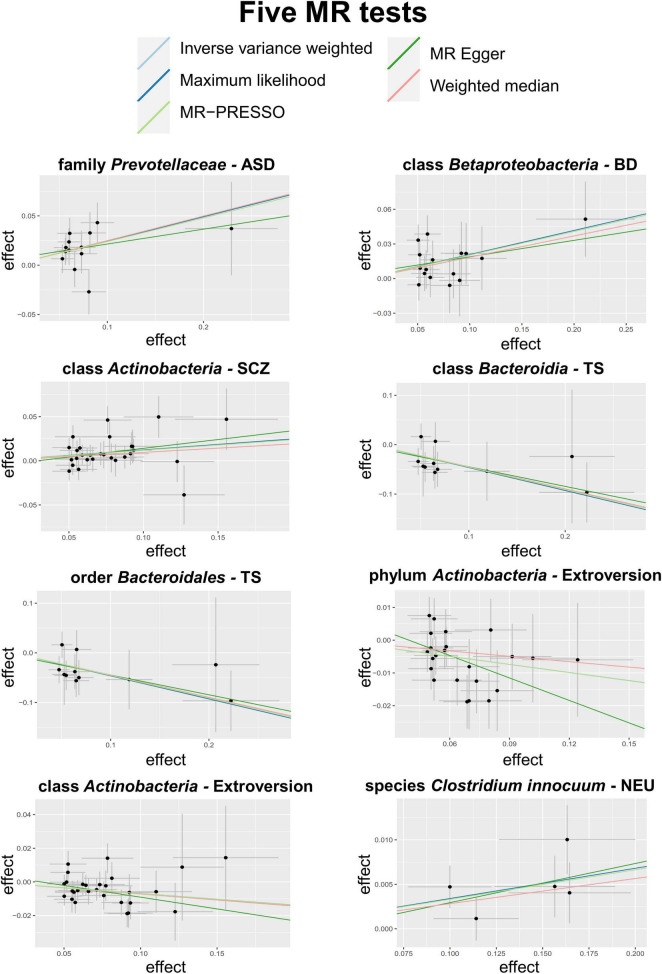
Evidence supports the observational associations of gut microbiota with a variety of psychiatric disorders, but the causal nature of such associations remains obscure. Aiming to comprehensively investigate their causal relationship and to identify specific causal microbe taxa for psychiatric diseases, we conducted a two-sample Mendelian randomization (MR) analysis of gut microbiome with 15 psychiatric diseases. Specifically, the microbiome genome-wide association study (GWAS) in 18,473 individuals from the MiBioGen study was used as exposure sample, and the GWAS for 15 psychiatric diseases was used as outcome samples. One-hundred ninety bacterial taxa from six levels were available for analysis. At a multiple-testing corrected significance level (phylum < 5.56 × 10, class < 3.33 × 10, order < 2.63 × 10, family < 1.67 × 10, genus < 4.90 × 10, and species < 3.33 × 10), the following eight causal associations from seven bacterial features (one phylum + three classes + one order + one family + one species) were identified: family with autism spectrum disorder ( = 5.31 × 10), class with bipolar disorder ( = 1.53 × 10), class with schizophrenia ( = 1.33 × 10), class and order with Tourette syndrome ( = 2.51 × 10 and 2.51 × 10), phylum and class with extroversion ( = 8.22 × 10 and 1.09 × 10), and species with neuroticism ( = 8.92 × 10). Sensitivity analysis showed no evidence of reverse causality, pleiotropy, and heterogeneity. Our findings offered novel insights into the gut microbiota-mediated development mechanism of psychiatric disorders.
有证据支持肠道微生物群与多种精神疾病之间的观察性关联,但这种关联的因果性质仍不明确。为了全面研究它们之间的因果关系,并确定精神疾病的特定因果微生物分类群,我们对肠道微生物群与15种精神疾病进行了两样本孟德尔随机化(MR)分析。具体而言,将来自MiBioGen研究的18473名个体的微生物组全基因组关联研究(GWAS)用作暴露样本,将15种精神疾病的GWAS用作结果样本。来自六个水平的190个细菌分类群可供分析。在多重检验校正的显著性水平(门<5.56×10,纲<3.33×10,目<2.63×10,科<1.67×10,属<4.90×10,种<3.33×10)下,从七个细菌特征(一个门+三个纲+一个目+一个科+一个种)中确定了以下八个因果关联:科与自闭症谱系障碍(=5.31×10),纲与双相情感障碍(=1.53×10),纲与精神分裂症(=1.33×10),纲和目与抽动秽语综合征(=2.51×10和2.51×10),门和纲与外向性(=8.22×10和1.09×10),以及种与神经质(=8.92×10)。敏感性分析未显示反向因果关系、多效性和异质性的证据。我们的研究结果为精神疾病的肠道微生物群介导的发育机制提供了新的见解。