
多壁碳纳米管和铁石棉诱导的大鼠恶性腹膜间皮瘤:转录组和表观遗传谱。
Malignant peritoneal mesotheliomas of rats induced by multiwalled carbon nanotubes and amosite asbestos: transcriptome and epigenetic profiles.
机构信息
Fraunhofer Institute for Toxicology and Experimental Medicine (ITEM), Nikolai-Fuchs-Strasse 1, 30625, Hannover, Germany.
出版信息
Part Fibre Toxicol. 2024 Jan 31;21(1):3. doi: 10.1186/s12989-024-00565-x.
BACKGROUND
Malignant mesothelioma is an aggressive cancer that often originates in the pleural and peritoneal mesothelium. Exposure to asbestos is a frequent cause. However, studies in rodents have shown that certain multiwalled carbon nanotubes (MWCNTs) can also induce malignant mesothelioma. The exact mechanisms are still unclear. To gain further insights into molecular pathways leading to carcinogenesis, we analyzed tumors in Wistar rats induced by intraperitoneal application of MWCNTs and amosite asbestos. Using transcriptomic and epigenetic approaches, we compared the tumors by inducer (MWCNTs or amosite asbestos) or by tumor type (sarcomatoid, epithelioid, or biphasic).
RESULTS
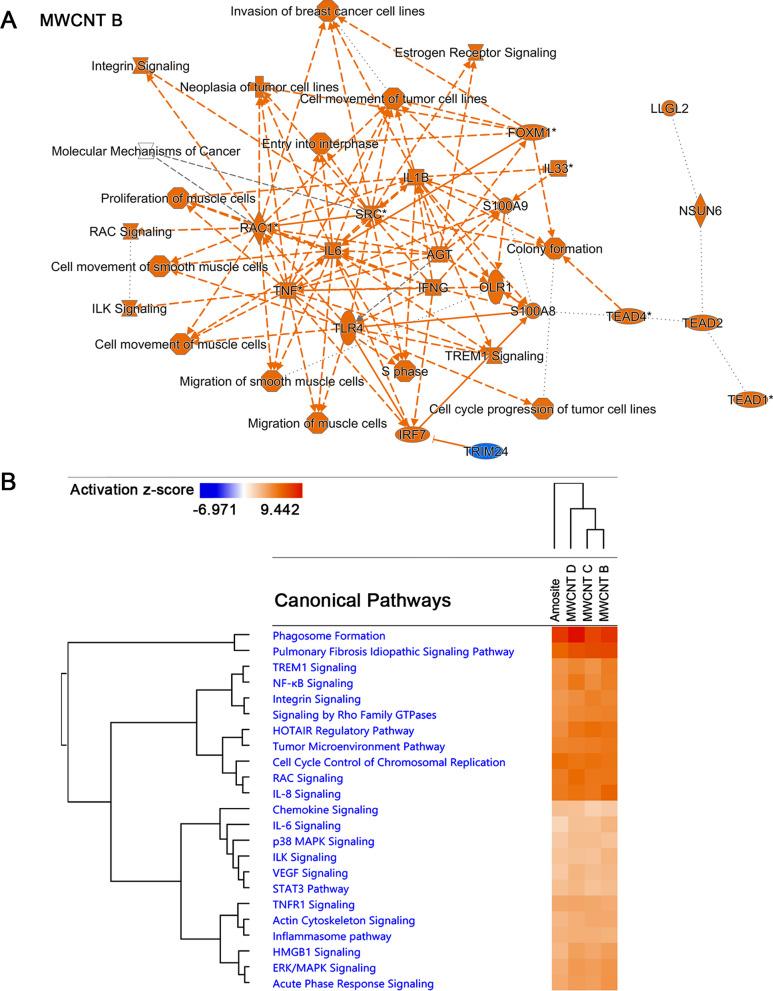
Genome-wide transcriptome datasets, whether grouped by inducer or tumor type, showed a high number of significant differentially expressed genes (DEGs) relative to control peritoneal tissues. Bioinformatic evaluations using Ingenuity Pathway Analysis (IPA) revealed that while the transcriptome datasets shared commonalities, they also showed differences in DEGs, regulated canonical pathways, and affected molecular functions. In all datasets, among highly- scoring predicted canonical pathways were Phagosome Formation, IL8 Signaling, Integrin Signaling, RAC Signaling, and TREM1 Signaling. Top-scoring activated molecular functions included cell movement, invasion of cells, migration of cells, cell transformation, and metastasis. Notably, we found many genes associated with malignant mesothelioma in humans, which showed similar expression changes in the rat tumor transcriptome datasets. Furthermore, RT-qPCR revealed downregulation of Hrasls, Nr4a1, Fgfr4, and Ret or upregulation of Rnd3 and Gadd45b in all or most of the 36 tumors analyzed. Bisulfite sequencing of Hrasls, Nr4a1, Fgfr4, and Ret revealed heterogeneity in DNA methylation of promoter regions. However, higher methylation percentages were observed in some tumors compared to control tissues. Lastly, global 5mC DNA, m6A RNA and 5mC RNA methylation levels were also higher in tumors than in control tissues.
CONCLUSIONS
Our findings may help better understand how exposure to MWCNTs can lead to carcinogenesis. This information is valuable for risk assessment and in the development of safe-by-design strategies.
背景
恶性间皮瘤是一种侵袭性癌症,通常起源于胸膜和腹膜间皮。暴露于石棉是常见的原因。然而,啮齿动物的研究表明,某些多壁碳纳米管(MWCNTs)也可以诱导恶性间皮瘤。确切的机制尚不清楚。为了更深入地了解导致癌变的分子途径,我们分析了腹腔内应用 MWCNTs 和温石棉诱导的 Wistar 大鼠肿瘤。使用转录组学和表观遗传方法,我们通过诱导剂(MWCNTs 或温石棉)或肿瘤类型(肉瘤样、上皮样或双相型)对肿瘤进行比较。
结果
无论按诱导剂还是肿瘤类型分组,全基因组转录组数据集与对照腹膜组织相比,均显示出大量显著差异表达基因(DEGs)。使用 IPA 进行的生物信息学评估显示,虽然转录组数据集具有共同性,但它们在 DEGs、调节的经典途径和受影响的分子功能方面也存在差异。在所有数据集,高评分预测经典途径包括吞噬体形成、IL8 信号、整合素信号、RAC 信号和 TREM1 信号。评分最高的激活分子功能包括细胞运动、细胞侵袭、细胞迁移、细胞转化和转移。值得注意的是,我们在人类恶性间皮瘤中发现了许多相关基因,这些基因在大鼠肿瘤转录组数据集中显示出相似的表达变化。此外,在所有或大多数 36 个分析的肿瘤中,我们发现 RT-qPCR 显示 Hrasls、Nr4a1、Fgfr4 和 Ret 下调或 Rnd3 和 Gadd45b 上调。Hrasls、Nr4a1、Fgfr4 和 Ret 的亚硫酸氢盐测序显示启动子区域 DNA 甲基化存在异质性。然而,与对照组织相比,一些肿瘤中观察到更高的甲基化百分比。最后,与对照组织相比,肿瘤中的全基因组 5mC DNA、m6A RNA 和 5mC RNA 甲基化水平也更高。
结论
我们的研究结果可能有助于更好地理解暴露于 MWCNTs 如何导致癌变。这些信息对于风险评估和安全设计策略的开发很有价值。




 Zotero 插件