Stephen Ruth, Barbera Mariagnese, Peters Ruth, Ee Nicole, Zheng Lidan, Lehtisalo Jenni, Kulmala Jenni, Håkansson Krister, Chowdhary Neerja, Dua Tarun, Solomon Alina, Anstey Kaarin J, Kivipelto Miia
Department of Neurology, Institute of Clinical Medicine, University of Eastern Finland, Kuopio, Finland.
The Ageing Epidemiology Research Unit, Faculty of Medicine, School of Public Health, Imperial College London, London, United Kingdom.
Front Neurol. 2021 Oct 26;12:763573. doi: 10.3389/fneur.2021.763573. eCollection 2021.
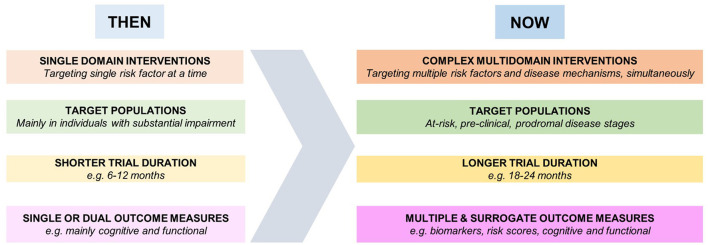
The first WHO guidelines for risk reduction of cognitive decline and dementia marked an important milestone in the field of dementia prevention. In this paper, we discuss the evidence reviewed as part of the guidelines development and present the main themes emerged from its synthesis, to inform future research and policies on dementia risk reduction. The role of intervention effect-size; the mismatch between observational and intervention-based evidence; the heterogeneity of evidence among intervention trials; the importance of intervention duration; the role of timing of exposure to a certain risk factor and interventions; the relationship between intervention intensity and response; the link between individual risk factors and specific dementia pathologies; and the need for tailored interventions emerged as the main themes. The interaction and clustering of individual risk factors, including genetics, was identified as the overarching theme. The evidence collected indicates that multidomain approaches targeting simultaneously multiple risk factors and tailored at both individual and population level, are likely to be most effective and feasible in dementia risk reduction. The current status of multidomain intervention trials aimed to cognitive impairment/dementia prevention was also briefly reviewed. Primary results were presented focusing on methodological differences and the potential of design harmonization for improving evidence quality. Since multidomain intervention trials address a condition with slow clinical manifestation-like dementia-in a relatively short time frame, the need for surrogate outcomes was also discussed, with a specific focus on the potential utility of dementia risk scores. Finally, we considered how multidomain intervention could be most effectively implemented in a public health context and the implications world-wide for other non-communicable diseases targeting common risk factors, taking into account the limited evidence in low-middle income countries. In conclusion, the evidence from the first WHO guidelines for risk reduction of cognitive decline and dementia indicated that "one size does not fit all," and multidomain approaches adaptable to different populations and individuals are likely to be the most effective. Harmonization in trial design, the use of appropriate outcome measures, and sustainability in large at-risk populations in the context of other chronic disorders also emerged as key elements.
世界卫生组织(WHO)首份关于降低认知衰退和痴呆症风险的指南,标志着痴呆症预防领域的一个重要里程碑。在本文中,我们讨论了作为指南制定一部分所审查的证据,并呈现了综合分析得出的主要主题,以为未来关于降低痴呆症风险的研究和政策提供参考。干预效应大小的作用;基于观察性和基于干预的证据之间的不匹配;干预试验中证据的异质性;干预持续时间的重要性;接触特定风险因素和干预措施的时机的作用;干预强度与反应之间的关系;个体风险因素与特定痴呆症病理之间的联系;以及量身定制干预措施的必要性,这些都成为了主要主题。包括遗传学在内的个体风险因素的相互作用和聚集,被确定为首要主题。所收集的证据表明,针对多个风险因素同时进行、在个体和人群层面都进行量身定制的多领域方法,在降低痴呆症风险方面可能是最有效且可行的。本文还简要回顾了旨在预防认知障碍/痴呆症的多领域干预试验的现状。呈现了主要结果,重点关注方法学差异以及设计协调对提高证据质量的潜力。由于多领域干预试验在相对较短的时间框架内应对像痴呆症这样临床表现缓慢的病症,因此还讨论了替代结局的必要性,特别关注痴呆症风险评分的潜在效用。最后,我们考虑了在公共卫生背景下如何最有效地实施多领域干预,以及考虑到中低收入国家证据有限,这对全球针对常见风险因素的其他非传染性疾病意味着什么。总之,WHO首份关于降低认知衰退和痴呆症风险的指南中的证据表明,“一刀切并不适用”,适应不同人群和个体的多领域方法可能是最有效的。试验设计的协调、使用适当的结局指标以及在其他慢性疾病背景下对大量高危人群的可持续性,也成为了关键要素。