Dorjkhorloo Gendensuren, Erkhem-Ochir Bilguun, Shiraishi Takuya, Sohda Makoto, Okami Haruka, Yamaguchi Arisa, Shioi Ikuma, Komine Chika, Nakazawa Nobuhiro, Ozawa Naoya, Shibasaki Yuta, Okada Takuhisa, Osone Katsuya, Sano Akihiko, Sakai Makoto, Ogawa Hiroomi, Yokobori Takehiko, Shirabe Ken, Saeki Hiroshi
Department of General Surgical Science, Graduate School of Medicine, Gunma University, Maebashi, Gunma 371-8511, Japan.
Division of Integrated Oncology Research, Gunma University Initiative for Advanced Research, Maebashi, Gunma 371-8511, Japan.
Oncol Lett. 2024 Jan 17;27(3):104. doi: 10.3892/ol.2024.14237. eCollection 2024 Mar.
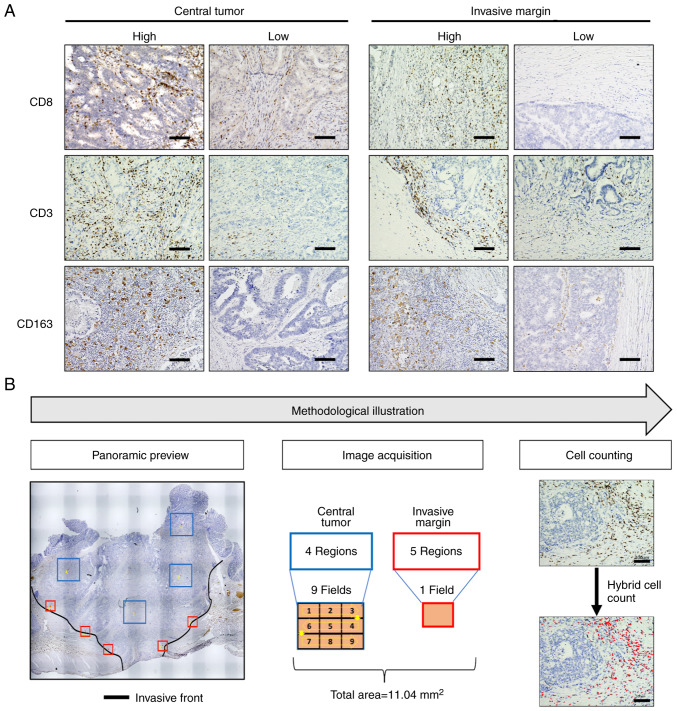
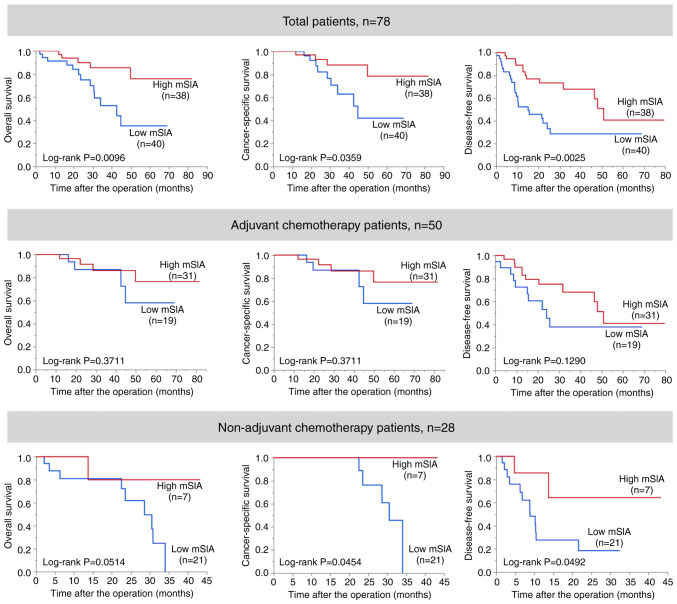
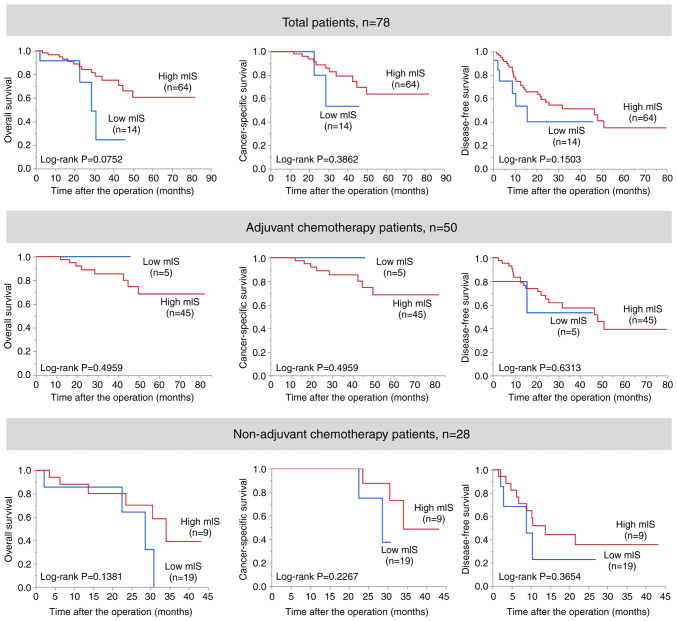
Tumor-infiltrating immune cells, such as lymphocytes and macrophages, have been associated with tumor aggressiveness, prognosis and treatment response in colorectal cancer (CRC). An immune scoring system, Immunoscore (IS), based on tumor-infiltrating T cells in stage I-III CRC, was used to predict prognosis. An alternative immune scoring signature of immune activation (SIA) reflects the balance between anti- and pro-tumoral immune components. The present study aimed to evaluate the prognostic value of modified IS (mIS) and modified SIA (mSIA) in locally advanced pathological T4 (pT4) CRC, including stage IV CRC. Immunohistochemical staining for immune cell markers, such as CD3 (pan-T cell marker), CD8 (anti-tumoral cytotoxic T cell marker) and CD163 (tumor-supportive macrophage marker), in specimens from patients with radically resected pT4 CRC at stages II-IV was performed. mIS levels in the T4 CRC cohort were not associated with prognosis. However, low mSIA levels were associated with low survival. Furthermore, low mSIA was an independent predictor of recurrence in patients with radically resected pT4 CRC. In patients with CRC who did not receive postoperative adjuvant chemotherapy, low mSIA was a major poor prognostic factor; however, this was not observed in patients receiving adjuvant chemotherapy. Evaluation of the tumor-infiltrating immune cell population could serve as a valuable marker of recurrence and poor prognosis in patients with locally advanced CRC. mSIA assessment after radical CRC resection may be promising for identifying high-risk patients with pT4 CRC who require aggressive adjuvant chemotherapy.
肿瘤浸润性免疫细胞,如淋巴细胞和巨噬细胞,已被证明与结直肠癌(CRC)的肿瘤侵袭性、预后及治疗反应相关。一种基于I-III期CRC肿瘤浸润性T细胞的免疫评分系统——免疫评分(IS),被用于预测预后。另一种免疫激活评分特征(SIA)反映了抗肿瘤和促肿瘤免疫成分之间的平衡。本研究旨在评估改良IS(mIS)和改良SIA(mSIA)在局部晚期病理T4(pT4)CRC(包括IV期CRC)中的预后价值。对II-IV期接受根治性切除的pT4 CRC患者标本进行免疫细胞标志物免疫组织化学染色,如CD3(全T细胞标志物)、CD8(抗肿瘤细胞毒性T细胞标志物)和CD163(肿瘤支持性巨噬细胞标志物)。T4 CRC队列中的mIS水平与预后无关。然而,低mSIA水平与低生存率相关。此外,低mSIA是根治性切除的pT4 CRC患者复发的独立预测因素。在未接受术后辅助化疗的CRC患者中,低mSIA是主要的不良预后因素;然而,在接受辅助化疗的患者中未观察到这一情况。评估肿瘤浸润性免疫细胞群体可作为局部晚期CRC患者复发和不良预后的重要标志物。根治性CRC切除术后的mSIA评估对于识别需要积极辅助化疗的pT4 CRC高危患者可能具有前景。