Oxford Institute of Population Ageing, University of Oxford, Oxford, UK.
School of Social Policy, University of Birmingham, Edgbaston, UK.
J Gerontol B Psychol Sci Soc Sci. 2024 Feb 1;79(2). doi: 10.1093/geronb/gbad166.
This study investigates the psychological well-being of informal caregivers over time. It identifies the thresholds (or "tipping points") of caring intensity at which caregiving is associated with lower psychological well-being, and how this varies by care location and caregiver-care recipient relationships. It also examines how caring location and relationship are linked to informal caregivers' psychological well-being while controlling for caring intensity.
Waves 1-18 (1991-2009) of the harmonized British Household Panel Survey and Waves 1-8 (2009-2017) of the U.K. Household Longitudinal Study were analyzed. Psychological well-being was measured using the General Health Questionnaire (GHQ)-12 score. Care intensity was measured by the weekly hours of care provided. Fixed-effects estimators were applied to the GHQ-12 score of caregivers across different care intensities, caring locations, and caring relationships.
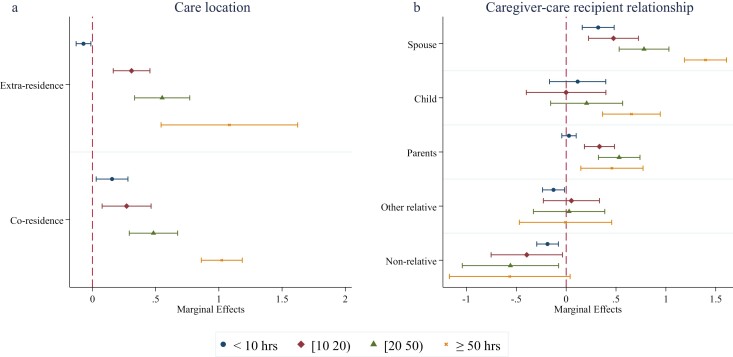
All levels of informal care intensity are associated with lower psychological well-being among spousal caregivers. The thresholds to well-being are 5 hours per week when caring for a parent, and 50 hours per week when caring for a child (with a disability or long-term illness). Caring for "other relatives" or nonrelatives is not negatively associated with psychological well-being. The thresholds are 5 hours per week for both coresident and extraresident caregivers. Extraresident caregivers experience better psychological well-being compared to coresident caregivers, given relatively lower weekly care hours. Caring for primary kin (especially spouses) is linked to lower psychological well-being compared to other caregiving relationships, regardless of care intensity.
Policy and practice responses should pay particular attention to spousal caregivers' well-being. Caregiving relationship has a stronger association with the caregiver's well-being than care location.
本研究考察了非正式照料者随时间推移的心理健康状况。它确定了照顾强度的阈值(或“临界点”),即在这些强度下,照顾与较低的心理健康相关,以及这种情况如何因照顾地点和照料者-被照顾者关系而变化。它还研究了在控制照顾强度的情况下,照顾地点和关系如何与非正式照料者的心理健康相关。
分析了协调后的英国家庭面板调查的第 1 波-18 波(1991-2009 年)和英国家庭纵向研究的第 1 波-8 波(2009-2017 年)。使用一般健康问卷(GHQ)-12 评分来衡量心理健康。通过每周提供的照顾时间来衡量照顾强度。针对不同照顾强度、照顾地点和照顾关系的照料者的 GHQ-12 评分,应用固定效应估计器。
所有程度的非正式照顾强度都与配偶照料者的心理健康状况较差相关。幸福感的阈值为每周照顾父母 5 小时,照顾有残疾或长期疾病的子女 50 小时。照顾“其他亲属”或非亲属与心理健康状况没有负相关。每周照顾时间为 5 小时时,对于同住和不住在一起的照料者来说,这两种情况都没有负面影响。与同住照料者相比,不住在一起的照料者每周提供的护理时间相对较低,因此心理健康状况较好。与其他照顾关系相比,照顾主要亲属(尤其是配偶)与较低的心理健康状况相关,而与照顾强度无关。
政策和实践应对措施应特别关注配偶照料者的幸福感。与照顾地点相比,照顾关系与照料者的幸福感有更强的关联。