Donders Institute for Brain, Cognition and Behaviour, Radboud University.
J Exp Psychol Hum Percept Perform. 2024 Apr;50(4):358-369. doi: 10.1037/xhp0001189. Epub 2024 Feb 1.
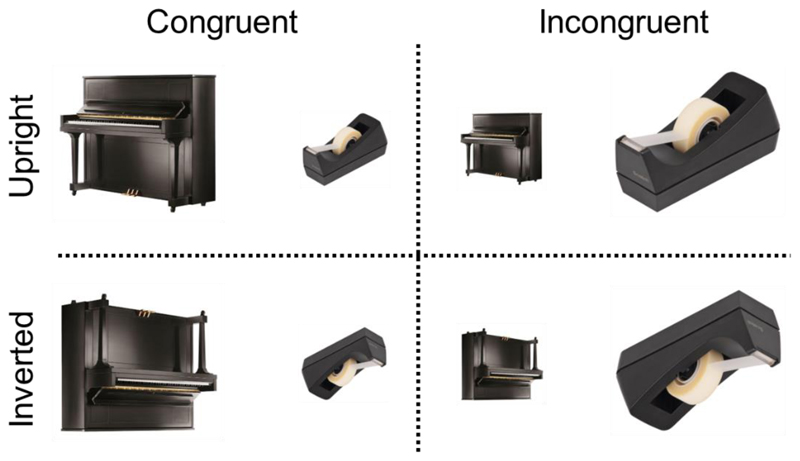
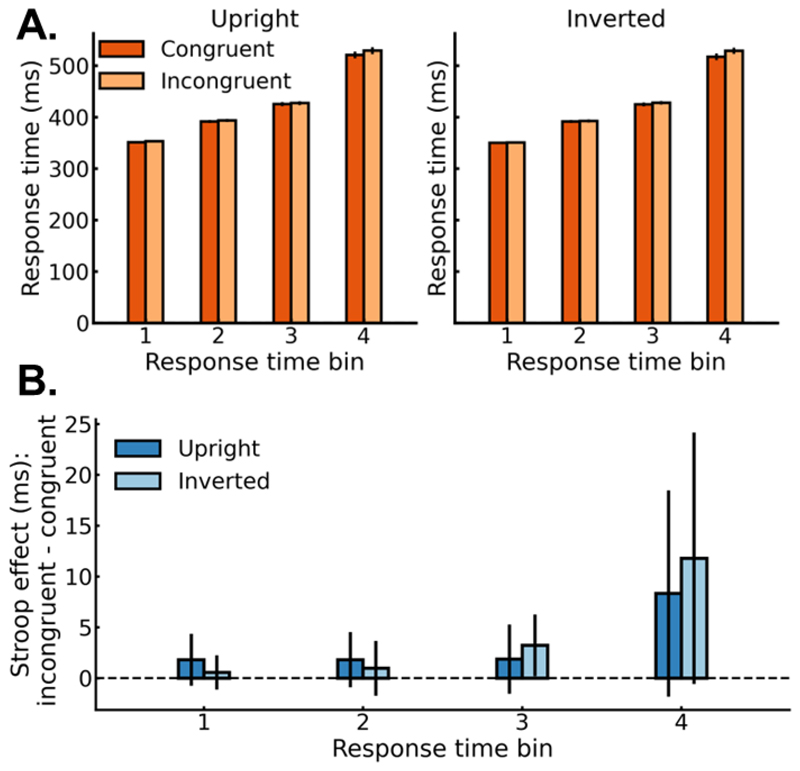
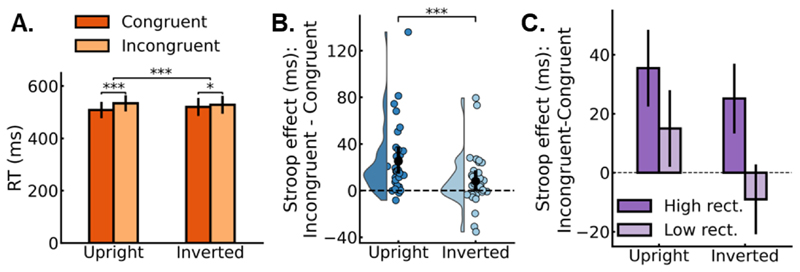
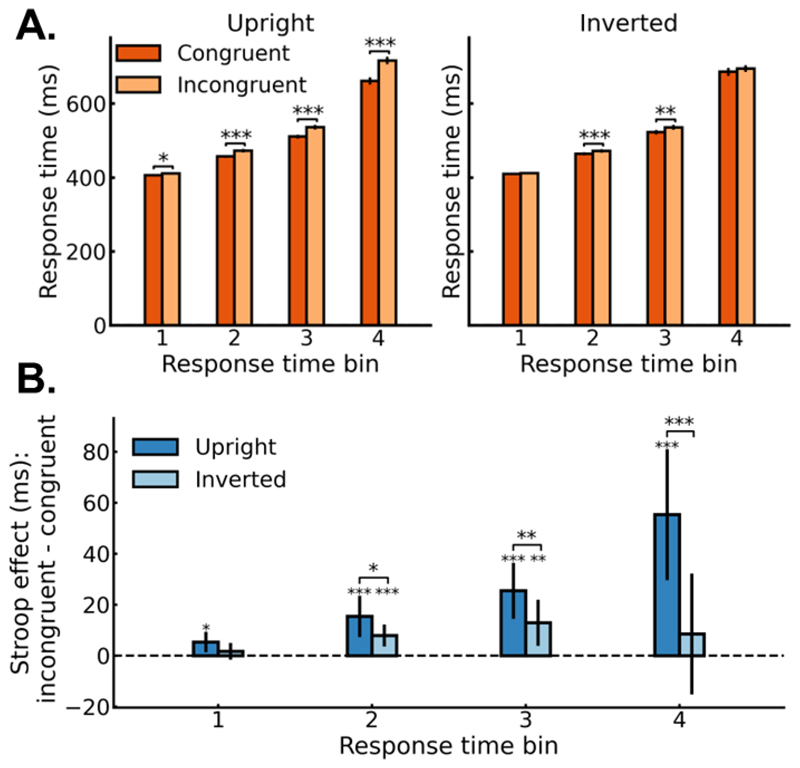
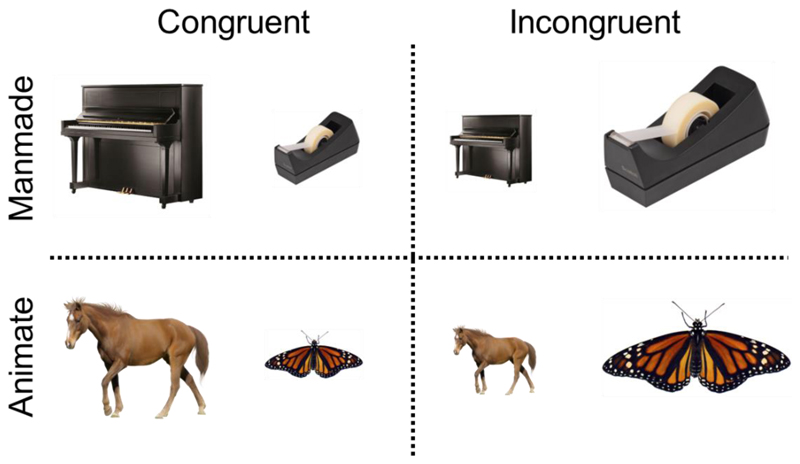
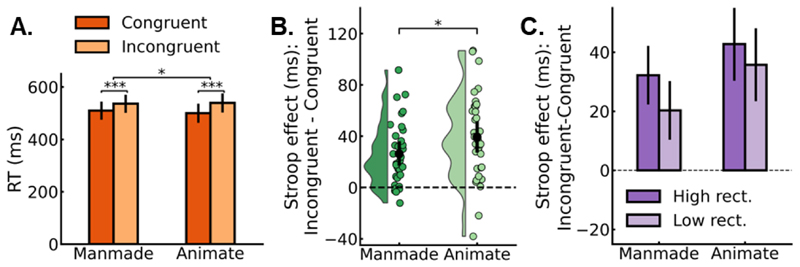
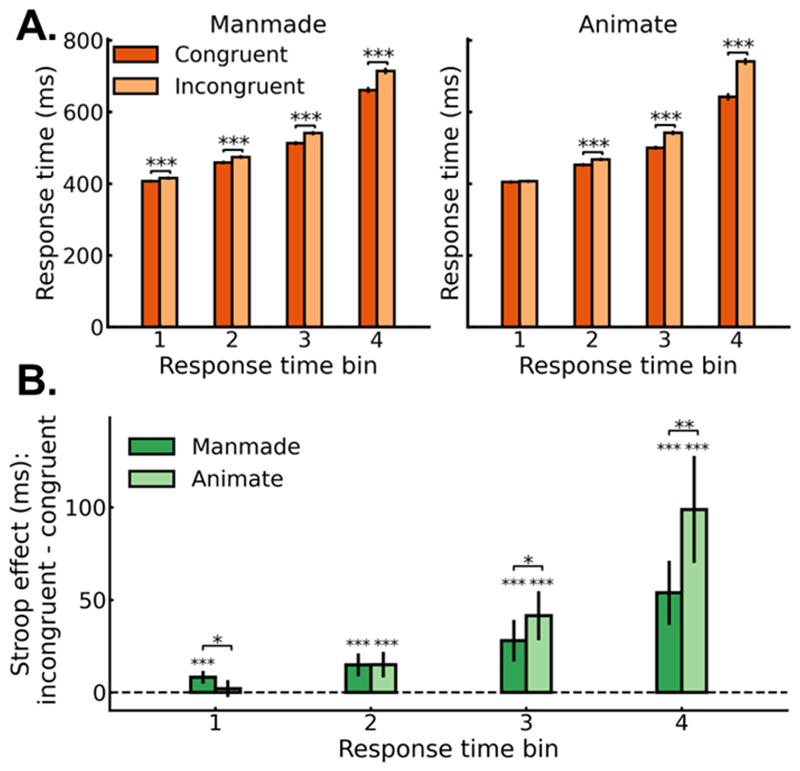
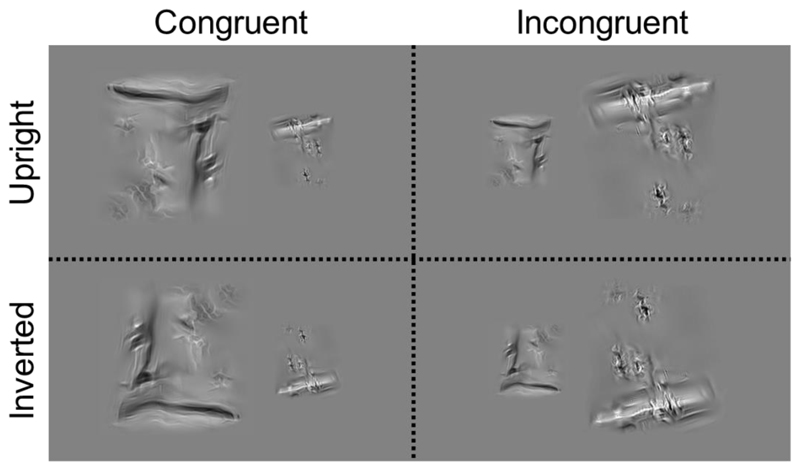
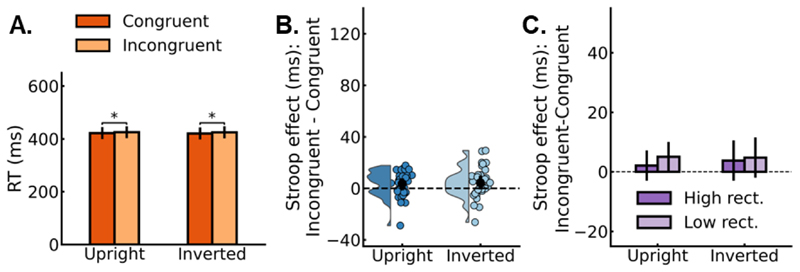
Real-world object size is a behaviorally relevant object property that is automatically retrieved when viewing object images: participants are faster to indicate the bigger of two object images when this object is also bigger in the real world. What drives this size Stroop effect? One possibility is that it reflects the automatic retrieval of real-world size after objects are recognized at the basic level (e.g., recognizing an object as a plane activates large real-world size). An alternative possibility is that the size Stroop effect is driven by automatic associations between low-/mid-level visual features (e.g., rectilinearity) and real-world size, bypassing object recognition. Here, we tested both accounts. In Experiment 1, objects were displayed upright and inverted, slowing down recognition while equating visual features. Inversion strongly reduced the Stroop effect, indicating that object recognition contributed to the Stroop effect. Independently of inversion, however, trial-wise differences in rectilinearity also contributed to the Stroop effect. In Experiment 2, the Stroop effect was compared between manmade objects (for which rectilinearity was associated with size) and animals (no association between rectilinearity and size). The Stroop effect was larger for animals than for manmade objects, indicating that rectilinear feature differences were not necessary for the Stroop effect. Finally, in Experiment 3, unrecognizable "texform" objects that maintained size-related visual feature differences were displayed upright and inverted. Results revealed a small Stroop effect for both upright and inverted conditions. Altogether, these results indicate that the size Stroop effect partly follows object recognition with an additional contribution from visual feature associations. (PsycInfo Database Record (c) 2024 APA, all rights reserved).
真实世界物体的大小是一种与行为相关的物体属性,当观察物体图像时会自动获取:当物体在现实世界中也更大时,参与者在指示两个物体图像中更大的一个时会更快。那么,这种大小斯特鲁普效应是由什么驱动的呢?一种可能性是,它反映了物体在基本水平(例如,将物体识别为平面)被识别后对现实世界大小的自动检索。另一种可能性是,大小斯特鲁普效应是由低/中水平视觉特征(例如,直线性)和现实世界大小之间的自动联想驱动的,而无需物体识别。在这里,我们检验了这两种解释。在实验 1 中,物体以直立和倒置的方式显示,这会减缓识别速度,同时使视觉特征保持一致。倒置强烈地降低了斯特鲁普效应,表明物体识别对斯特鲁普效应有贡献。然而,与倒置无关,直线性的试次间差异也对斯特鲁普效应有贡献。在实验 2 中,比较了人造物体(直线性与大小相关联)和动物(直线性与大小之间没有关联)之间的斯特鲁普效应。动物的斯特鲁普效应大于人造物体,表明直线性特征差异不是斯特鲁普效应的必要条件。最后,在实验 3 中,显示了直立和倒置的不可识别的“texform”物体,这些物体保持了与大小相关的视觉特征差异。结果显示,无论是直立还是倒置条件,都存在较小的斯特鲁普效应。总的来说,这些结果表明,大小斯特鲁普效应部分遵循物体识别,同时还有视觉特征关联的额外贡献。(PsycInfo 数据库记录(c)2024 APA,保留所有权利)。