Carvajal-Yepes Monica, Ospina Jessica A, Aranzales Ericson, Velez-Tobon Monica, Correa Abondano Miguel, Manrique-Carpintero Norma Constanza, Wenzl Peter
Genetic Resources Program, Alliance Bioversity International and International Center for Tropical Agriculture (CIAT), Cali, Colombia.
Front Plant Sci. 2024 Jan 18;14:1338377. doi: 10.3389/fpls.2023.1338377. eCollection 2023.
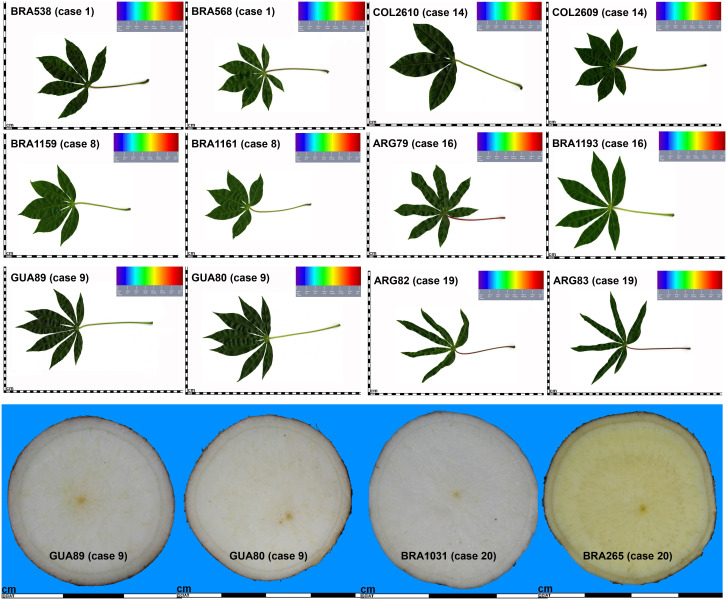
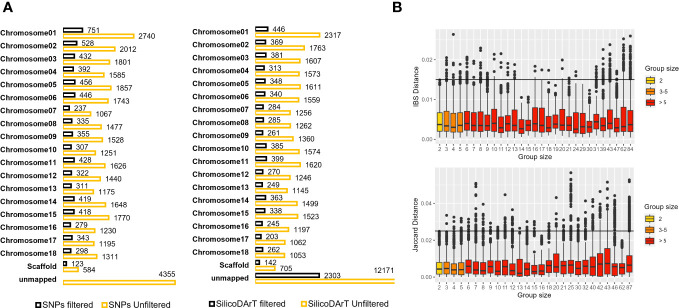
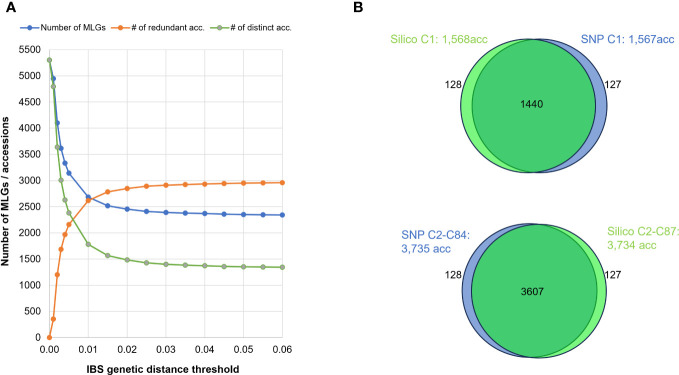
Crop diversity conserved in genebanks facilitates the development of superior varieties, improving yields, nutrition, adaptation to climate change and resilience against pests and diseases. Cassava () plays a vital role in providing carbohydrates to approximately 500 million people in Africa and other continents. The International Center for Tropical Agriculture (CIAT) conserves the largest global cassava collection, housing 5,963 accessions of cultivated cassava and wild relatives within its genebank. Efficient genebank management requires identifying and eliminating genetic redundancy within collections. In this study, we optimized the identification of genetic redundancy in CIAT's cassava genebank, applying empirical distance thresholds, and using two types of molecular markers (single-nucleotide polymorphism (SNP) and SilicoDArT) on 5,302 accessions. A series of quality filters were applied to select the most informative and high-quality markers and to exclude low-quality DNA samples. The analysis identified a total of 2,518 and 2,526 (47 percent) distinct genotypes represented by 1 to 87 accessions each, using SNP or SilicoDArT markers, respectively. A total of 2,776 (SNP) and 2,785 (SilicoDArT) accessions were part of accession clusters with up to 87 accessions. Comparing passport and historical characterization data, such as pulp color and leaf characteristic, we reviewed clusters of genetically redundant accessions. This study provides valuable guidance to genebank curators in defining minimum genetic-distance thresholds to assess redundancy within collections. It aids in identifying a subset of genetically distinct accessions, prioritizing collection management activities such as cryopreservation and provides insights for follow-up studies in the field, potentially leading to removal of duplicate accessions.
基因库中保存的作物多样性有助于培育优良品种,提高产量、改善营养、增强对气候变化的适应能力以及抵御病虫害的能力。木薯( )在为非洲和其他各大洲约5亿人提供碳水化合物方面发挥着至关重要的作用。国际热带农业中心(CIAT)保存着全球最大的木薯种质库,其基因库中存有5963份栽培木薯及其野生近缘种的种质。高效的基因库管理需要识别并消除种质库中的遗传冗余。在本研究中,我们优化了CIAT木薯基因库中遗传冗余的识别方法,应用经验距离阈值,并对5302份种质使用了两种分子标记(单核苷酸多态性(SNP)和硅基DArT)。应用了一系列质量筛选标准来选择信息含量最高且质量最好的标记,并排除低质量DNA样本。使用SNP或硅基DArT标记分析分别鉴定出总共2518个和2526个(47%)不同基因型,每个基因型分别由1至87份种质代表。共有2776份(SNP)和2785份(硅基DArT)种质属于包含多达87份种质的种质聚类。通过比较诸如果肉颜色和叶片特征等护照数据和历史特征数据,我们复查了遗传冗余种质的聚类。本研究为基因库管理者定义用于评估种质库内冗余的最小遗传距离阈值提供了有价值的指导。它有助于识别一组遗传上不同的种质,确定诸如冷冻保存等收集管理活动的优先级,并为该领域的后续研究提供见解,可能会促使去除重复种质。