Department of Urology, The First Affiliated Hospital of Shantou University Medical College, Medical College of Shantou University, Shantou 515041, China.
The Second School of Clinical Medicine, Southern Medical University, Guangzhou 510260, China.
Asian J Androl. 2024 Jul 1;26(4):382-388. doi: 10.4103/aja202378. Epub 2024 Jan 30.
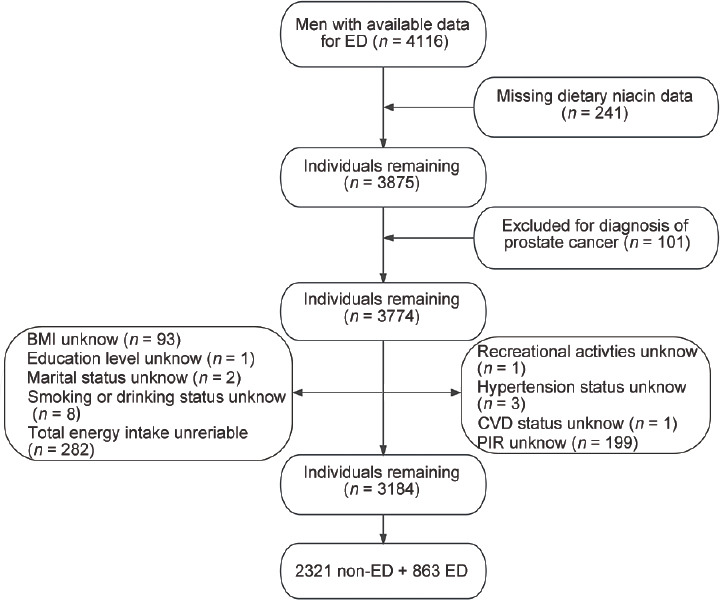
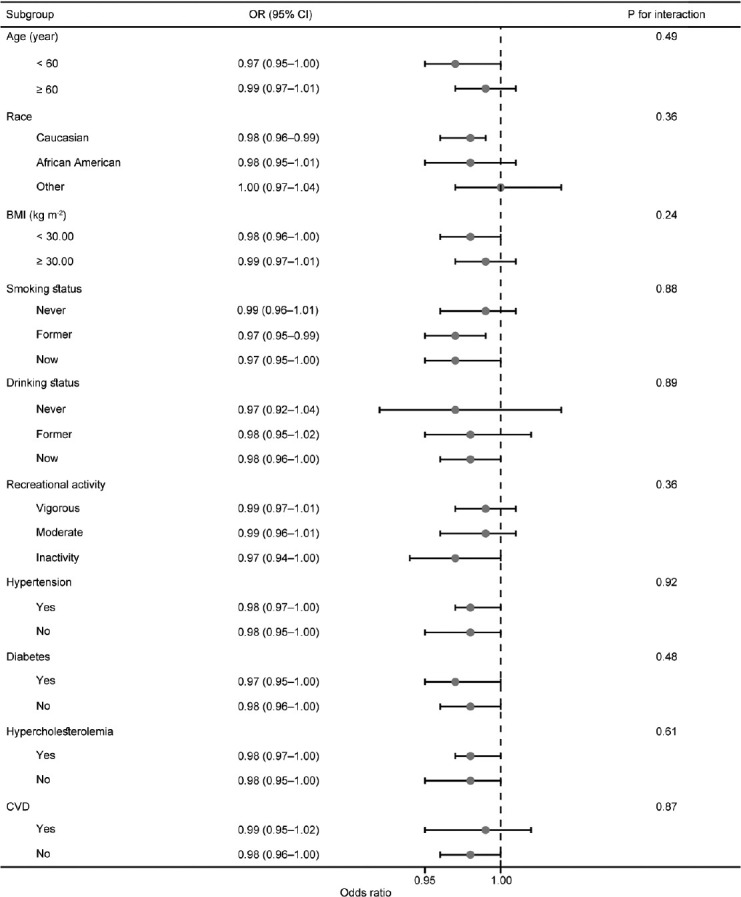
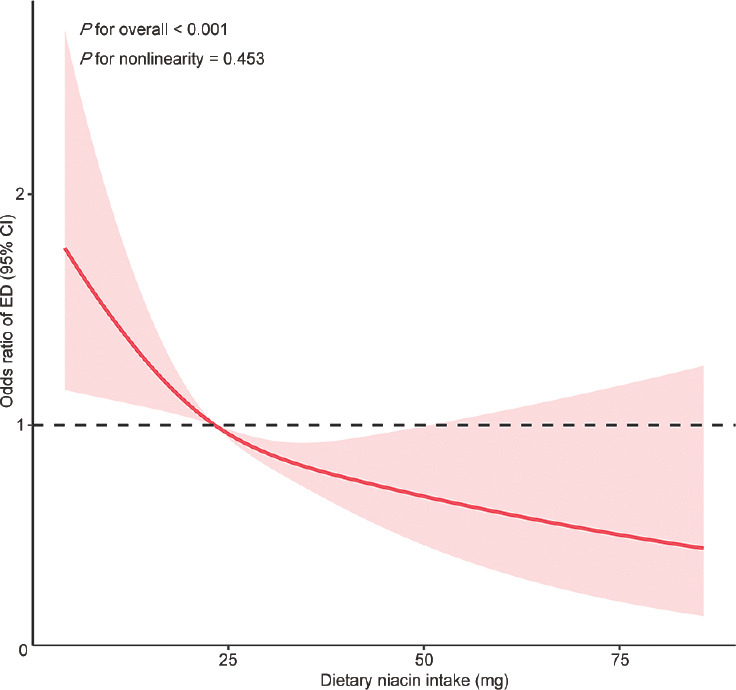
Existing research on the precise link between dietary niacin intake and erectile dysfunction (ED) is scarce. Thus, this study aimed to investigate the potential association between dietary niacin intake and the risk of ED. Multivariate logistic regression and restricted cubic splines (RCSs) were used to examine the relationship between dietary niacin intake and ED. Subgroup interaction analysis was performed to assess the impact of different subgroups on the study outcomes. In addition, 1:1 propensity score matching (PSM) was employed to adjust for potential confounding factors, ensuring the reliability of the results. The analyzed data were collected from the 2001-2004 National Health and Nutrition Examination Survey (NHANES) in the USA. The study encompassed 3184 adults, among whom 863 participants were identified as having ED. Following adjustments for potential confounders, the findings revealed that higher niacin intake, specifically in the highest tertile, was associated with a decreased risk of ED compared to that in the lowest tertile, showing an odds ratio (OR) of 0.56 (95% confidence interval [CI]: 0.37-0.85). Analysis of dose-response curves illustrated a negative correlation between dietary niacin intake and the risk of ED. Subgroup and interaction analyses fortified the consistency of these results. Furthermore, PSM corroborated the validity of the findings. This study suggests an inverse association between dietary niacin intake and the risk of ED. However, establishing a cause-and-effect relationship remains elusive, and defining the safe threshold of niacin intake to prevent ED requires further investigation.
目前关于饮食烟酸摄入与勃起功能障碍(ED)之间的确切联系的研究还很少。因此,本研究旨在探讨饮食烟酸摄入与 ED 风险之间的潜在关联。多变量逻辑回归和限制性立方样条(RCS)被用来检查饮食烟酸摄入与 ED 之间的关系。进行亚组交互分析,以评估不同亚组对研究结果的影响。此外,采用 1:1 倾向评分匹配(PSM)来调整潜在的混杂因素,以确保结果的可靠性。分析的数据来自美国 2001-2004 年国家健康和营养调查(NHANES)。该研究包括 3184 名成年人,其中 863 名被确定为患有 ED。在调整了潜在的混杂因素后,研究结果表明,与最低三分位组相比,较高的烟酸摄入,特别是在最高三分位组,与 ED 的风险降低相关,比值比(OR)为 0.56(95%置信区间[CI]:0.37-0.85)。剂量-反应曲线分析表明,饮食烟酸摄入与 ED 风险之间呈负相关。亚组和交互分析加强了这些结果的一致性。此外,PSM 证实了研究结果的有效性。本研究表明,饮食烟酸摄入与 ED 风险之间存在负相关。然而,建立因果关系仍然难以捉摸,确定预防 ED 的烟酸摄入安全阈值需要进一步研究。