Rajput Gargi, Gao Andy, Wu Tzu-Chun, Tsai Ching-Tzu, Molano Jennifer, Wu Danny T Y
Department of Biomedical Informatics, College of Medicine, University of Cincinnati, Cincinnati, OH, United States.
Medical Sciences Baccalaureate Program, College of Medicine, University of Cincinnati, Cincinnati, OH, United States.
JMIR Form Res. 2024 Feb 2;8:e45910. doi: 10.2196/45910.
Poor sleep hygiene persists in college students today, despite its heavy implications on adolescent development and academic performance. Although sleep patterns in undergraduates have been broadly investigated, no study has exclusively assessed the sleep patterns of premedical undergraduate students. A gap also exists in the knowledge of how students perceive their sleep patterns compared to their actual sleep patterns.
This study aims to address 2 research questions: What are the sleep patterns of premedical undergraduate students? Would the proposed study protocol be feasible to examine the perception of sleep quality and promote sleep behavioral changes in premedical undergraduate students?
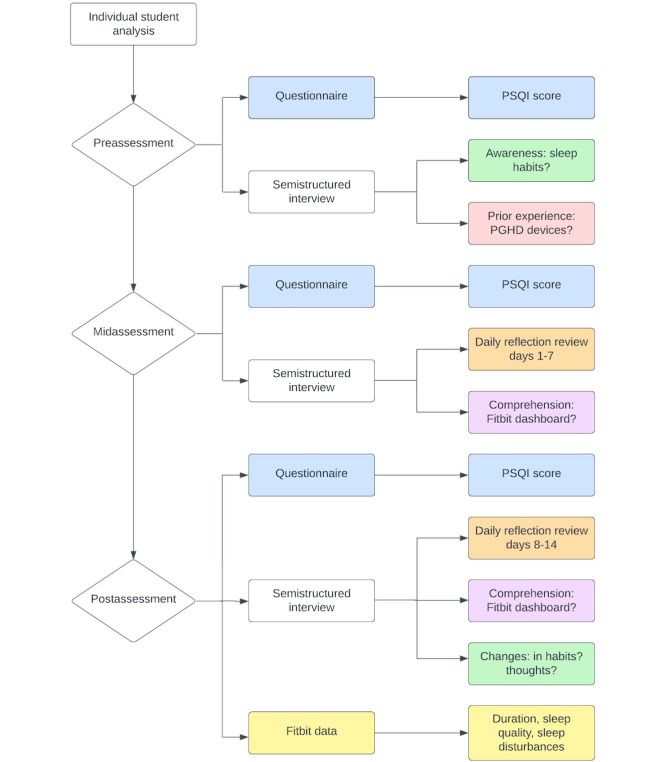
An anonymous survey was conducted with premedical students in the Medical Science Baccalaureate program at an R1: doctoral university in the Midwest United States to investigate their sleep habits and understand their demographics. The survey consisted of both Pittsburg Sleep Quality Index (PSQI) questionnaire items (1-9) and participant demographic questions. To examine the proposed protocol feasibility, we recruited 5 students from the survey pool for addressing the perception of sleep quality and changes. These participants followed a 2-week protocol wearing Fitbit Inspire 2 watches and underwent preassessments, midassessments, and postassessments. Participants completed daily reflections and semistructured interviews along with PSQI questionnaires during assessments.
According to 103 survey responses, premedical students slept an average of 7.1 hours per night. Only a quarter (26/103) of the participants experienced good sleep quality (PSQI<5), although there was no significant difference (P=.11) in the proportions of good (PSQI<5) versus poor sleepers (PSQI≥5) across cohorts. When students perceived no problem at all in their sleep quality, 50% (14/28) of them actually had poor sleep quality. Among the larger proportion of students who perceived sleep quality as only a slight problem, 26% (11/43) of them presented poor sleep quality. High stress levels were associated with poor sleep quality. This study reveals Fitbit as a beneficial tool in raising sleep awareness. Participants highlighted Fitbit elements that aid in comprehension such as being able to visualize their sleep stage breakdown and receive an overview of their sleep pattern by simply looking at their Fitbit sleep scores. In terms of protocol evaluation, participants believed that assessments were conducted within the expected duration, and they did not have a strong opinion about the frequency of survey administration. However, Fitbit was found to provide notable variation daily, leading to missing data. Moreover, the Fitbit app's feature description was vague and could lead to confusion.
Poor sleep quality experienced by unaware premedical students points to a need for raising sleep awareness and developing effective interventions. Future work should refine our study protocol based on lessons learned and health behavior theories and use Fitbit as an informatics solution to promote healthy sleep behaviors.
尽管睡眠卫生不佳对青少年发育和学业成绩有重大影响,但如今大学生中这一问题依然存在。虽然已经对本科生的睡眠模式进行了广泛研究,但尚无研究专门评估医学预科本科生的睡眠模式。在学生如何看待自己的睡眠模式与实际睡眠模式之间的认知方面,也存在差距。
本研究旨在解决两个研究问题:医学预科本科生的睡眠模式是怎样的?拟议的研究方案对于检验医学预科本科生对睡眠质量的认知并促进其睡眠行为改变是否可行?
在美国中西部一所R1博士大学的医学学士学位项目中,对医学预科学生进行了一项匿名调查,以调查他们的睡眠习惯并了解其人口统计学特征。该调查包括匹兹堡睡眠质量指数(PSQI)问卷项目(1 - 9)和参与者人口统计学问题。为了检验拟议方案的可行性,我们从调查对象中招募了5名学生来探讨睡眠质量认知和变化情况。这些参与者遵循一个为期两周的方案,佩戴Fitbit Inspire 2手表,并进行了预评估、中期评估和后期评估。参与者在评估期间完成每日反思、半结构化访谈以及PSQI问卷。
根据103份调查回复,医学预科学生平均每晚睡眠7.1小时。只有四分之一(26/103)的参与者睡眠质量良好(PSQI<5),尽管不同群体中睡眠良好(PSQI<5)与睡眠不佳(PSQI≥5)的比例没有显著差异(P = 0.11)。当学生认为自己的睡眠质量完全没有问题时,其中50%(14/28)实际上睡眠质量较差。在认为睡眠质量只是稍有问题的较大比例学生中,26%(11/43)的人睡眠质量较差。高压力水平与睡眠质量差有关。本研究表明Fitbit是提高睡眠意识的有益工具。参与者强调了Fitbit有助于理解的元素,比如能够直观看到自己的睡眠阶段细分情况,以及通过查看Fitbit睡眠分数就能了解自己的睡眠模式概况。在方案评估方面,参与者认为评估是在预期时间内进行的,并且他们对调查频率没有强烈的看法。然而,发现Fitbit每天提供的数据存在显著差异,导致数据缺失。此外,Fitbit应用程序的功能描述模糊,可能会导致混淆。
未意识到睡眠质量差的医学预科学生表明有必要提高睡眠意识并制定有效的干预措施。未来的工作应根据经验教训和健康行为理论完善我们的研究方案,并将Fitbit用作促进健康睡眠行为的信息学解决方案。


