Masiero Marianna, Filipponi Chiara, Fragale Elisa, Pizzoli Silvia Francesca Maria, Munzone Elisabetta, Milani Alessandra, Guido Luca, Guardamagna Vittorio, Marceglia Sara, Prandin Roberto, Prenassi Marco, Caruso Annamaria, Manzelli Vania, Savino Chiara, Conti Costanza, Rizzi Federica, Casalino Alice, Candiani Giulia, Memini Francesca, Chiveri Luca, Vitali Andrea Luigi, Corbo Massimo, Grasso Roberto, Didier Florence, Ferrucci Roberta, Pravettoni Gabriella
Department of Oncology and Hemato-Oncology, University of Milan, Milan, Italy.
Applied Research Division for Cognitive and Psychological Science, European Institute of Oncology, Istituto di Ricovero e Cura a Carattere Scientifico, Milan, Italy.
JMIR Form Res. 2024 Feb 2;8:e51021. doi: 10.2196/51021.
Chronic pain is one of the most common and critical long-term effects of breast cancer. Digital health technologies enhance the management of chronic pain by monitoring physical and psychological health status and supporting pain self-management and patient treatment decisions throughout the clinical pathway.
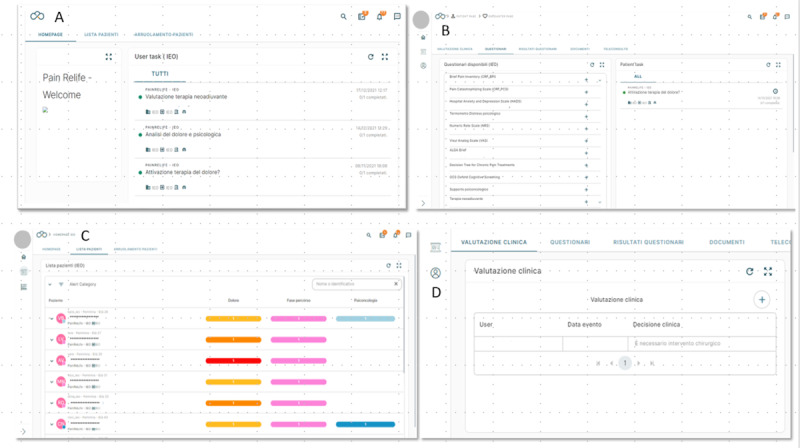
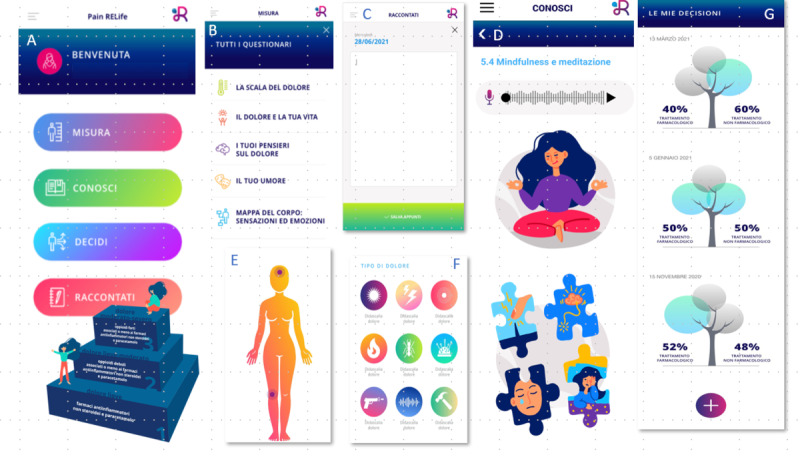
This pilot study aims to evaluate patients' experiences, including usability, with a novel digital integrated health ecosystem for chronic pain named PainRELife. The sample included patients with breast cancer during survivorship. The PainRELife ecosystem comprises a cloud technology platform interconnected with electronic health records and patients' devices to gather integrated health care data.
We enrolled 25 patients with breast cancer (mean age 47.12 years) experiencing pain. They were instructed to use the PainRELife mobile app for 3 months consecutively. The Mobile Application Rating Scale (MARS) was used to evaluate usability. Furthermore, pain self-efficacy and participation in treatment decisions were evaluated. The study received ethical approval (R1597/21-IEO 1701) from the Ethical Committee of the European Institute of Oncology.
The MARS subscale scores were medium to high (range: 3.31-4.18), and the total app quality score was 3.90. Patients with breast cancer reported reduced pain intensity at 3 months, from a mean of 5 at T0 to a mean of 3.72 at T2 (P=.04). The total number of times the app was accessed was positively correlated with pain intensity at 3 months (P=.03). The engagement (P=.03), information (P=.04), and subjective quality (P=.007) subscales were positively correlated with shared decision-making. Furthermore, participants with a lower pain self-efficacy at T2 (mean 40.83) used the mobile app more than participants with a higher pain self-efficacy (mean 48.46; P=.057).
The data collected in this study highlight that digital health technologies, when developed using a patient-driven approach, might be valuable tools for increasing participation in clinical care by patients with breast cancer, permitting them to achieve a series of key clinical outcomes and improving quality of life. Digital integrated health ecosystems might be important tools for improving ongoing monitoring of physical status, psychological burden, and socioeconomic issues during the cancer survivorship trajectory.
INTERNATIONAL REGISTERED REPORT IDENTIFIER (IRRID): RR2-10.2196/41216.
慢性疼痛是乳腺癌最常见且关键的长期影响之一。数字健康技术通过监测身心健康状况,并在整个临床路径中支持疼痛自我管理和患者治疗决策,从而加强慢性疼痛的管理。
这项试点研究旨在评估患者对一种名为PainRELife的新型慢性疼痛数字综合健康生态系统的体验,包括其易用性。样本包括处于癌症康复期的乳腺癌患者。PainRELife生态系统由一个与电子健康记录和患者设备互连的云技术平台组成,用于收集综合医疗数据。
我们招募了25名正在经历疼痛的乳腺癌患者(平均年龄47.12岁)。他们被指示连续3个月使用PainRELife移动应用程序。使用移动应用程序评分量表(MARS)评估易用性。此外,还评估了疼痛自我效能感和参与治疗决策的情况。该研究获得了欧洲肿瘤研究所伦理委员会的伦理批准(R1597/21-IEO 1701)。
MARS子量表得分中等偏高(范围:3.31 - 4.18),应用程序总质量得分为3.90。乳腺癌患者报告在3个月时疼痛强度降低,从T0时的平均5分降至T2时的平均3.72分(P = 0.04)。应用程序被访问的总次数与3个月时的疼痛强度呈正相关(P = 0.03)。参与度(P = 0.03)、信息(P = 0.04)和主观质量(P = 0.007)子量表与共同决策呈正相关。此外,在T2时疼痛自我效能感较低(平均40.83)的参与者比疼痛自我效能感较高(平均48.46)的参与者更多地使用移动应用程序(P = 0.057)。
本研究收集的数据表明,以患者为导向开发的数字健康技术可能是增加乳腺癌患者参与临床护理的有价值工具,使他们能够实现一系列关键临床结果并改善生活质量。数字综合健康生态系统可能是在癌症康复轨迹中改善对身体状况、心理负担和社会经济问题持续监测的重要工具。
国际注册报告识别码(IRRID):RR2-10.2196/41216。