Department of Phytochemistry and Plant Systematics, National Research Centre, Dokki, 12622, Cairo, Egypt.
Pharmacognosy Department, College of Pharmacy, Arab Academy for Science, Technology and Maritime Transport, Alexandria, 1029, Egypt.
Sci Rep. 2024 Feb 2;14(1):2809. doi: 10.1038/s41598-024-53219-5.
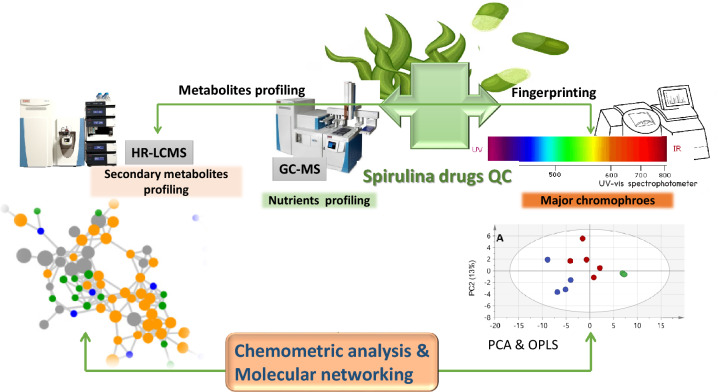
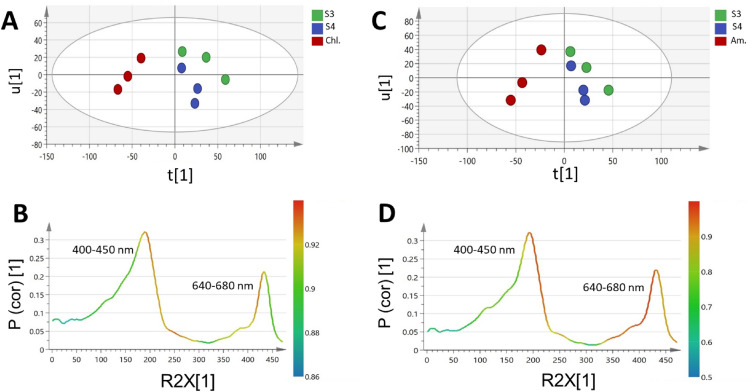
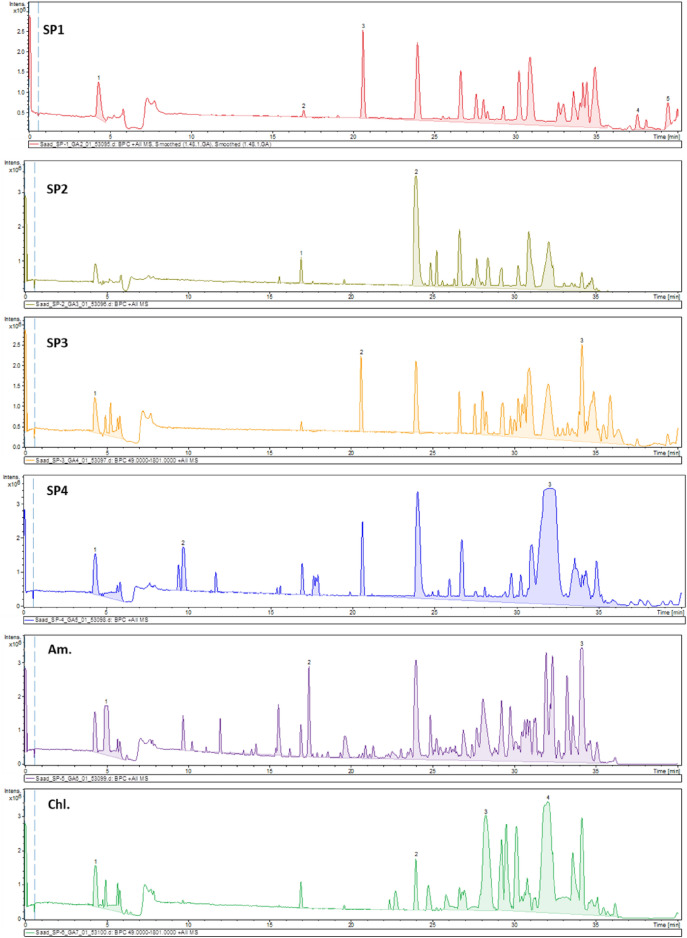
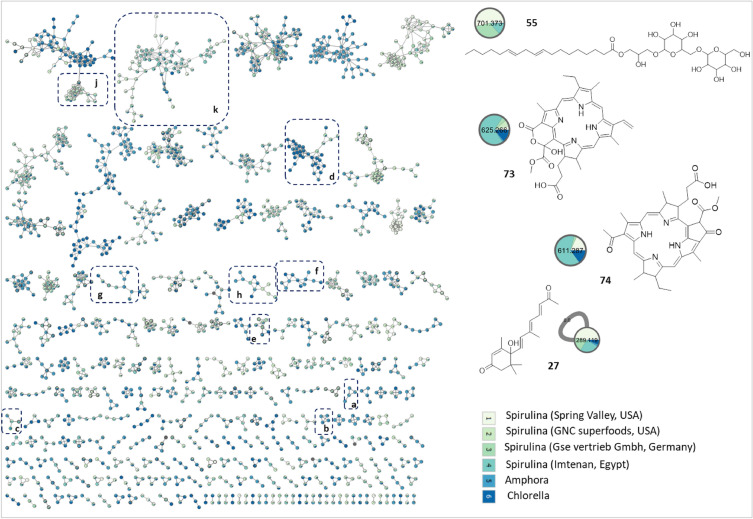
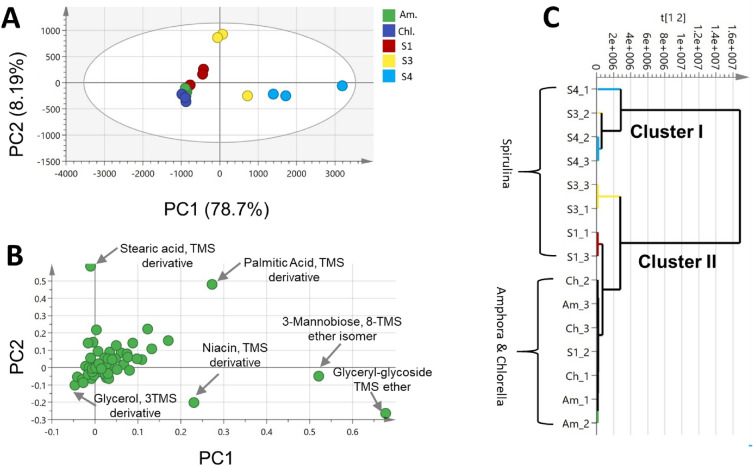
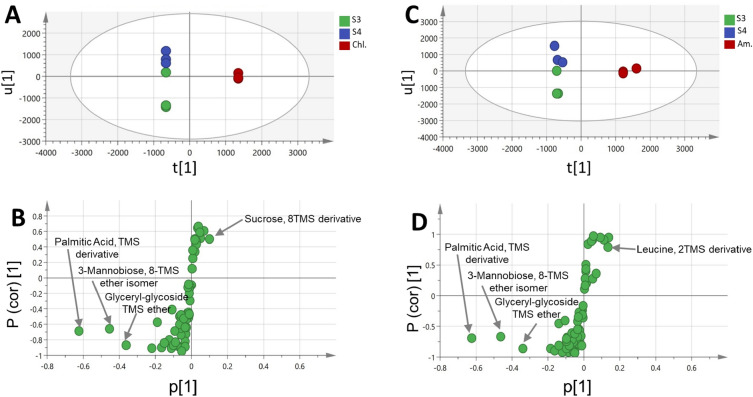
Microalgae species are of economic importance regarded as "green gold" being rich in bioactive compounds. Spirulina and Chlorella are the most popular microalgal species and are marketed as healthy food supplements. At the same time, Amphora holds potential as a source of healthy lipids and essential fatty acids. Yet, there are considerable variations in their reported chemical composition, and less is known about their compositional differences. A multiplexed metabolomic approach was adopted for the quality control (QC) of Spirulina supplements and to compare its constitutive metabolome to Chlorella and Amphora. The adopted protocol comprised gas chromatography-mass spectrometry (GC-MS), ultra-high performance liquid chromatography coupled with high-resolution tandem mass spectrometry (UPLC-HRMS/MS), and ultraviolet-visible spectrophotometry (UV/Vis) for mapping their primary and secondary metabolome. Interestingly, UPLC-HRMS/MS analysis delineated the abundance of fatty acids in Amphora versus glycolipids enrichment in Spirulina, and porphyrins were the main pigments identified in Spirulina, with scarce occurrence in Chlorella. Orthogonal projections to latent structures discriminant analysis (OPLS-DA) analysis of GC-MS data set revealed palmitic acid, 3-mannobiose, and glyceryl-glycoside as being most enriched in Spirulina, versus sucrose and leucine in Chlorella and Amphora, respectively. Despite being of low discriminatory potential, UV/Vis OPLS-DA modeling showed that Spirulina was distinguished with the UV absorbances of carotenoids and chlorophyll pigments, as indicated by its OPLS-DA derived S-plot. Our study provides a QC approach for the analysis of the microalgal species and poses alternative spectral and compositional markers for their discrimination.
微藻物种具有经济重要性,被称为“绿色黄金”,富含生物活性化合物。螺旋藻和小球藻是最受欢迎的微藻物种,被作为健康食品补充剂销售。同时,双叉藻具有作为健康脂质和必需脂肪酸来源的潜力。然而,它们的报告化学成分存在相当大的差异,对它们的组成差异知之甚少。采用多指标代谢组学方法对螺旋藻补充剂进行质量控制 (QC),并将其组成代谢组与小球藻和双叉藻进行比较。所采用的方案包括气相色谱-质谱联用 (GC-MS)、超高效液相色谱-高分辨串联质谱联用 (UPLC-HRMS/MS) 和紫外-可见分光光度法 (UV/Vis),用于绘制其初级和次级代谢组图谱。有趣的是,UPLC-HRMS/MS 分析描绘了双叉藻中脂肪酸的丰度,而螺旋藻中糖脂的富集,叶绿素是螺旋藻中主要的色素,在小球藻中很少出现。GC-MS 数据集的正交投影到潜在结构判别分析 (OPLS-DA) 分析显示,棕榈酸、3-甘露二糖和甘油糖苷在螺旋藻中含量最丰富,而蔗糖和亮氨酸分别在小球藻和双叉藻中含量最丰富。尽管具有低判别潜力,但 UV/Vis OPLS-DA 建模表明,螺旋藻可以通过类胡萝卜素和叶绿素色素的 UV 吸光度来区分,这一点可以从其 OPLS-DA 衍生的 S-plot 中看出。我们的研究为微藻物种的分析提供了一种 QC 方法,并提出了替代的光谱和组成标记物来区分它们。