Department of Conservative Dentistry, Faculty of Dentistry, Jordan University of Science and Technology, Box 3030, Irbid, Jordan.
Dental Teaching Clinics, Jordan University of Science and Technology, Irbid, Jordan.
BMC Oral Health. 2024 Feb 2;24(1):170. doi: 10.1186/s12903-024-03934-2.
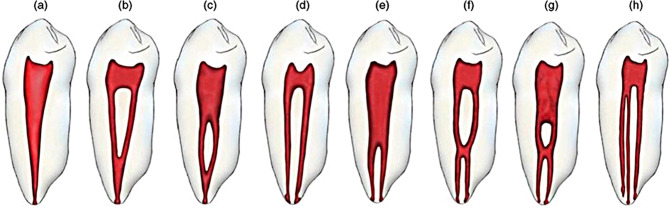
Adequate knowledge of root canal morphology and its variation is essential for success of root canal treatment and to overcome treatemnt failure. The aim of this study was to investigate the root and canal morphology of mandibular anterior teeth using 2 classification systems.
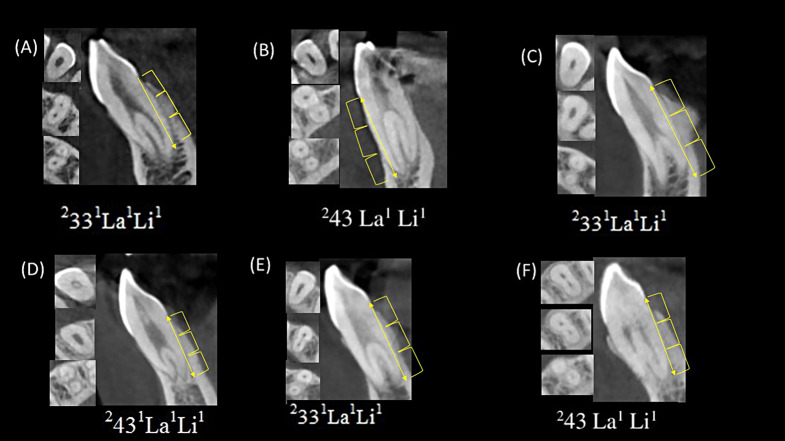
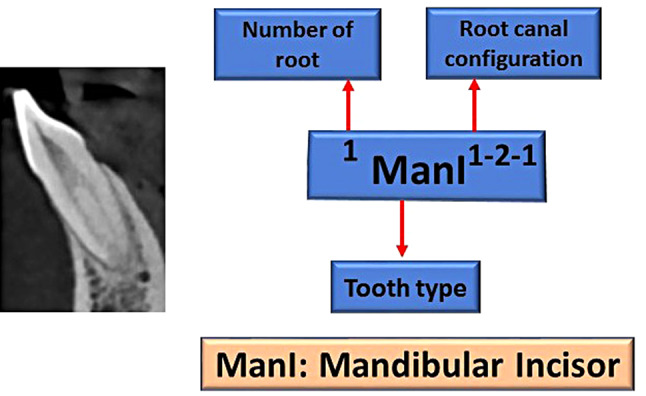
3342 lower anteriors were evaluated from 557 CBCT scans. The images were examined in sagittal, axial and coronal views using a CS 3D imaging software (V3.10.4, Carestream Dental). Demographic data recorded, the number of roots and canal's morphology were described according to Vertucci and Ahmed classifications.
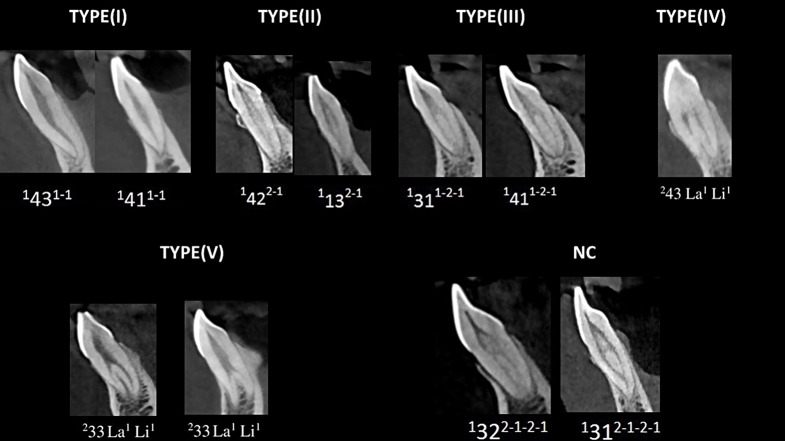
Frequency of Type I configuration was significantly the highest in incisors and canines (76%, N = 2539), followed by Type III (20.6%, N = 687). Type II (1.1%, N = 37), IV (1.1%, N = 37), and V (0.3%, N = 11) were rarely encountered. 0.9% (N = 31) of the teeth could not be classified with the Vertucci System. The frequency of 2 roots (MA in Ahmed classification) which has no correspondence in the Vertucci classification, was 1.1% (N = 38), it was significantly higher in canines and in females (35 canines and 3 laterals). A moderate correlation in root canal morpology was found between the left and right sides (V > 0.30). 80% (N = 2538) of the teeth did not exhibit any divergence/merging. The bifurcation level occurred mostly in the middle third of the root.
One fourth of anterior teeth had variation from the simple type I canal configuration and therefore requires attention during treatment. The new classification system offers a more accurate and simplified presentation of canal morphology.
The prevalence and mid root bifurcation of second canal in lower anteriors requires attention to ensure adequate quality root canal treatment without compromising the integrity of teeth.
充分了解根管形态及其变异对于根管治疗的成功和克服治疗失败至关重要。本研究旨在使用两种分类系统研究下颌前牙的根管和根形态。
从 557 个 CBCT 扫描中评估了 3342 个下颌前牙。使用 CS 3D 成像软件(V3.10.4,Carestream Dental)在矢状面、轴面和冠状面检查图像。记录人口统计学数据,根据 Vertucci 和 Ahmed 分类描述根管的数量和形态。
在切牙和尖牙中,I 型构型的频率明显最高(76%,N=2539),其次是 III 型(20.6%,N=687)。II 型(1.1%,N=37)、IV 型(1.1%,N=37)和 V 型(0.3%,N=11)很少见。0.9%(N=31)的牙齿无法用 Vertucci 系统进行分类。在 Ahmed 分类中没有对应 Vertucci 分类的双根(MA)的频率为 1.1%(N=38),在尖牙和女性中明显更高(35 颗尖牙和 3 颗侧切牙)。左右两侧根管形态存在中度相关性(V>0.30)。80%(N=2538)的牙齿没有任何分叉/融合。分叉发生在根的中三分之一处。
四分之一的前牙的根管形态与简单的 I 型不同,因此在治疗过程中需要注意。新的分类系统提供了一种更准确和简化的根管形态呈现方式。
下颌前牙的第二根管的存在和中根分叉需要注意,以确保高质量的根管治疗,同时不损害牙齿的完整性。