National Department of Public Health, Ministry of Health, Maputo City, Mozambique.
Department of Global Health, University of Washington, Seattle, WA, USA.
BMC Health Serv Res. 2024 Feb 2;24(1):164. doi: 10.1186/s12913-024-10638-4.
Scarce evidence exists on audit and feedback implementation processes in low-resource health systems. The Integrated District Evidence to Action (IDEAs) is a multi-component audit and feedback strategy designed to improve the implementation of maternal and child guidelines in Mozambique. We report IDEAs implementation outcomes.
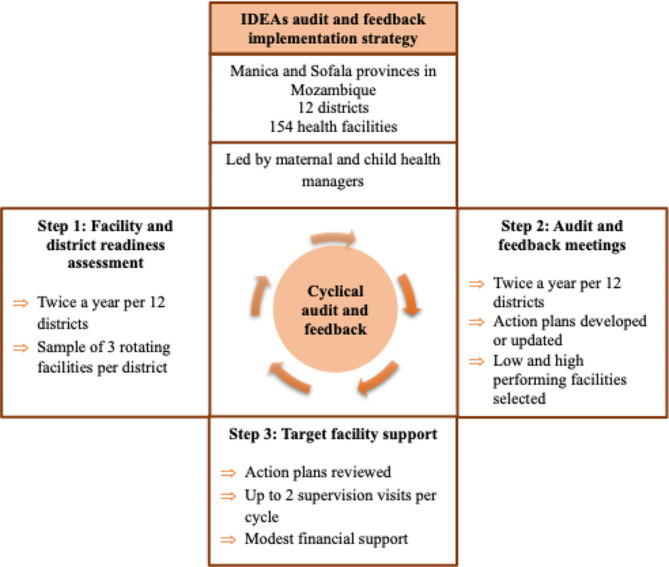
IDEAs was implemented in 154 health facilities across 12 districts in Manica and Sofala provinces between 2016 and 2020 and evaluated using a quasi-experimental design guided by the Reach, Effectiveness, Adoption, Implementation, and Maintenance (RE-AIM) framework. Reach is the proportion of pregnant women attending IDEAs facilities. Adoption is the proportion of facilities initiating audit and feedback meetings. Implementation is the fidelity to the strategy components, including readiness assessments, meetings (frequency, participation, action plan development), and targeted financial support and supervision. Maintenance is the sustainment at 12, 24, and 54 months.
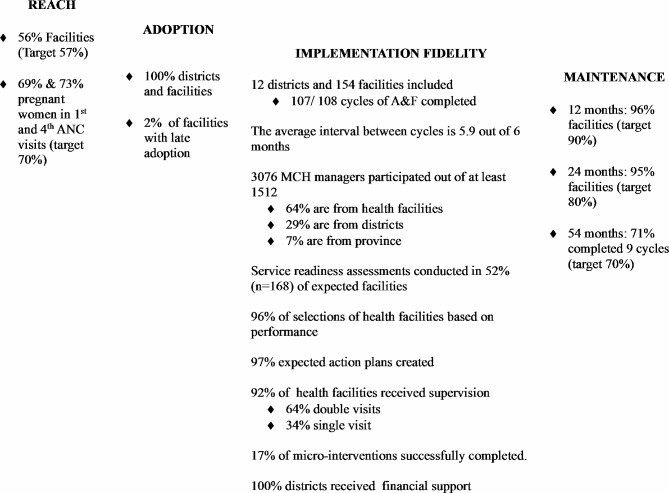
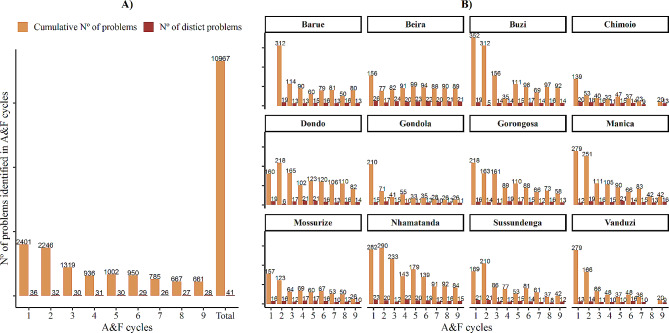
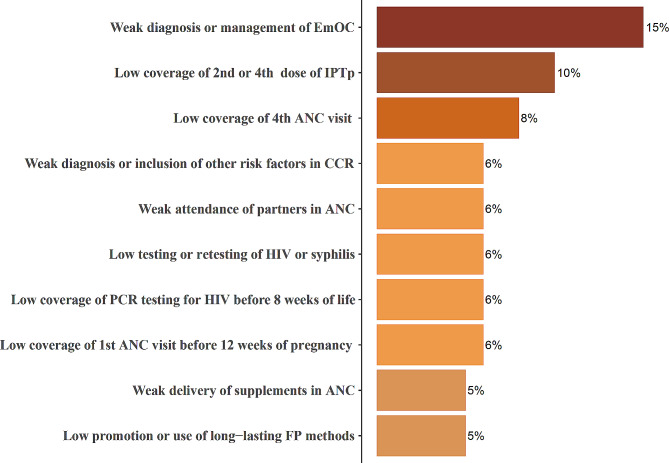
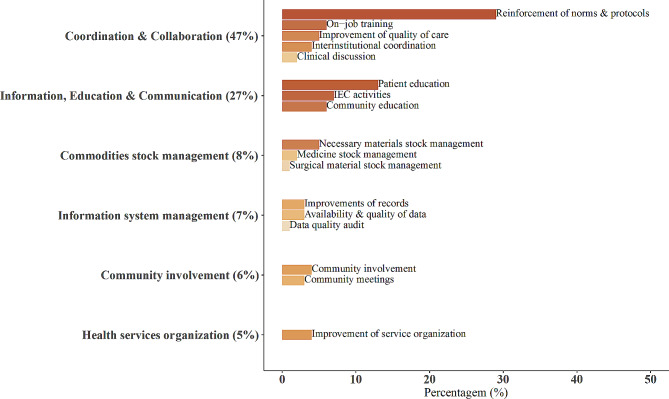
Across both provinces, 56% of facilities were exposed to IDEAs (target 57%). Sixty-nine and 73% of pregnant women attended those facilities' first and fourth antenatal consultations (target 70%). All facilities adopted the intervention. 99% of the expected meetings occurred with an average interval of 5.9 out of 6 months. Participation of maternal and child managers was high, with 3076 attending meetings, of which 64% were from the facility, 29% from the district, and 7% from the province level. 97% of expected action plans were created, and 41 specific problems were identified. "Weak diagnosis or management of obstetric complications" was identified as the main problem, and "actions to reinforce norms and protocols" was the dominant subcategory of micro-interventions selected. Fidelity to semiannual readiness assessments was low (52% of expected facilities), and in completing micro-interventions (17% were completed). Ninety-six and 95% of facilities sustained the intervention at 12 and 24 months, respectively, and 71% had completed nine cycles at 54 months.
Maternal and child managers can lead audit and feedback processes in primary health care in Mozambique with high reach, adoption, and maintenance. The IDEAs strategy should be adapted to promote higher fidelity around implementing action plans and conducting readiness assessments. Adding effectiveness to these findings will help to inform strategy scale-up.
在资源匮乏的卫生系统中,关于审核和反馈实施过程的证据十分有限。综合区域循证决策(IDEAs)是一种多组件的审核和反馈策略,旨在提高莫桑比克母婴指南的实施效果。我们报告了 IDEAs 的实施结果。
IDEAs 于 2016 年至 2020 年在马兰吉和索法拉省的 12 个区的 154 个卫生机构实施,并根据扩展、有效性、采用、实施和维持(RE-AIM)框架指导,采用准实验设计进行评估。可达性是指参加 IDEAs 设施的孕妇比例。采用是指启动审核和反馈会议的设施比例。实施是指对战略组件的保真度,包括准备情况评估、会议(频率、参与度、行动计划制定)以及有针对性的财务支持和监督。维持是指在 12、24 和 54 个月时的持续情况。
在两个省,有 56%的设施接受了 IDEAs(目标为 57%)。69%和 73%的孕妇参加了这些设施的第一次和第四次产前检查(目标为 70%)。所有设施都采用了干预措施。预期会议中有 99%发生,平均间隔为 6 个月 5.9 次。母婴管理人员的参与度很高,有 3076 人参加了会议,其中 64%来自设施,29%来自区,7%来自省。97%的预期行动计划得以制定,共确定了 41 个具体问题。“产科并发症的诊断或管理薄弱”被确定为主要问题,而“强化规范和协议的行动”则是选择的主要微干预子类别。半年度准备情况评估的完成率较低(预期设施中有 52%),微干预的完成率也较低(完成率为 17%)。96%和 95%的设施分别在 12 个月和 24 个月维持干预措施,71%的设施在 54 个月时完成了 9 个周期。
在莫桑比克的初级卫生保健中,母婴管理人员可以主导审核和反馈过程,具有较高的可达性、采用率和维持率。IDEAs 战略应进行调整,以促进在实施行动计划和开展准备情况评估方面提高保真度。在这些发现中加入有效性将有助于为战略的扩大提供信息。