University of British Columbia, Vancouver, Canada.
University of Northern British Columbia, Prince George, Canada.
BMC Cancer. 2024 Feb 3;24(1):171. doi: 10.1186/s12885-024-11905-7.
Radiotherapy delivery regimens can vary between a single fraction (SF) and multiple fractions (MF) given daily for up to several weeks depending on the location of the cancer or metastases. With limited evidence comparing fractionation regimens for oligometastases, there is support to explore toxicity levels to nearby organs at risk as a primary outcome while using SF and MF stereotactic ablative radiotherapy (SABR) as well as explore differences in patient-reported quality of life and experience.
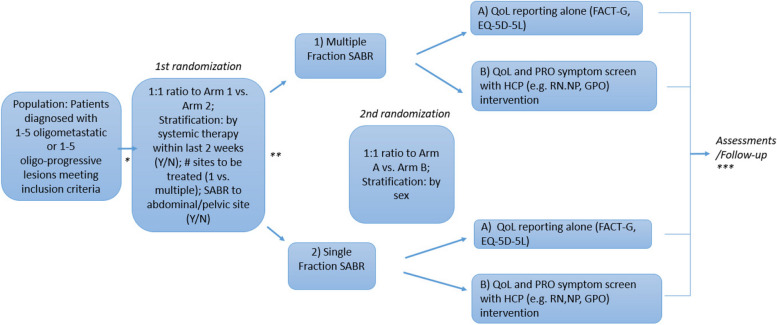
This study will randomize 598 patients in a 1:1 ratio between the standard arm (MF SABR) and the experimental arm (SF SABR). This trial is designed as two randomized controlled trials within one patient population for resource efficiency. The primary objective of the first randomization is to determine if SF SABR is non-inferior to MF SABR, with respect to healthcare provider (HCP)-reported grade 3-5 adverse events (AEs) that are related to SABR. Primary endpoint is toxicity while secondary endpoints include lesional control rate (LCR), and progression-free survival (PFS). The second randomization (BC Cancer sites only) will allocate participants to either complete quality of life (QoL) questionnaires only; or QoL questionnaires and a symptom-specific survey with symptom-guided HCP intervention. The primary objective of the second randomization is to determine if radiation-related symptom questionnaire-guided HCP intervention results in improved reported QoL as measured by the EuroQoL-5-dimensions-5levels (EQ-5D-5L) instrument. The primary endpoint is patient-reported QoL and secondary endpoints include: persistence/resolution of symptom reporting, QoL, intervention cost effectiveness, resource utilization, and overall survival.
This study will compare SF and MF SABR in the treatment of oligometastases and oligoprogression to determine if there is non-inferior toxicity for SF SABR in selected participants with 1-5 oligometastatic lesions. This study will also compare patient-reported QoL between participants who receive radiation-related symptom-guided HCP intervention and those who complete questionnaires alone.
Clinicaltrials.gov identifier: NCT05784428. Date of Registration: 23 March 2023.
根据癌症或转移灶的位置,放射治疗方案可在数周内每天给予单次分割(SF)或多次分割(MF)。由于寡转移瘤的分割方案证据有限,因此支持探索使用 SF 和 MF 立体定向消融放疗(SABR)时附近危及器官的毒性水平作为主要结局,同时探索患者报告的生活质量和体验差异。
本研究将按照 1:1 的比例将 598 名患者随机分配到标准组(MF SABR)和实验组(SF SABR)。该试验设计为同一患者人群内的两个随机对照试验,以提高资源效率。第一次随机的主要目的是确定 SF SABR 是否不劣于 MF SABR,对于与 SABR 相关的医疗保健提供者(HCP)报告的 3-5 级不良事件(AE)。主要终点是毒性,次要终点包括病变控制率(LCR)和无进展生存期(PFS)。第二次随机(仅限 BC 癌症部位)将参与者分配到仅完成全面生活质量(QoL)问卷;或 QoL 问卷和症状特异性调查与症状指导的 HCP 干预。第二次随机的主要目的是确定放射相关症状问卷指导的 HCP 干预是否会改善报告的 QoL,用欧洲五维健康量表(EQ-5D-5L)工具进行测量。主要终点是患者报告的 QoL,次要终点包括:症状报告的持续/缓解、QoL、干预成本效益、资源利用和总生存期。
本研究将比较 SF 和 MF SABR 在治疗寡转移瘤和寡进展中的作用,以确定在 1-5 个寡转移灶的选定参与者中,SF SABR 的毒性是否不劣于 MF SABR。本研究还将比较接受放射相关症状指导的 HCP 干预的参与者和仅完成问卷的参与者之间的患者报告的 QoL。
Clinicaltrials.gov 标识符:NCT05784428。注册日期:2023 年 3 月 23 日。