Wang Yu-Cong, Jin Xin-Yang, Lei Zheng, Liu Xiao-Jiao, Liu Yu, Zhang Bang-Guo, Gong Jian, Wang Lie-Tao, Shi Lv-Yuan, Wan Ding-Yuan, Fu Xin, Wang Lu-Ping, Ma Ai-Jia, Cheng Yi-Song, Yang Jing, He Min, Jin Xiao-Dong, Kang Yan, Wang Bo, Zhang Zhong-Wei, Wu Qin
Department of Critical Care Medicine, West China Hospital, Sichuan University, Chengdu 610041, Sichuan Province, China.
School of Pharmacy, Macau University of Science and Technology, Macau 999078, China.
World J Gastroenterol. 2024 Jan 28;30(4):346-366. doi: 10.3748/wjg.v30.i4.346.
Extreme heat exposure is a growing health problem, and the effects of heat on the gastrointestinal (GI) tract is unknown. This study aimed to assess the incidence of GI symptoms associated with heatstroke and its impact on outcomes.
To assess the incidence of GI symptoms associated with heatstroke and its impact on outcomes.
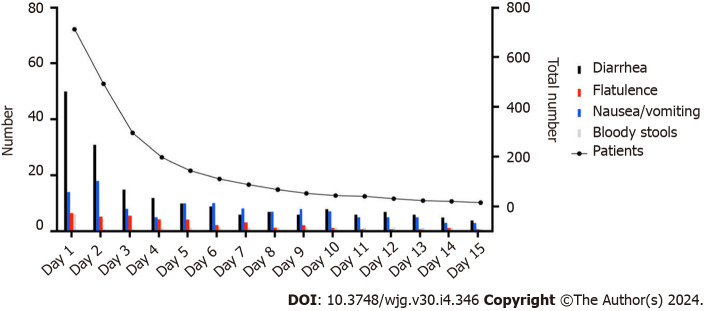
Patients admitted to the intensive care unit (ICU) due to heatstroke were included from 83 centres. Patient history, laboratory results, and clinically relevant outcomes were recorded at ICU admission and daily until up to day 15, ICU discharge, or death. GI symptoms, including nausea/vomiting, diarrhoea, flatulence, and bloody stools, were recorded. The characteristics of patients with heatstroke concomitant with GI symptoms were described. Multivariable regression analyses were performed to determine significant predictors of GI symptoms.
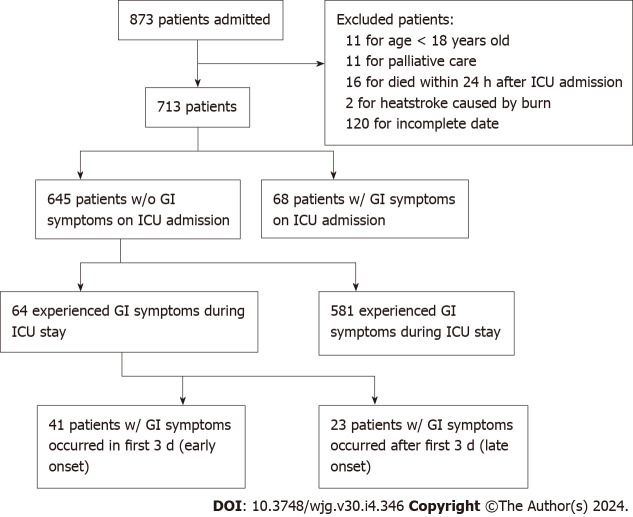
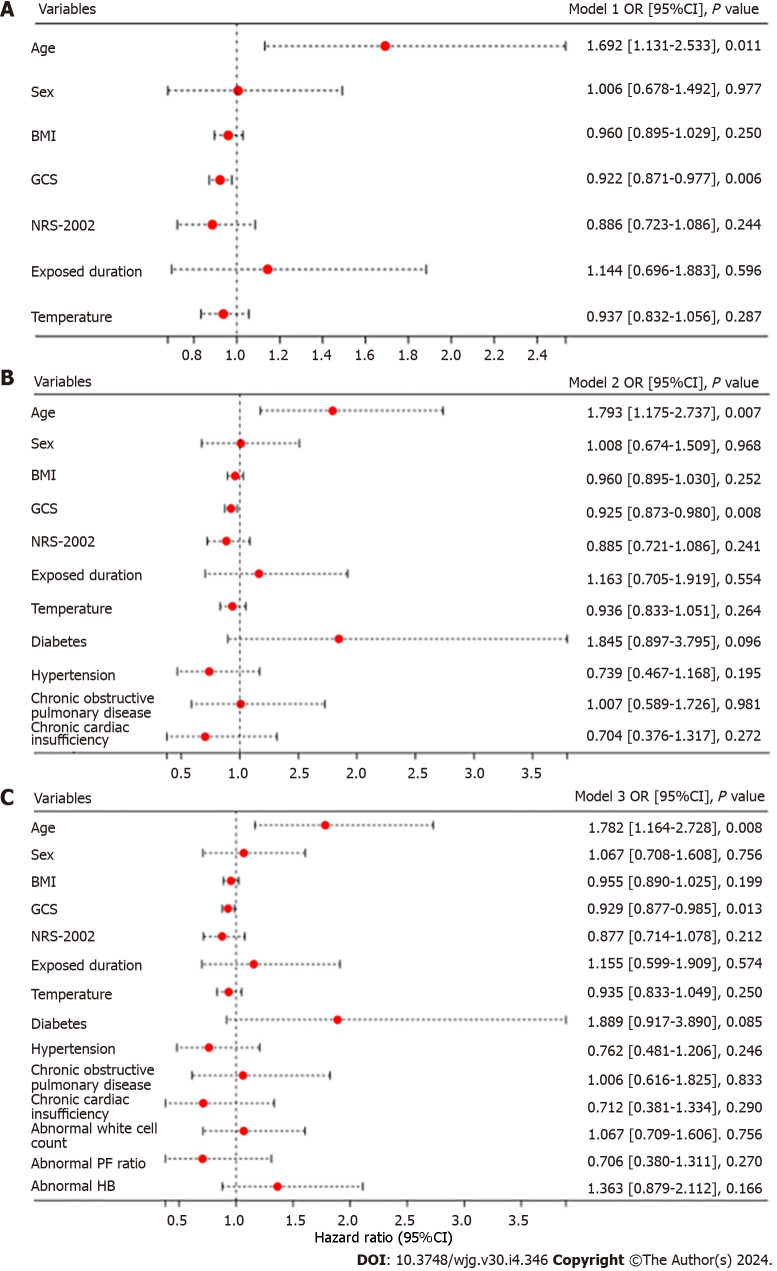
A total of 713 patients were included in the final analysis, of whom 132 (18.5%) patients had at least one GI symptom during their ICU stay, while 26 (3.6%) suffered from more than one symptom. Patients with GI symptoms had a significantly higher ICU stay compared with those without. The mortality of patients who had two or more GI symptoms simultaneously was significantly higher than that in those with one GI symptom. Multivariable logistic regression analysis revealed that older patients with a lower GCS score on admission were more likely to experience GI symptoms.
The GI manifestations of heatstroke are common and appear to impact clinically relevant hospitalization outcomes.
极端高温暴露是一个日益严重的健康问题,而高温对胃肠道(GI)的影响尚不清楚。本研究旨在评估与中暑相关的胃肠道症状的发生率及其对预后的影响。
评估与中暑相关的胃肠道症状的发生率及其对预后的影响。
从83个中心纳入因中暑入住重症监护病房(ICU)的患者。在ICU入院时及直至第15天、ICU出院或死亡期间,记录患者病史、实验室检查结果及临床相关预后情况。记录胃肠道症状,包括恶心/呕吐、腹泻、腹胀和便血。描述伴有胃肠道症状的中暑患者的特征。进行多变量回归分析以确定胃肠道症状的显著预测因素。
最终分析共纳入713例患者,其中132例(18.5%)患者在ICU住院期间至少出现一种胃肠道症状,26例(3.6%)患者出现一种以上症状。有胃肠道症状的患者ICU住院时间显著长于无胃肠道症状的患者。同时出现两种或更多胃肠道症状的患者死亡率显著高于出现一种胃肠道症状的患者。多变量逻辑回归分析显示,入院时格拉斯哥昏迷评分(GCS)较低的老年患者更易出现胃肠道症状。
中暑的胃肠道表现很常见,且似乎会影响临床相关的住院预后。