Hasan Rifat, Kasera Nitesh, Beck Ashley E, Hall Steven G
Department of Biological and Agricultural Engineering, North Carolina State University, Raleigh, NC, USA.
Department of Biological and Environmental Sciences, Carroll College, Helena, MT, USA.
Heliyon. 2024 Jan 18;10(3):e24646. doi: 10.1016/j.heliyon.2024.e24646. eCollection 2024 Feb 15.
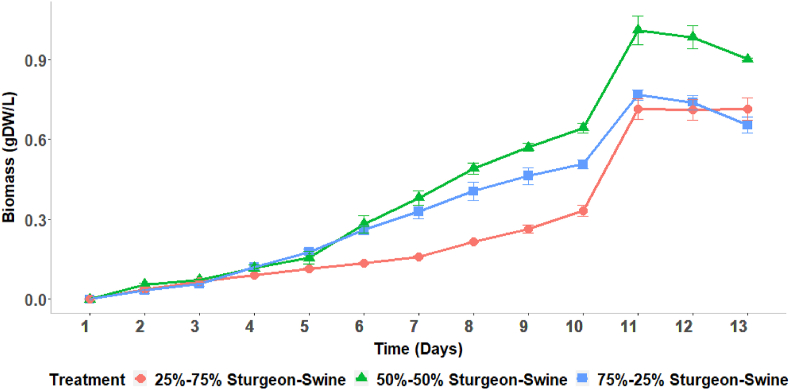
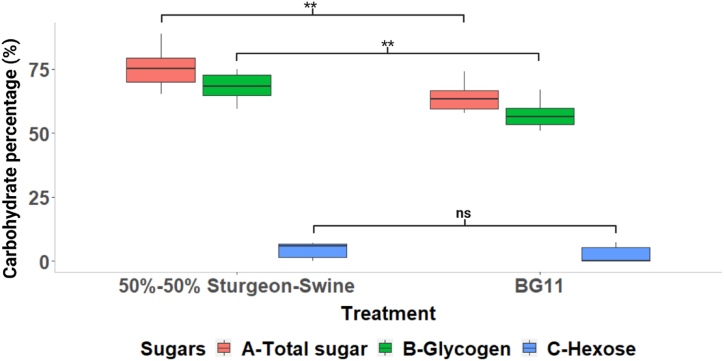
The demand for protein is increasing with an expanding world population and is influencing the rapid growth of fish and animal agriculture. These sectors are becoming a significant source of water pollution and need to develop environmentally sustainable techniques that are cost-effective, ideally with potential for downstream value-added production. This study investigated the potential of one of the fastest-growing cyanobacterial species, UTEX 2973, for bioremediation of mixed wastewater (combination of sturgeon and swine wastewater). Three different mixing ratios (25:75, 50:50, and 75:25 sturgeon:swine) were compared to find a suitable combination for the growth of as well as carbohydrate accumulation in biomass. The final biomass production was found to be 0.65 ± 0.03 g Dry cell Weight (DW)/L for 75%-25 %, 0.90 ± 0.004 g DW/L for 50%-50 %, and 0.71 ± 0.04 g DW/L for 25%-75 % sturgeon-swine wastewater combination. Cyanobacteria cultivated in 50%-50 % sturgeon-swine wastewater also accumulated 70 % total carbohydrate of DW, whereas 75%-25 % sturgeon-swine and 25%-75 % sturgeon-swine accumulated 53 % and 45 %, respectively. Subsequently, the cells were grown in a separate batch of 50%-50 % sturgeon-swine wastewater and compared with cells grown in BG11 synthetic growth media. Cultivation in BG11 resulted in higher biomass production but lower carbohydrate accumulation than 50%-50 % mixed wastewater. Final biomass production was 0.85 ± 0.08 g DW/L for BG11 and 0.65 ± 0.04 g DW/L for 50%-50 % sturgeon-swine wastewater. Total carbohydrate accumulated was 75 % and 64 % of DW for 50%-50 % sturgeon-swine mixed wastewater and BG11 growth media, respectively, where glycogen was the main carbohydrate component (90 %). The nutrient removal efficiencies of were 67.15 % for orthophosphate, 93.39 % for nitrate-nitrite, and 97.98 % for ammonia. This study suggested that is a promising candidate for enabling simultaneous bioremediation of mixed wastewater and the production of value-added biochemicals.
随着世界人口的增长,对蛋白质的需求不断增加,这推动了鱼类和畜牧业的快速发展。这些行业正成为水污染的重要来源,需要开发具有成本效益的环境可持续技术,理想情况下还应具备下游增值生产的潜力。本研究调查了生长最快的蓝藻物种之一——UTEX 2973对混合废水(鲟鱼和猪废水的混合物)进行生物修复的潜力。比较了三种不同的混合比例(鲟鱼:猪为25:75、50:50和75:25),以找到适合其生长以及生物量中碳水化合物积累的合适组合。结果发现,对于75%-25%的组合,最终生物量产量为0.65±0.03克干细胞重量(DW)/升;对于50%-50%的组合,为0.90±0.004克DW/升;对于25%-75%的鲟鱼-猪废水组合,为0.71±0.04克DW/升。在50%-50%的鲟鱼-猪废水中培养的蓝藻还积累了占DW 70%的总碳水化合物,而75%-25%和25%-75%的鲟鱼-猪组合分别积累了53%和45%。随后,将细胞在另一批50%-50%的鲟鱼-猪废水中培养,并与在BG11合成生长培养基中培养的细胞进行比较。在BG11中培养导致生物量产量更高,但碳水化合物积累低于50%-50%的混合废水。BG11的最终生物量产量为0.85±0.08克DW/升,50%-50%的鲟鱼-猪废水为0.65±0.04克DW/升。50%-50%的鲟鱼-猪混合废水和BG11生长培养基中积累的总碳水化合物分别占DW的75%和64%,其中糖原是主要的碳水化合物成分(90%)。对正磷酸盐的营养去除效率为67.15%,对硝酸盐-亚硝酸盐为93.39%,对氨为97.98%。本研究表明,该蓝藻是实现混合废水同步生物修复和增值生化产品生产的有潜力的候选者。