Liggins Institute, The University of Auckland, Auckland, New Zealand.
Department of Psychological Medicine, University of Auckland, Auckland, New Zealand.
BMJ Open. 2024 Feb 6;14(2):e074625. doi: 10.1136/bmjopen-2023-074625.
Autism (formally autism spectrum disorder) encompasses a group of complex neurodevelopmental conditions, characterised by differences in communication and social interactions. Co-occurring chronic gastrointestinal symptoms are common among autistic individuals and can adversely affect their quality of life. This study aims to evaluate the efficacy of oral encapsulated faecal microbiome transfer (FMT) in improving gastrointestinal symptoms and well-being among autistic adolescents and adults.
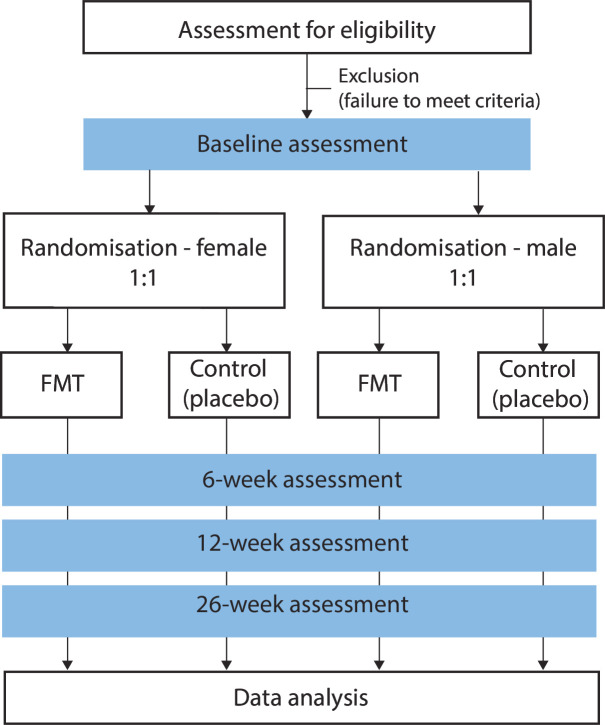
This double-blind, randomised, placebo-controlled trial will recruit 100 autistic adolescents and adults aged 16-45 years, who have mild to severe gastrointestinal symptoms (Gastrointestinal Symptoms Rating Scale (GSRS) score ≥2.0). We will also recruit eight healthy donors aged 18-32 years, who will undergo extensive clinical screening. Recipients will be randomised 1:1 to receive FMT or placebo, stratified by biological sex. Capsules will be administered over two consecutive days following an overnight bowel cleanse with follow-up assessments at 6, 12 and 26 weeks post-treatment. The primary outcome is GSRS score at 6 weeks. Other assessments include anthropometry, body composition, hair cortisol concentration, gut microbiome profile, urine/plasma gut-derived metabolites, plasma markers of gut inflammation/permeability and questionnaires on general well-being, sleep quality, physical activity, food diversity and treatment tolerability. Adverse events will be recorded and reviewed by an independent data monitoring committee.
Ethics approval for the study was granted by the Central Health and Disability Ethics Committee on 24 August 2021 (reference number: 21/CEN/211). Results will be published in peer-reviewed journals and presented to both scientific and consumer group audiences.
ACTRN12622000015741.
自闭症(正式名称为自闭症谱系障碍)包含一组复杂的神经发育障碍,其特征是在沟通和社交互动方面存在差异。自闭症患者常伴有并存的慢性胃肠道症状,这些症状会对他们的生活质量产生不利影响。本研究旨在评估口服封装粪便微生物群移植(FMT)在改善自闭症青少年和成年人胃肠道症状和幸福感方面的疗效。
这是一项双盲、随机、安慰剂对照试验,将招募 100 名年龄在 16-45 岁、有轻度至重度胃肠道症状(胃肠道症状评分量表(GSRS)评分≥2.0)的自闭症青少年和成年人。我们还将招募 8 名年龄在 18-32 岁之间的健康供体,他们将接受广泛的临床筛查。接受者将按照生物性别分层 1:1 随机分为 FMT 组或安慰剂组。胶囊将在连续两天内服用,在一夜的肠道清洁后开始,在治疗后 6、12 和 26 周进行随访评估。主要结局是 6 周时的 GSRS 评分。其他评估包括人体测量、身体成分、头发皮质醇浓度、肠道微生物组谱、尿液/血浆肠道衍生代谢物、肠道炎症/通透性的血浆标志物以及一般幸福感、睡眠质量、身体活动、食物多样性和治疗耐受性的问卷。将记录不良事件并由独立的数据监测委员会进行审查。
该研究的伦理批准于 2021 年 8 月 24 日获得中央卫生和残疾伦理委员会的批准(参考编号:21/CEN/211)。结果将发表在同行评议的期刊上,并提交给科学和消费者群体。
ACTRN12622000015741。