The Liggins Institute, University of Auckland, Auckland, New Zealand.
The Broad Institute of MIT and Harvard, Cambridge, MA, USA.
Microbiome. 2021 May 13;9(1):107. doi: 10.1186/s40168-021-01060-7.
Donor selection is an important factor influencing the engraftment and efficacy of fecal microbiota transplantation (FMT) for complex conditions associated with microbial dysbiosis. However, the degree, variation, and stability of strain engraftment have not yet been assessed in the context of multiple donors.
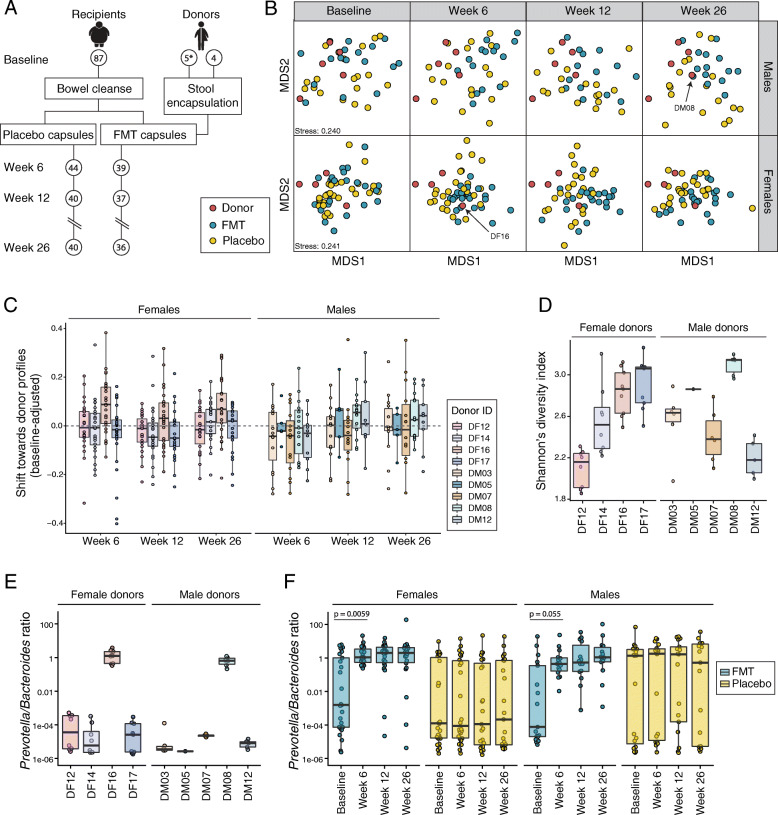
We conducted a double-blinded randomized control trial of FMT in 87 adolescents with obesity. Participants were randomized to receive multi-donor FMT (capsules containing the fecal microbiota of four sex-matched lean donors) or placebo (saline capsules). Following a bowel cleanse, participants ingested a total of 28 capsules over two consecutive days. Capsules from individual donors and participant stool samples collected at baseline, 6, 12, and 26 weeks post-treatment were analyzed by shotgun metagenomic sequencing allowing us to track bacterial strain engraftment and its functional implications on recipients' gut microbiomes.
Multi-donor FMT sustainably altered the structure and the function of the gut microbiome. In what was effectively a microbiome competition experiment, we discovered that two donor microbiomes (one female, one male) dominated strain engraftment and were characterized by high microbial diversity and a high Prevotella to Bacteroides (P/B) ratio. Engrafted strains led to enterotype-level shifts in community composition and provided genes that altered the metabolic potential of the community. Despite our attempts to standardize FMT dose and origin, FMT recipients varied widely in their engraftment of donor strains.
Our study provides evidence for the existence of FMT super-donors whose microbiomes are highly effective at engrafting in the recipient gut. Dominant engrafting male and female donor microbiomes harbored diverse microbial species and genes and were characterized by a high P/B ratio. Yet, the high variability of strain engraftment among FMT recipients suggests the host environment also plays a critical role in mediating FMT receptivity.
The Gut Bugs trial was registered with the Australian New Zealand Clinical Trials Registry ( ACTRN12615001351505 ).
The trial protocol is available at https://bmjopen.bmj.com/content/9/4/e026174 . Video Abstract.
供体选择是影响粪便微生物群移植(FMT)治疗与微生物失调相关的复杂疾病的移植和疗效的重要因素。然而,在多个供体的情况下,尚未评估菌株定植的程度、变异性和稳定性。
我们对 87 名肥胖青少年进行了 FMT 的双盲随机对照试验。参与者被随机分为多供体 FMT(胶囊含有 4 名性别匹配的瘦供体的粪便微生物群)或安慰剂(盐水胶囊)。在进行肠道清洁后,参与者在连续两天内共服用 28 粒胶囊。对来自个体供体和参与者基线、6、12 和 26 周治疗后粪便样本的胶囊进行 shotgun 宏基因组测序分析,使我们能够跟踪细菌菌株定植及其对受者肠道微生物组的功能影响。
多供体 FMT 可持续改变肠道微生物组的结构和功能。在实际上是微生物组竞争实验中,我们发现两个供体微生物组(一个女性,一个男性)主导菌株定植,其特点是微生物多样性高,普雷沃氏菌与拟杆菌(P/B)比值高。定植的菌株导致群落组成发生肠型水平的转变,并提供改变群落代谢潜力的基因。尽管我们试图标准化 FMT 剂量和来源,但 FMT 受者在供体菌株的定植上差异很大。
我们的研究为 FMT 超级供体的存在提供了证据,其微生物组在受者肠道中非常有效地定植。占主导地位的定植男性和女性供体微生物组含有多种微生物物种和基因,其特点是 P/B 比值高。然而,FMT 受者中菌株定植的高度可变性表明宿主环境也在介导 FMT 接受性方面发挥着关键作用。
肠道细菌试验在澳大利亚新西兰临床试验注册中心(ACTRN12615001351505)注册。
试验方案可在 https://bmjopen.bmj.com/content/9/4/e026174 获得。视频摘要。