Fu Wenxuan, Yue Yuhong, Song Yichuan, Zhang Shunli, Shi Jie, Zhao Rui, Wang Qingtao, Zhang Rui
Department of Clinical Laboratory, Beijing Chao-yang Hospital, Capital Medical University, Beijing, China.
Heliyon. 2024 Jan 29;10(3):e25158. doi: 10.1016/j.heliyon.2024.e25158. eCollection 2024 Feb 15.
This study aimed to assess the current status of carcinoembryonic antigen (CEA) detection. We evaluated the correlation, consistency, and comparability of CEA results among six automated immunoassays, and combined with the results of CEA trueness verification of the Beijing Center for Clinical Laboratories (BCCL) for further analysis.
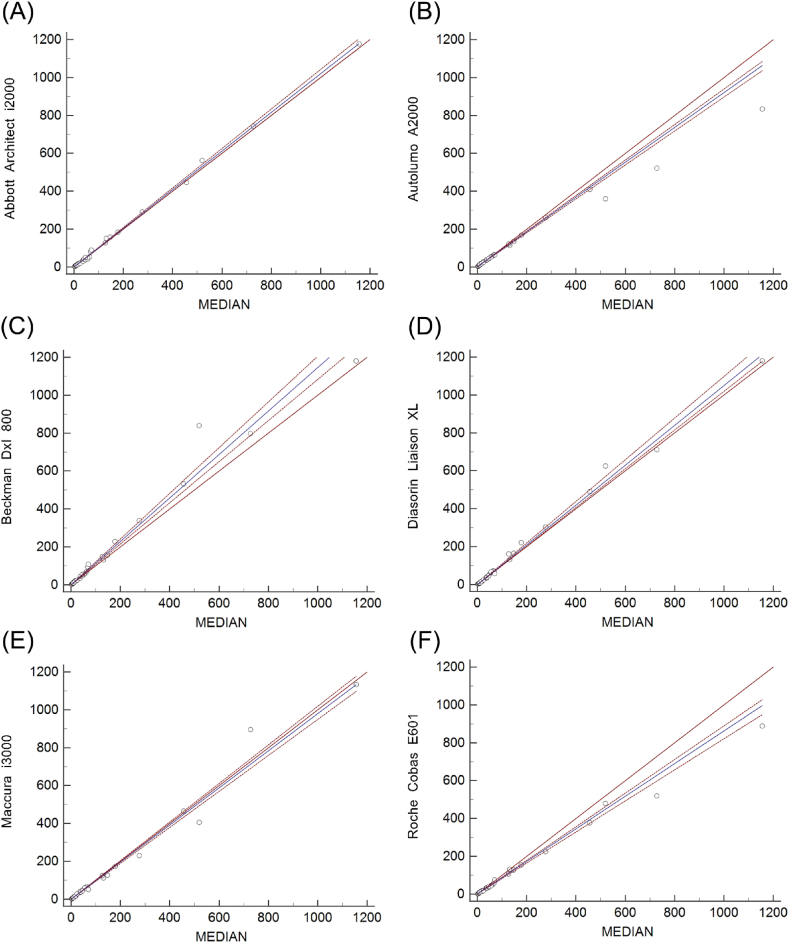
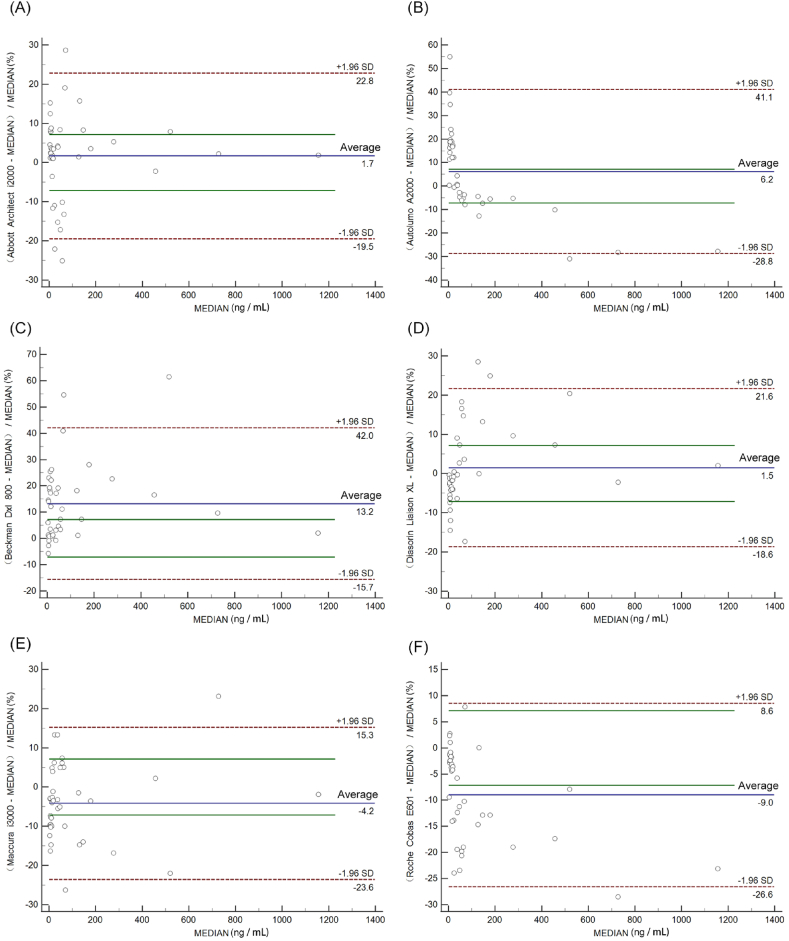
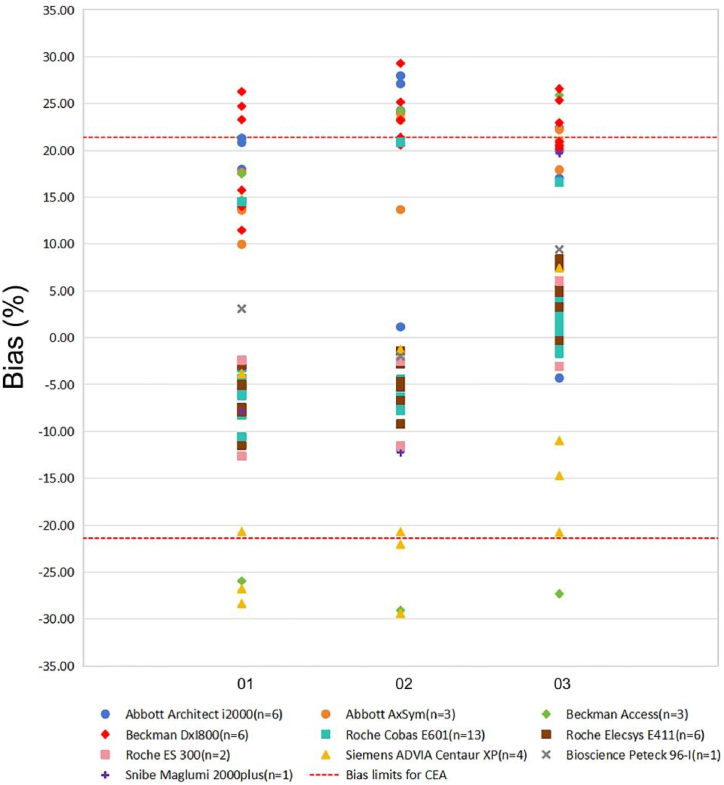
Abbott Architect i2000, Beckman DxI800, Roche Cobas E601, Diasorin Liaison XL, Maccura IS1200, and Autolumo A2000 were used to detect 40 individual serum CEA samples. Taking the optimal analytical quality specifications calculated from data on biological variation as the evaluation criterion. Passing-Bablok regression and Bland-Altman analysis were performed between each assay and all-assays median values to evaluate the correlation and relative difference. The concordance correlation coefficient (CCC) was used for consistency analysis. Additionally, the trueness verification program used samples at three concentration levels to assess the bias, coefficient of variation (CV), and total error (TE) between the average measured values and the target value.
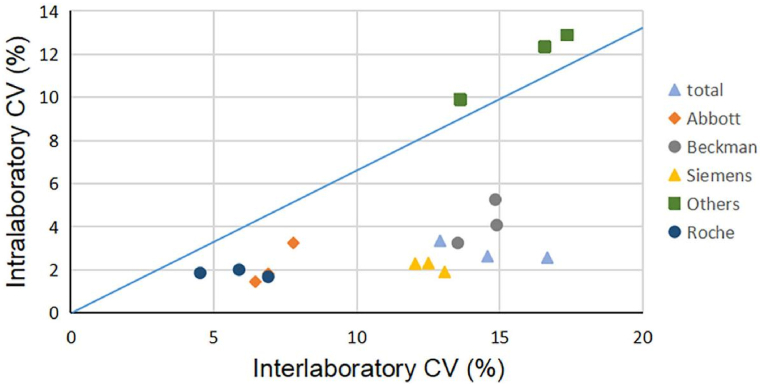
The Spearman's rank correlation coefficient (r) was ≥0.996 and the CCC ranged between 0.9448 and 0.9990 for each assay vs. all-assays median. Considering the all-assays median value of each sample as a reference, there were proportional and systematic differences according to the Passing-bablok regression analysis. The relative difference of the four assays (Abbott Architect i2000, Autolumo A2000, Diasorin Liaison XL, and Maccura IS1200) met the optimal analytical quality specifications. On the other hand, Beckman DxI800 (13.2 %) and Roche Cobas E601 (-9.0 %) were only able to fulfill the desirable analytical quality specifications. The average pass rates for bias, CV, and TE of the trueness verification program were 80 %, 98 %, and 96 %, respectively.
The six automated immunoassays vs. all-assays median have a good correlation in CEA detection. However, there is a lack of comparability of CEA results. Further improvements are needed in harmonization among CEA detections.
本研究旨在评估癌胚抗原(CEA)检测的现状。我们评估了六种自动化免疫测定法之间CEA结果的相关性、一致性和可比性,并结合北京临床检验中心(BCCL)的CEA准确性验证结果进行进一步分析。
使用雅培Architect i2000、贝克曼DxI800、罗氏Cobas E601、索灵Liaison XL、迈瑞IS1200和全自动生化分析仪Autolumo A2000检测40份个体血清CEA样本。以根据生物学变异数据计算出的最佳分析质量规范作为评估标准。在每种测定法与所有测定法的中位数之间进行Passing-Bablok回归分析和Bland-Altman分析,以评估相关性和相对差异。一致性相关系数(CCC)用于一致性分析。此外,准确性验证程序使用三个浓度水平的样本评估平均测量值与目标值之间的偏差、变异系数(CV)和总误差(TE)。
每种测定法与所有测定法中位数的Spearman等级相关系数(r)≥0.996,CCC在0.9448至0.9990之间。以每个样本的所有测定法中位数为参考,根据Passing-bablok回归分析存在比例差异和系统差异。四种测定法(雅培Architect i2000、全自动生化分析仪Autolumo A2000、索灵Liaison XL和迈瑞IS1200)的相对差异符合最佳分析质量规范。另一方面,贝克曼DxI800(13.2%)和罗氏Cobas E601(-9.0%)仅能满足理想的分析质量规范。准确性验证程序的偏差、CV和TE的平均通过率分别为80%、98%和96%。
六种自动化免疫测定法与所有测定法中位数在CEA检测中具有良好的相关性。然而,CEA结果缺乏可比性。CEA检测之间的协调性需要进一步改进。