Liu Yanyan, Li Meijiao, Zhang Hao, Gao Le, Liu Jitao, Zhu Xuetong, Li Chenzhong, Liu Shan, Hou Yue, Xu Jiancheng
School of Life Science and Technology, Changchun University of Technology, Changchun 130013, China.
Jilin Getein Biotechnology Co., Ltd, Changchun, Jilin 130103, China.
BME Front. 2024 Dec 23;5:0085. doi: 10.34133/bmef.0085. eCollection 2024.
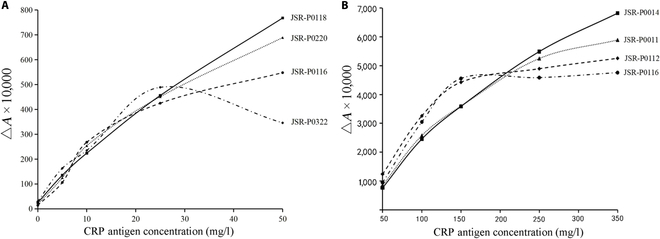
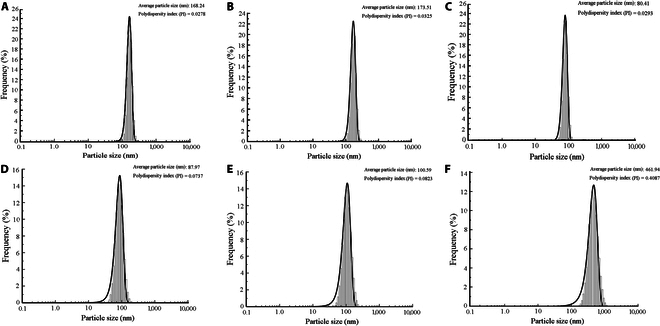
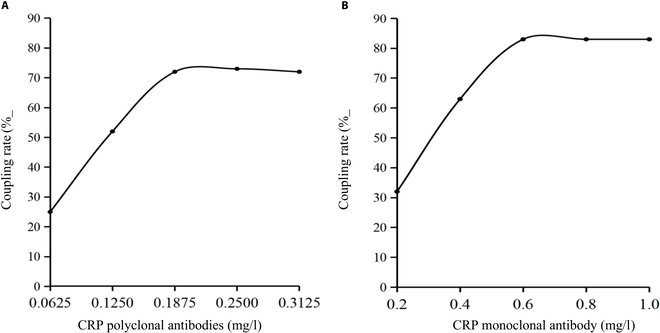
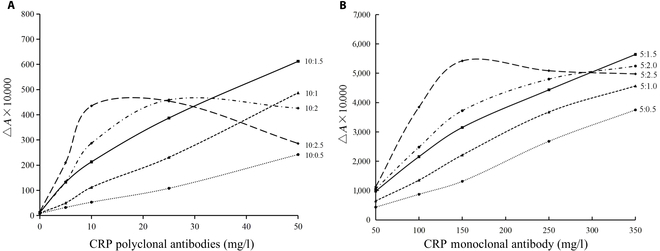
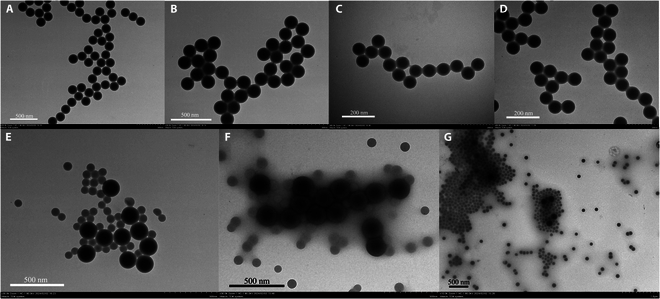
This study aims to couple C-reactive protein (CRP) antibodies onto latex spheres of 2 different sizes to enhance the accuracy and sensitivity of CRP detection. Furthermore, it seeks to establish a robust methodological framework crucial for advancing the development of latex-enhanced immunoturbidimetric detection reagents. CRP, an acute-phase protein, rapidly elevates in response to infections or tissue damage. Double-particle latex-enhanced immunoturbidimetry offers important advantages for accurately measuring CRP levels. CRP antibodies were coupled with 2 sizes of polystyrene latex spheres. Coupling rates were evaluated to determine optimal conditions. Particle sizes suitable for CRP detection, as well as coupling and mixing ratios, were optimized using automated biochemical analysis. Transmission electron microscopy and nanoparticle size analysis were employed to characterize the morphology and size changes of CRP antibodies and coupled latex spheres before and after immune reaction. Optimization identified 168- and 80-nm latex sphere sizes, with CRP antibody coupling rates of 92% and 91%, respectively. The optimal ratios were 10:1.5 for large latex spheres to polyclonal antibodies and 5:1.5 for small latex spheres to monoclonal antibodies. A 1:8 mixing ratio of large to small latex spheres was effective. Transmission electron microscopy confirmed uniform sizes postcoupling, maintaining dispersion with no morphological changes. CRP reacted with the double-particle latex reagent, forming immune complexes that exhibited agglutination. Mixed latex spheres showed varied agglutination states with CRP concentration, altering solution absorbance. This study validates the efficacy of the dual-particle-size CRP antibody latex reagent, highlighting its potential for future immunoturbidimetric analysis applications.
本研究旨在将C反应蛋白(CRP)抗体偶联到两种不同大小的乳胶微球上,以提高CRP检测的准确性和灵敏度。此外,本研究旨在建立一个稳健的方法框架,这对于推进乳胶增强免疫比浊检测试剂的开发至关重要。CRP是一种急性期蛋白,在受到感染或组织损伤时会迅速升高。双颗粒乳胶增强免疫比浊法在准确测量CRP水平方面具有重要优势。将CRP抗体与两种大小的聚苯乙烯乳胶微球偶联。评估偶联率以确定最佳条件。使用自动生化分析优化适合CRP检测的颗粒大小以及偶联和混合比例。采用透射电子显微镜和纳米颗粒大小分析来表征免疫反应前后CRP抗体和偶联乳胶微球的形态和大小变化。优化确定了168纳米和80纳米的乳胶微球大小,CRP抗体偶联率分别为92%和91%。最佳比例为大乳胶微球与多克隆抗体为10:1.5,小乳胶微球与单克隆抗体为5:1.5。大、小乳胶微球的混合比例为1:8是有效的。透射电子显微镜证实偶联后大小均匀,保持分散且无形态变化。CRP与双颗粒乳胶试剂反应,形成表现出凝集的免疫复合物。混合乳胶微球与CRP浓度呈现出不同的凝集状态,改变了溶液吸光度。本研究验证了双粒径CRP抗体乳胶试剂的有效性,突出了其在未来免疫比浊分析应用中的潜力。