Hanai Akiko, Ishikawa Tetsuo, Sugao Shoko, Fujii Makoto, Hirai Kei, Watanabe Hiroko, Matsuzaki Masayo, Nakamoto Goji, Takeda Toshihiro, Kitabatake Yasuji, Itoh Yuichi, Endo Masayuki, Kimura Tadashi, Kawakami Eiryo
Medical Data Mathematical Reasoning Team, Advanced Data Science Project, RIKEN Information R&D and Strategy Headquarters, RIKEN, Yokohama, Japan.
Artificial Intelligence Medicine, Graduate School of Medicine, Chiba University, Chiba, Japan.
JMIR Form Res. 2024 Feb 7;8:e47372. doi: 10.2196/47372.
One life event that requires extensive resilience and adaptation is parenting. However, resilience and perceived support in child-rearing vary, making the real-world situation unclear, even with postpartum checkups.
This study aimed to explore the psychosocial status of mothers during the child-rearing period from newborn to toddler, with a classifier based on data on the resilience and adaptation characteristics of mothers with newborns.
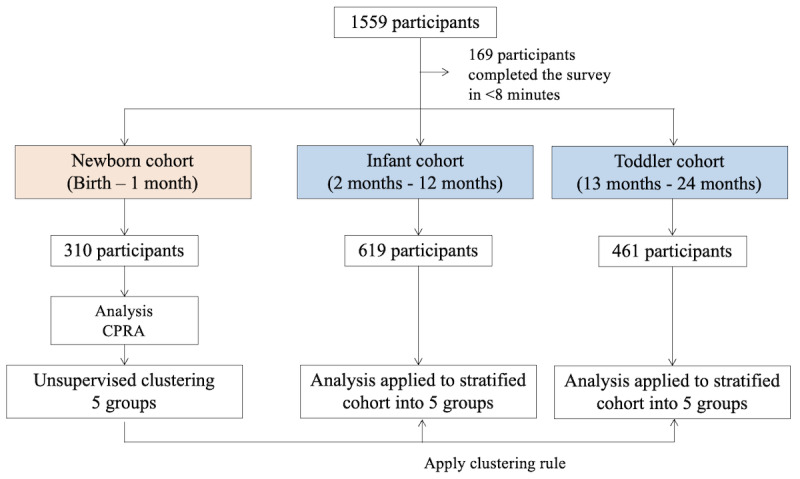
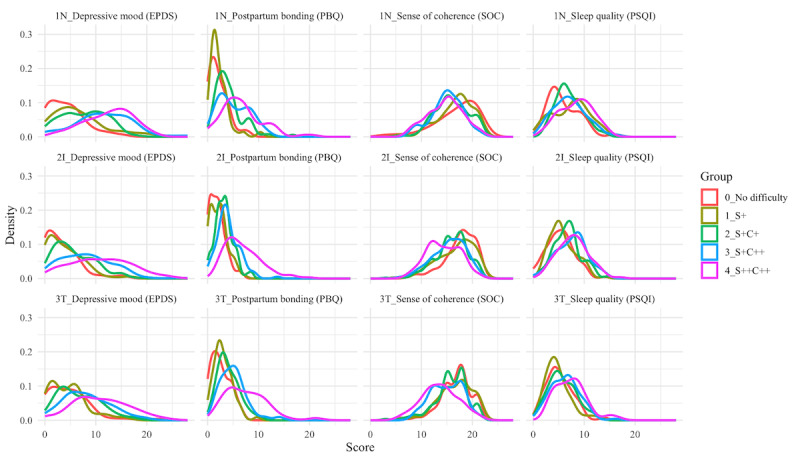
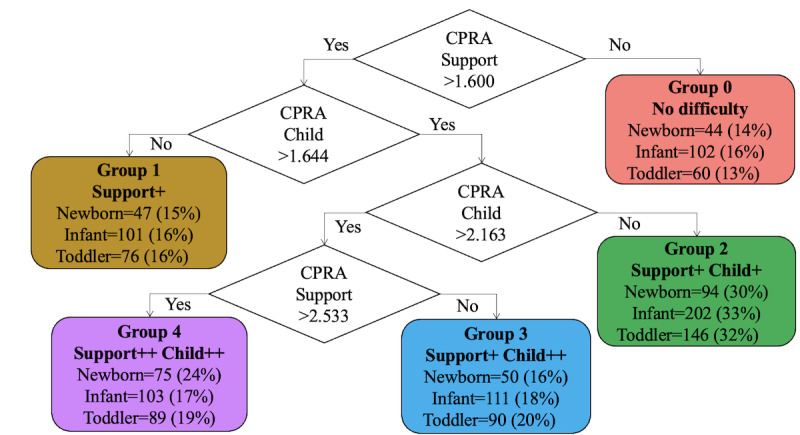
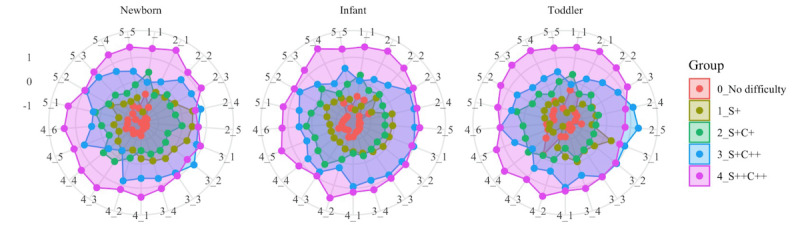
A web-based cross-sectional survey was conducted. Mothers with newborns aged approximately 1 month (newborn cohort) were analyzed to construct an explainable machine learning classifier to stratify parenting-related resilience and adaptation characteristics and identify vulnerable populations. Explainable k-means clustering was used because of its high explanatory power and applicability. The classifier was applied to mothers with infants aged 2 months to 1 year (infant cohort) and mothers with toddlers aged >1 year to 2 years (toddler cohort). Psychosocial status, including depressed mood assessed by the Edinburgh Postnatal Depression Scale (EPDS), bonding assessed by the Postpartum Bonding Questionnaire (PBQ), and sleep quality assessed by the Pittsburgh Sleep Quality Index (PSQI) between the classified groups, was compared.
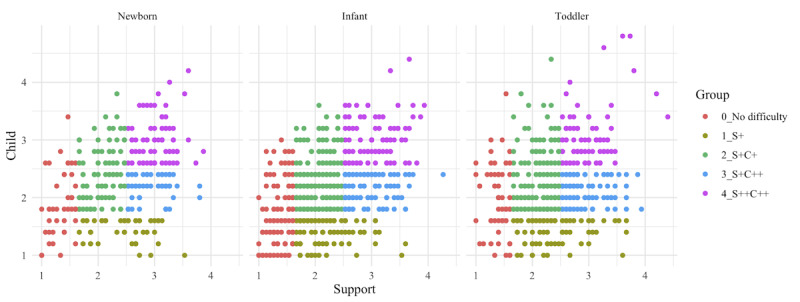
A total of 1559 participants completed the survey. They were split into 3 cohorts, comprising populations of various characteristics, including parenting difficulties and psychosocial measures. The classifier, which stratified participants into 5 groups, was generated from the self-reported scores of resilience and adaptation in the newborn cohort (n=310). The classifier identified that the group with the greatest difficulties in resilience and adaptation to a child's temperament and perceived support had higher incidences of problems with depressed mood (relative prevalence [RP] 5.87, 95% CI 2.77-12.45), bonding (RP 5.38, 95% CI 2.53-11.45), and sleep quality (RP 1.70, 95% CI 1.20-2.40) compared to the group with no difficulties in perceived support. In the infant cohort (n=619) and toddler cohort (n=461), the stratified group with the greatest difficulties had higher incidences of problems with depressed mood (RP 9.05, 95% CI 4.36-18.80 and RP 4.63, 95% CI 2.38-9.02, respectively), bonding (RP 1.63, 95% CI 1.29-2.06 and RP 3.19, 95% CI 2.03-5.01, respectively), and sleep quality (RP 8.09, 95% CI 4.62-16.37 and RP 1.72, 95% CI 1.23-2.42, respectively) compared to the group with no difficulties.
The classifier, based on a combination of resilience and adaptation to the child's temperament and perceived support, was able identify psychosocial vulnerable groups in the newborn cohort, the start-up stage of childcare. Psychosocially vulnerable groups were also identified in qualitatively different infant and toddler cohorts, depending on their classifier. The vulnerable group identified in the infant cohort showed particularly high RP for depressed mood and poor sleep quality.
为人父母是一件需要强大适应力和广泛调整的人生大事。然而,育儿过程中的适应力和感知到的支持因人而异,即便有产后检查,现实情况仍不明确。
本研究旨在利用基于新生儿母亲适应力和特征数据的分类器,探究从新生儿到幼儿期母亲的心理社会状况。
开展了一项基于网络的横断面调查。对年龄约1个月的新生儿母亲(新生儿队列)进行分析,以构建一个可解释的机器学习分类器,对育儿相关的适应力和特征进行分层,并识别弱势群体。由于其具有较高的解释力和适用性,因此使用了可解释的k均值聚类。将该分类器应用于2个月至1岁婴儿的母亲(婴儿队列)和1岁以上至2岁幼儿的母亲(幼儿队列)。比较了分类组之间的心理社会状况,包括通过爱丁堡产后抑郁量表(EPDS)评估的抑郁情绪、通过产后依恋问卷(PBQ)评估的依恋关系,以及通过匹兹堡睡眠质量指数(PSQI)评估的睡眠质量。
共有1559名参与者完成了调查。她们被分为3个队列,包括具有不同特征的人群,如育儿困难和心理社会指标。该分类器将参与者分为5组,是根据新生儿队列(n = 310)中自我报告的适应力和得分生成的。该分类器确定,在适应力以及适应孩子气质和感知支持方面困难最大的组,与在感知支持方面没有困难的组相比,抑郁情绪问题(相对患病率[RP] 5.87,95% CI 2.77 - 12.45)、依恋关系问题(RP 5.38,CI 2.53 - 11.45)和睡眠质量问题(RP 1.70,95% CI 1.20 - 2.40)的发生率更高。在婴儿队列(n = 619)和幼儿队列(n = 461)中,困难最大的分层组与没有困难的组相比,抑郁情绪问题(分别为RP 9.05,95% CI 4.36 - 18.80和RP 4.63,95% CI 2.38 - 9.02)、依恋关系问题(分别为RP 1.63,95% CI 1.29 - 2.06和RP 3.19,95% CI 2.03 - 5.01)和睡眠质量问题(分别为RP 8.09,95% CI 4.62 - 16.37和RP 1.72,95% CI 1.23 - 2.42)的发生率更高。
基于适应力、对孩子气质的适应以及感知支持的组合构建的分类器,能够识别新生儿队列(育儿起始阶段)中的心理社会弱势群体。在性质不同的婴儿和幼儿队列中,也根据分类器识别出了心理社会弱势群体。在婴儿队列中识别出的弱势群体在抑郁情绪和睡眠质量方面的相对患病率特别高。