Department of Investigational Cancer Therapeutics, Division of Cancer Medicine, The University of Texas MD Anderson Cancer Center, Houston, TX, USA.
Department of Haematology-Oncology, National University Cancer Institute, Singapore, Singapore.
Oncologist. 2024 Jun 3;29(6):493-503. doi: 10.1093/oncolo/oyae011.
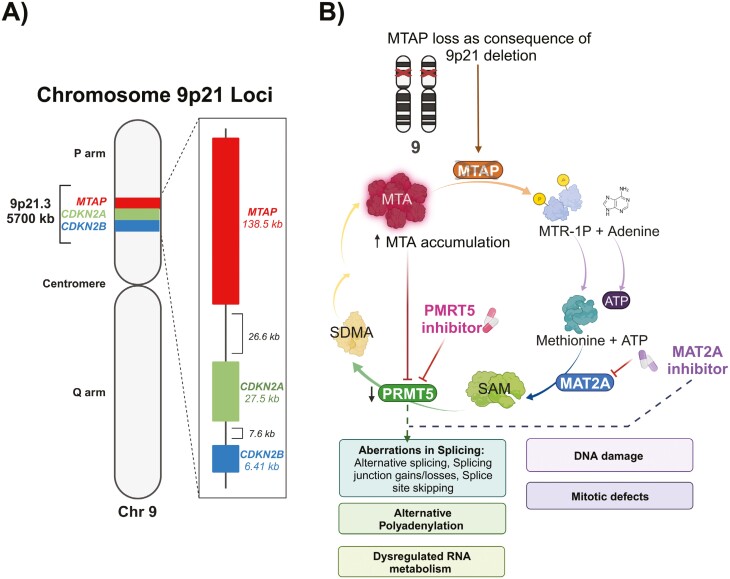
One of the most common sporadic homozygous deletions in cancers is 9p21 loss, which includes the genes methylthioadenosine phosphorylase (MTAP), CDKN2A, and CDKN2B, and has been correlated with worsened outcomes and immunotherapy resistance. MTAP-loss is a developing drug target through synthetic lethality with MAT2A and PMRT5 inhibitors. The purpose of this study is to investigate the prevalence and genomic landscape of MTAP-loss in advanced gastrointestinal (GI) tumors and investigate its role as a prognostic biomarker.
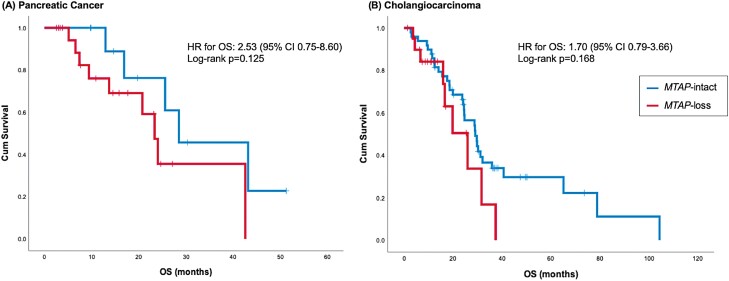
We performed next-generation sequencing and comparative genomic and clinical analysis on an extensive cohort of 64 860 tumors comprising 5 GI cancers. We compared the clinical outcomes of patients with GI cancer harboring MTAP-loss and MTAP-intact tumors in a retrospective study.
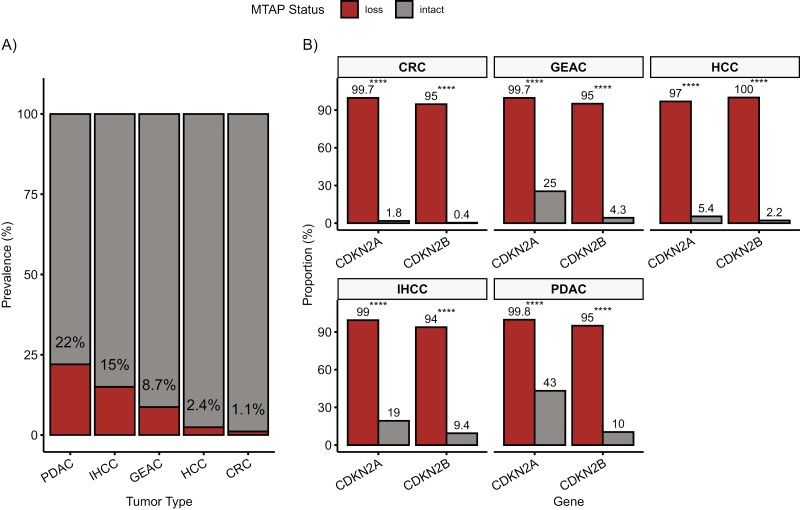
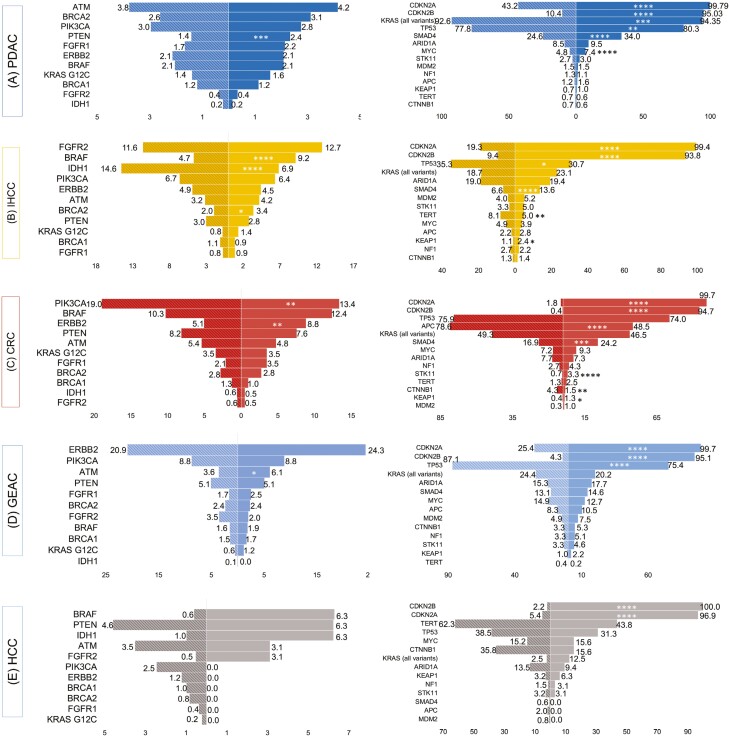
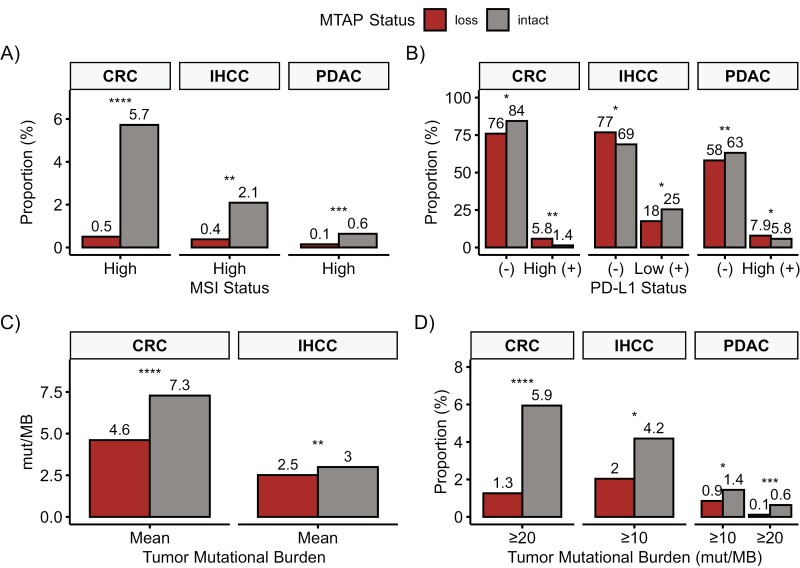
The prevalence of MTAP-loss in GI cancers is 8.30%. MTAP-loss was most prevalent in pancreatic ductal adenocarcinoma (PDAC) at 21.7% and least in colorectal carcinoma (CRC) at 1.1%. MTAP-loss tumors were more prevalent in East Asian patients with PDAC (4.4% vs 3.2%, P = .005) or intrahepatic cholangiocarcinoma (IHCC; 6.4% vs 4.3%, P = .036). Significant differences in the prevalence of potentially targetable genomic alterations (ATM, BRAF, BRCA2, ERBB2, IDH1, PIK3CA, and PTEN) were observed in MTAP-loss tumors and varied according to tumor type. MTAP-loss PDAC, IHCC, and CRC had a lower prevalence of microsatellite instability or elevated tumor mutational burden. Positive PD-L1 tumor cell expression was less frequent among MTAP-loss versus MTAP-intact IHCC tumors (23.2% vs 31.2%, P = .017).
In GI cancers, MTAP-loss occurs as part of 9p21 loss and has an overall prevalence of 8%. MTAP-loss occurs in 22% of PDAC, 15% of IHCC, 8.7% of gastroesophageal adenocarcinoma, 2.4% of hepatocellular carcinoma, and 1.1% of CRC and is not mutually exclusive with other targetable mutations.
癌症中最常见的散发性纯合缺失之一是 9p21 缺失,其中包括甲基硫腺苷磷酸化酶(MTAP)、CDKN2A 和 CDKN2B 基因,并且与预后不良和免疫治疗耐药相关。MTAP 缺失是通过与 MAT2A 和 PMRT5 抑制剂的合成致死性成为一种有发展前景的药物靶点。本研究旨在调查晚期胃肠道(GI)肿瘤中 MTAP 缺失的流行率和基因组图谱,并研究其作为预后生物标志物的作用。
我们对包括 5 种 GI 癌在内的 64860 个肿瘤的广泛队列进行了下一代测序和比较基因组及临床分析。我们在回顾性研究中比较了 GI 癌患者中携带 MTAP 缺失和 MTAP 完整肿瘤的临床结局。
GI 癌中 MTAP 缺失的发生率为 8.30%。MTAP 缺失在胰腺导管腺癌(PDAC)中最为常见(21.7%),在结直肠癌(CRC)中最为罕见(1.1%)。东亚 PDAC(4.4%比 3.2%,P=0.005)或肝内胆管癌(IHCC;6.4%比 4.3%,P=0.036)患者中 MTAP 缺失肿瘤更为常见。在 MTAP 缺失肿瘤中观察到 ATM、BRAF、BRCA2、ERBB2、IDH1、PIK3CA 和 PTEN 等潜在可靶向基因组改变的发生率存在显著差异,并且根据肿瘤类型而有所不同。MTAP 缺失的 PDAC、IHCC 和 CRC 中微卫星不稳定性或肿瘤突变负荷升高的发生率较低。与 MTAP 完整的 IHCC 肿瘤相比,MTAP 缺失的 IHCC 肿瘤中 PD-L1 肿瘤细胞表达阳性的频率较低(23.2%比 31.2%,P=0.017)。
在 GI 癌中,MTAP 缺失是 9p21 缺失的一部分,总体发生率为 8%。MTAP 缺失发生在 22%的 PDAC、15%的 IHCC、8.7%的胃食管腺癌、2.4%的肝细胞癌和 1.1%的 CRC 中,并且与其他可靶向突变并不互斥。