Department of Microbiology, College of Arts and Sciences, The Ohio State University, Columbus, Ohio, United States of America.
Genetic Counseling Program, College of Biological Sciences, University of Minnesota, Minneapolis, Minnesota, United States of America.
PLoS One. 2024 Feb 9;19(2):e0297172. doi: 10.1371/journal.pone.0297172. eCollection 2024.
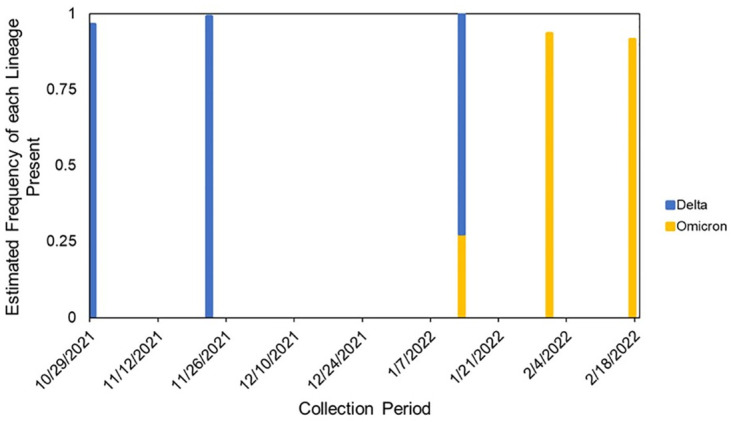
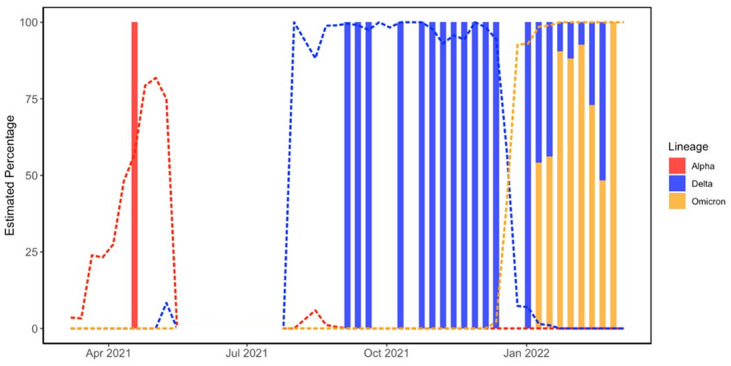
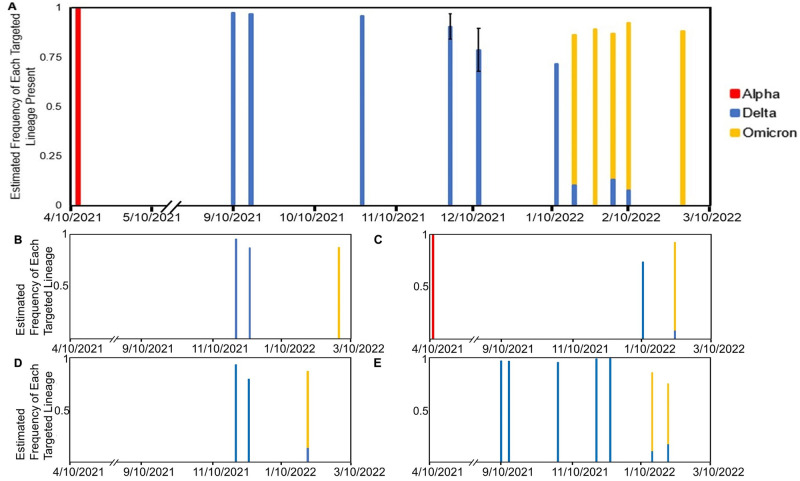
Environmental surveillance of pathogens underlying infectious disease is critical to ensure public health. Recent efforts to track SARS-CoV-2 have utilized wastewater sampling to infer community trends in viral abundance and variant composition. Indoor dust has also been used for building-level inferences, though to date no sequencing data providing variant-scale resolution have been reported from dust samples, and strategies to monitor circulating variants in dust are needed to help inform public health decisions. In this study, we demonstrate that SARS-CoV-2 lineages can be detected and sequenced from indoor bulk dust samples. We collected 93 vacuum bags from April 2021 to March 2022 from buildings on The Ohio State University's (OSU) Columbus campus, and the dust was used to develop and apply an amplicon-based whole-genome sequencing protocol to identify the variants present and estimate their relative abundances. Three variants of concern were detected in the dust: Alpha, Delta, and Omicron. Alpha was found in our earliest sample in April 2021 with an estimated frequency of 100%. Delta was the primary variant present from October of 2021 to January 2022, with an average estimated frequency of 91% (±1.3%). Omicron became the primary variant in January 2022 and was the dominant strain in circulation through March with an estimated frequency of 87% (±3.2%). The detection of these variants on OSU's campus correlates with the circulation of these variants in the surrounding population (Delta p<0.0001 and Omicron p = 0.02). Overall, these results support the hypothesis that dust can be used to track COVID-19 variants in buildings.
对传染病病原体进行环境监测对于确保公众健康至关重要。最近,人们利用废水采样来推断社区中病毒丰度和变体组成的趋势,以追踪 SARS-CoV-2。室内灰尘也被用于进行建筑物层面的推断,但迄今为止,尚未有报道称从灰尘样本中获得了提供变体规模分辨率的测序数据,并且需要监测灰尘中循环变体的策略,以帮助为公共卫生决策提供信息。在这项研究中,我们证明可以从室内批量灰尘样本中检测和测序 SARS-CoV-2 谱系。我们从俄亥俄州立大学(OSU)哥伦布校区的建筑物中收集了 93 个真空袋,这些真空袋来自 2021 年 4 月至 2022 年 3 月,并用这些灰尘开发并应用了基于扩增子的全基因组测序方案来识别存在的变体并估计其相对丰度。在灰尘中检测到三种关注变体:Alpha、Delta 和 Omicron。Alpha 于 2021 年 4 月最早的样本中被发现,估计频率为 100%。Delta 是 2021 年 10 月至 2022 年 1 月期间主要存在的变体,平均估计频率为 91%(±1.3%)。Omicron 于 2022 年 1 月成为主要变体,并在 3 月通过循环成为主要菌株,估计频率为 87%(±3.2%)。这些变体在 OSU 校园中的检测结果与这些变体在周边人群中的循环情况相关(Delta p<0.0001 和 Omicron p = 0.02)。总的来说,这些结果支持了灰尘可用于追踪建筑物中 COVID-19 变体的假设。